

Why keeping youth discontent in check remains Indian PM Modi's biggest challenge
India has the biggest youth population in the world but few are able to find good jobs despite rising education levels.
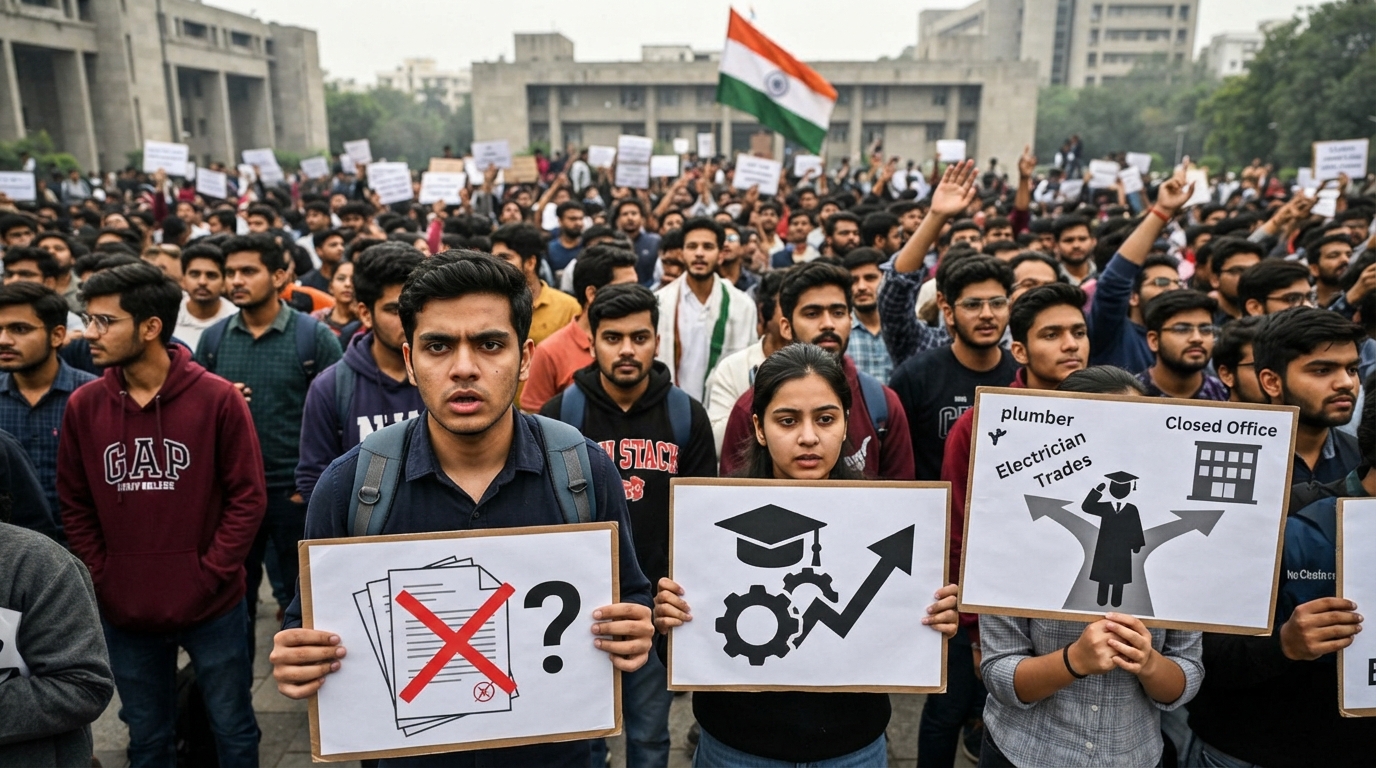
Addressing youth dissatisfaction remains the primary hurdle for Indian Prime Minister Modi, as recent years have seen significant youth protests fueled by exam irregularities and limited opportunities.
Last month, Dharmendra Pradhan was compelled to step down as India's education minister following widespread street protests by Gen-Z individuals angered by repeated leaks of entrance exam papers. While his resignation offered Prime Minister Narendra Modi immediate relief, managing youth discontent is likely to pose a persistent challenge for his administration.
Modi swiftly announced the establishment of fast-track courts to prosecute those implicated in the leaks and appointed tech magnate Nandan Nilekani to spearhead government efforts to overhaul the examination system. However, a more comprehensive approach may be necessary to alleviate the concerns of young people, who express growing impatience with a system that fails to provide adequate livelihood prospects or education leading to meaningful employment.
"The labor market has become brutal in the last 10 years. Non-farm jobs have not been growing and real wages have stagnated," Santosh Mehrotra, a seasoned economist and author of the new book *India Out of Work: Rethinking India's Growth Story*, informed the BBC. "India has a simultaneous problem. The economy is structurally weak as a result of which demand for labor is not growing. And our education system is so poor, that it is unable to supply new labor that is employable."
To date, the government's standard defense against critiques regarding the uneven nature of India's economic growth has been rapid GDP expansion, driven by substantial state investment in infrastructure. Nevertheless, experts suggest that the unrest of the past month may finally compel the government to confront the education crisis and the challenge of youth unemployment.
Mehrotra points to the "unprecedented growth in India's welfare state," particularly direct cash transfers, as an indication that the government has, at least privately, acknowledged the issue. However, the scale of the problem demands an enormous solution.
India's Gen-Z protests led to the resignation of the country's education minister last month. India boasts the world's largest youth population, with over 360 million individuals aged between 15 and 29. Significant strides have been made in education enrollment, and the number of private colleges and vocational training institutions has surged exponentially over the past two decades.
Despite this progress, "the transition from education to employment remains a major challenge, particularly for graduates," according to the *State of Working India 2026 report* from Azim Premji University. Unemployment rates among young people are nearly four times higher than those for non-youth and considerably exceed global averages.
This issue is not new; graduate unemployment has consistently hovered around 35-40% for the last 25 years. However, it has been "magnified" in recent years due to India's demographic surge—a growing segment of the population entering the workforce—and improved educational outcomes. In 1983, 4% of 20 to 29-year-olds were graduates, with 13% of them unemployed. By 2023, 28% were graduates, and among them, 67% were not employed.
The quality of education remains a significant factor impacting employability, as the increase in the number of graduates has not been matched by a corresponding growth in graduate employment. The report states, "Between 2004-05 and 2023, while approximately five million graduates were added each year, only around 2.8 million found employment, and an even smaller share entered salaried employment, contributing to rising graduate unemployment and slowing earnings growth." Furthermore, there is no evidence that ambition is being rewarded. According to the report, merely 3.7% of graduates or post-graduates secured white-collar positions, and fewer than 7% obtained permanent salaried jobs.
The manufacturing sector's share of India's GDP has declined in recent years, exacerbating the jobs crisis. This is not a problem amenable to quick fixes.
"Some jobs can definitely come from a quick revival of the small and medium sized industries (SMEs) which have been completely knocked out since 'demonetisation' [when 86% of India's currency was taken out of circulation in four hours in what was a widely criticised policy move] and the uneven implementation of a goods and services tax," Mehrotra asserts. However, he adds that India will need to devise a new industrial policy focused on revitalizing overall manufacturing. "Manufacturing's share of GDP has gone down from 17% in 2015 to 14% currently. And manufacturing employment fell for five years after 2015 and has only now climbed back up slightly above those levels."
Meanwhile, Mehrotra notes that total employment in agriculture has actually increased by 80 million people after 2020, which he identifies as a clear sign of disguised unemployment. This is because, in a rapidly industrializing economy, workers typically transition from agriculture to services or manufacturing, a pattern observed globally.
These challenges are further complicated by the fact that the business model of key job-creating industries like software—a cornerstone of the Indian middle-class dream for three decades—has been disrupted by the emergence of AI. Wall Street Bank Goldman Sachs recently estimated that 8-12% of non-farm jobs in India are at risk of being replaced by AI, and the effects are already becoming apparent.
According to Neeti Sharma, CEO of Team Lease Digital, a prominent Indian staffing agency, IT hiring has seen only single-digit growth in recent months, unstable contract work is on the rise, wages have stagnated for years, and the knowledge-based jobs that Indian STEM graduates once took for granted two decades ago are no longer available in large numbers.
India's $300 billion software industry is feeling the pressure from AI. In fact, a recent event at HCL Technologies, one of the country's largest software companies, in Chennai was interrupted by hundreds of employees chanting "we want a hike" in unison, reflecting the frustrations within an industry once considered a guaranteed path to a better life.
"Young graduates will have to rewire their brains to the new reality that white-collar knowledge jobs are going down. And education institutions will have to pivot to providing vocational skills rather than just knowledge-based learning. Because the hiring has also moved from degrees to actual skills," Sharma told the BBC. This implies that young Indians, even those with graduate degrees, may need to accept the reality of working as plumbers, electricians, and mechanics, rather than expecting comfortable careers in air-conditioned offices.
As leading market investor Devina Mehra observed on X, this means a generation can no longer assume a lifestyle superior to that of their parents. Mehra warns that plateauing in earnings at such an early stage of India's development could be a "disaster"—one that the Modi government will have to work diligently to avert.