

Which countries have the highest level of university independence?
A new study, based on the V-Dem Academic Freedom Index and data from Our World in Data, assesses the level of independence of universities and scholars in countries around the world. While the Czech Republic ranked first, academic freedom indicators have declined in 50 countries over the past decade.
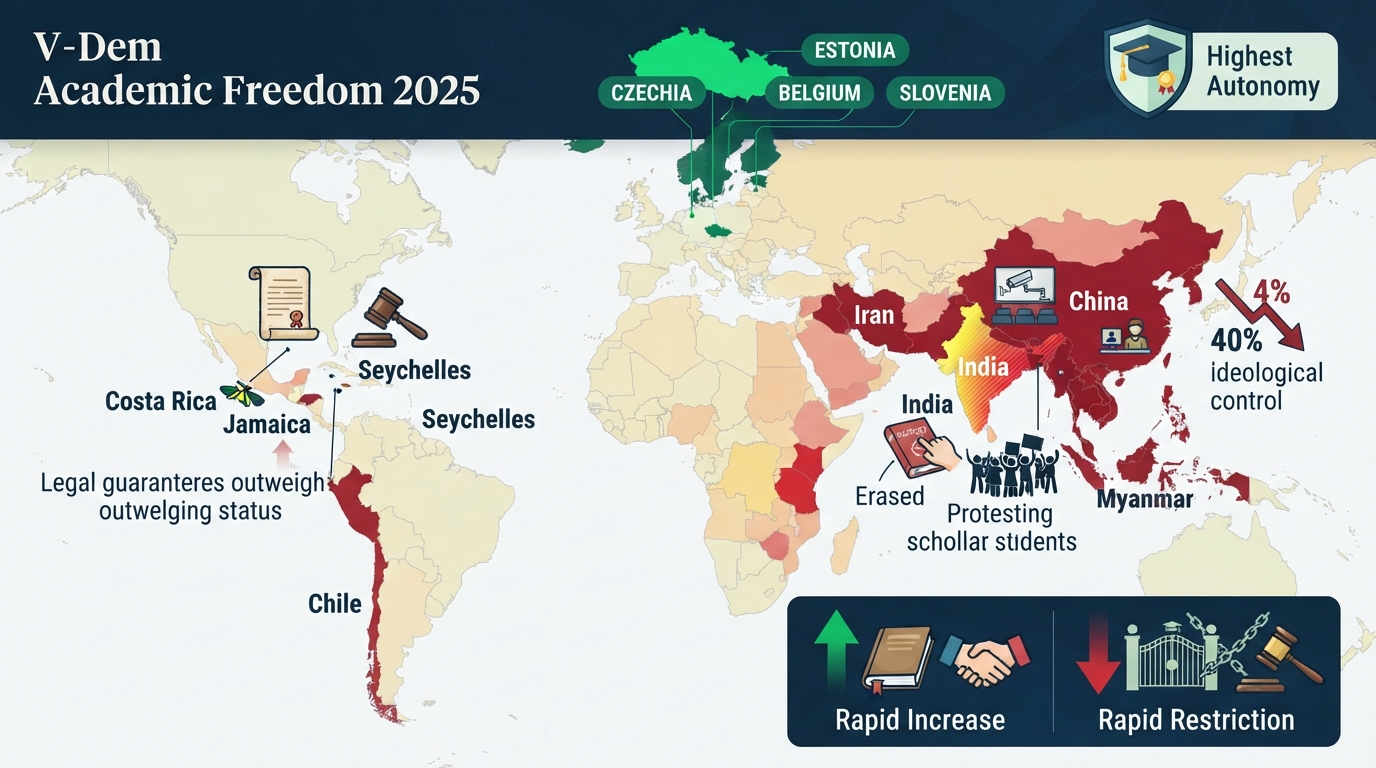
The infographic published by Visual Capitalist shows which countries have the highest level of university independence. It reflects the degree to which universities and academic institutions are protected from state and other institutions interference in countries around the world based on the V-Dem Academic Freedom Index for 2025.
According to the research results, the Czech Republic recorded the highest result in terms of academic freedom, taking first place in the rating with a score of 0.98. It is followed by Estonia (0.97), Belgium (0.95) and Slovenia (0.94).
The top part of the rating is almost entirely made up of European countries. At the same time, Chile and Costa Rica also surpassed many economically rich countries and entered the ranks of the leaders. Experts explain this by the fact that in a number of Latin American countries, university autonomy is guaranteed at the constitutional level. Jamaica and the Seychelles also took high places. This shows that independent institutions and legal guarantees are more important than economic power in ensuring academic freedom.
At the bottom of the ranking are China, Iran, Myanmar and Nicaragua. It is noted that the activities of scientists and universities in these countries are under strict state control. In particular, in China, academic freedom has decreased by almost 40 percent over the past decade due to the introduction of video surveillance systems in classrooms, the practice of collecting information from students and strong ideological control.
India is also noted as one of the countries where academic freedom has declined most rapidly. Under the leadership of Prime Minister Narendra Modi, changes have been made to school textbooks, and parts of the country's history have been rewritten. Scholars who express opinions contrary to official policies have begun to face pressure and threats. The problems in the higher education system have also been highlighted by mass student protests that began in 2026 after the cancellation of the NEET-UG medical entrance exam due to leaks. The protests have also led to the resignation of the country's education minister, Dharmendra Pradhan.
The authors say the study shows that academic freedom is not as slow as many people think, but can change significantly over a period of years, influenced by political decisions and legislative changes. Even in countries with long-standing university traditions, academic independence can be strengthened or, conversely, restricted in a short period of time.