

What's changing in Uzbekistan this August: New laws and key updates
Tashkent Times is an English language online-newspaper that brings all latest Uzbekistan news
Here's a rewrite of the news text, preserving all facts, names, numbers, and quotes:
## Uzbekistan: August Brings New Laws and Key Changes
August is set to usher in a series of new legislative changes and significant updates across Uzbekistan.
**Auto Loan Interest Reimbursement for Trade-Ins**
A new initiative will allow individuals and legal entities participating in a trade-in program to receive reimbursement for a portion of the interest on auto loans used to purchase a new vehicle. This measure aims to enhance the convenience of car ownership for the public. However, the official launch date for this program has not yet been announced by the government.
**Increased Limit for Foreign Currency Purchases Without ID**
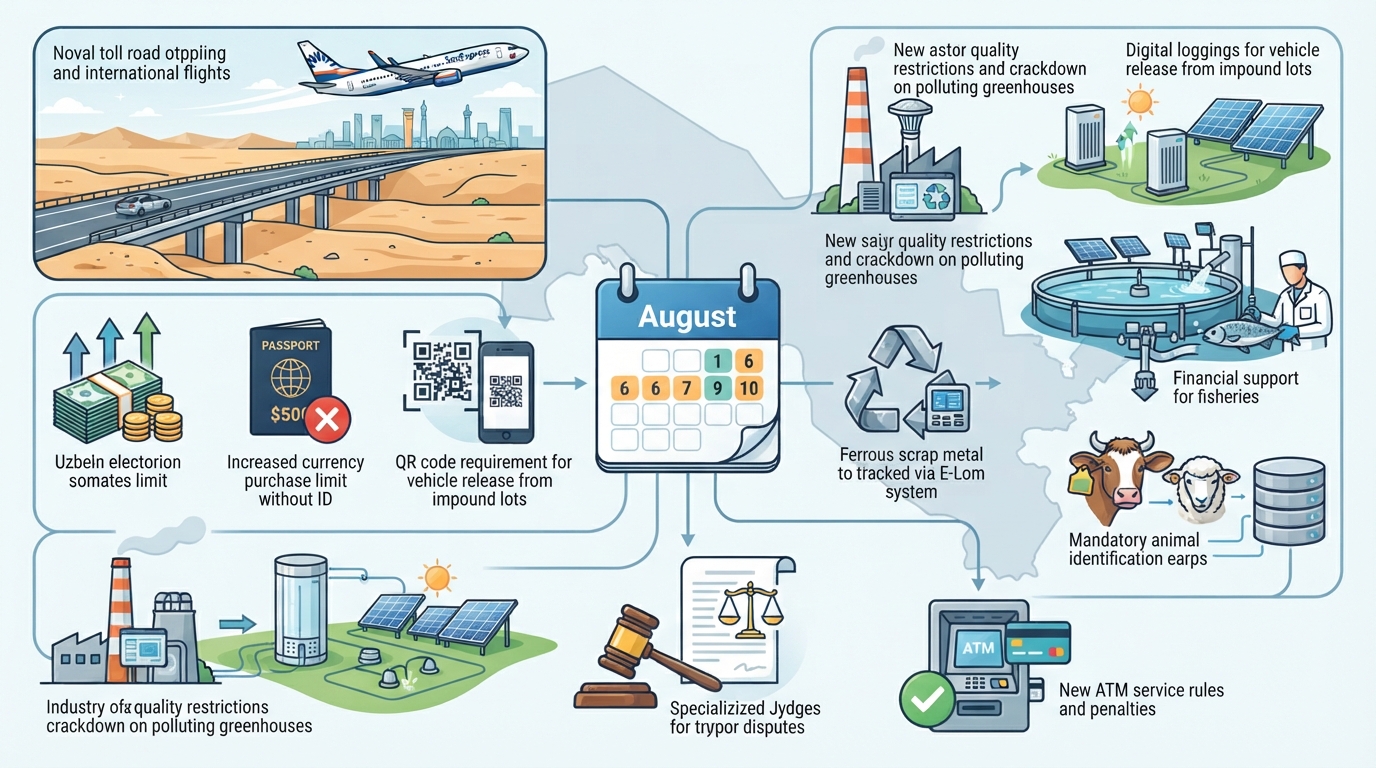
Effective August 9, banks will raise the limit for cash foreign currency purchases without requiring identification. Following a joint resolution from the Central Bank's management board and the Prosecutor General's Office's Department for Combating Economic Crimes, citizens will be able to buy up to $500 in cash foreign currency without presenting a passport, ID card, or other identifying document. The current limit stands at $100.
**Uzbekistan's Inaugural Toll Road to Open**
President Shavkat Mirziyoyev has announced that Uzbekistan's first toll road, connecting Urgench and Khiva, will open next month. The President highlighted the project's importance as key infrastructure for both local residents and tourists, domestic and international. The Road Committee reports that construction of the 35-kilometer road is 80 percent complete, incorporating 15 bridges, one tunnel, five underpasses, and 101 water-crossing structures.
**Ferrous Scrap Metal Trade to Be Monitored via E-Lom System**
During a July 13 meeting on the ferrous metallurgy industry, President Mirziyoyev noted that the Bekabad Metallurgical Plant produces 40 percent of its rolled metal from secondary raw materials and 60 percent from imports. While 700,000 tons of ferrous scrap metal are supplied to the plant annually nationwide, an additional 500,000 tons remain in the shadow market. To address this, all ferrous metal trade processes will be monitored in real-time through an electronic platform called E-Lom. A dedicated project office will be established within the government to ensure fair competition, price stability, and effective oversight in the ferrous metallurgy industry. This office will conduct daily market analysis, manage raw material and finished goods supply and demand, and maintain digital passports detailing product quality, origin, and composition. Officials have been tasked with making the project office operational within a month and launching the E-Lom platform by August 1.
**QR Code Required for Vehicle Release from Impound Lots**
As of August 1, permission to retrieve a vehicle from an impound lot will be issued exclusively in electronic form via a QR code through the impound lot information system. The Interior Ministry, State Tax Committee, and Ministry of Digital Technologies will integrate this system with tax authority databases within two months. This integration will automatically generate information about impounded vehicles—including make, license plate, impound duration, and fees collected—within the tax system. It will also include details of legal entities providing storage services for seized vehicles.
**Penalties for Banks Violating ATM Service Rules**
Starting August 6, banks that fail to adhere to customer service rules concerning ATM usage will face financial penalties, according to a new regulation from the Central Bank. The regulator mandates that banks enhance payment infrastructure quality and view ATM malfunctions as potential consumer rights violations, not merely technical glitches. In 2025, 291,000 ATM-related issues were recorded, with nearly 15 percent attributed to the conduct of banks and payment system operators.
**Mandatory Animal Identification and Registration**
A law on mandatory animal identification and registration takes effect in Uzbekistan on August 7. Animals must be identified and registered within specified timeframes. Information about animals and their owners will be stored in a unified electronic database. However, the requirement for owners to register their animals and the ban on keeping unregistered ones will only become effective on January 1, 2028.
**New Financial Support Mechanisms for Fish Farms**
From August 1, 2026, through August 1, 2030, new financial support mechanisms will be introduced for fish farms. These include reimbursement for a portion of interest expenses on loans for purchasing and installing solar panels, a 25 percent subsidy for solar panel installation costs up to 50 kW, and coverage for 50 percent of the cost of aerators equipped with alternative energy sources. Additionally, partial costs will be covered for importing breeding broodstock, implementing closed water recirculation systems, and acquiring equipment for producing compound feed for intensive fish farming. Fifty percent of salary costs for foreign ichthyologists and fish disease specialists will also be compensated. Through August 31, 2030, fishery entrepreneurs will receive partial compensation on loan interest, with guarantees covering up to 50 percent of loans (up to the equivalent of 10 billion soums). Commercial banks will also issue loans to fishery enterprises using funds from international financial institutions, with terms up to 24 months, including a grace period of up to nine months, at an annual rate of 18 percent. Preferential lending arrangements currently in place for livestock projects will be extended to fishery projects, including breeding fish farming.
**Symbolic Water Tax for Industrial Parks with Water-Saving Technologies**
Beginning August 1, industrial parks that have adopted water-saving technologies will pay a symbolic tax rate of just 1 soum for water drawn from drilled wells. This benefit will be in effect for five years, through August 1, 2031.
**New Air Quality Restrictions in Tashkent and Surrounding Districts**
A government resolution has introduced new restrictions aimed at improving air quality in Tashkent city and the Yuqori Chirchiq, Qibray, Yangiyul, Zangiota, and Tashkent districts of Tashkent region. Starting August 1, natural gas supply to existing greenhouses will be completely halted, and gas supply contracts will be terminated. Water fees for greenhouses will be charged at five times the maximum tariff set for industrial enterprises. Compensation payments for environmental pollution caused by burning coal, tires, fuel oil, bitumen, rubber, film, and similar materials will be increased twentyfold, and environmental review findings will be reconsidered in such cases. Greenhouse operations that fail to comply with environmental requirements will be ineligible for certain state subsidies, benefits, and financial support, and will be denied a positive environmental review or have any previously issued approval suspended. Educational and research institutions are exempt, permitted to use existing greenhouses for scientific purposes—such as plant breeding, seed and seedling propagation, and adapting foreign varieties to the local climate—provided they comply with environmental requirements.
**Digitalization of Fuel and Gas Filling Station Data and Liquefied Gas Trade**
By August 1, Uzenergoinspection, in collaboration with relevant agencies, is slated to submit proposals to the government for creating an information system to collect and process real-time data from dispensers at fuel and gas filling stations. Also by August, the electronic trading system of the Republican Commodity Exchange will be integrated with the licensing information system. Consequently, liquefied gas on designated exchange trading sections will only be available for purchase by business entities holding a valid license to sell it. Enterprises that use liquefied gas for technological processes or their own needs, and possess the necessary infrastructure for receiving, storing, and distributing it, will also be entitled to purchase gas on separate trading sections based on a list provided by the inspectorate.
**Community Phytosanitary Inspectors and Export Verification**
Starting August 1, community phytosanitary inspectors will begin operating in specific districts to support fruit and vegetable exports. They will assist quarantine inspectors in issuing internal phytosanitary certificates, aiming to improve product quality, ensure safety compliance, and boost export appeal. Also from August, a new procedure will be introduced for verifying that exported fruits and vegetables meet requirements on pesticide and nitrate residues, using one of two specified methods.
**Customer-Focus Index for Tax Authorities**
Effective August 1, a customer-focus index for tax authorities will be introduced. The State Tax Committee is tasked with developing and approving a methodology for calculating this index, with results to be regularly published on its official website. The index will enable taxpayers to assess the convenience of tax services, service quality, time spent fulfilling tax obligations, and overall cooperation with tax authorities.
**Rewards for Reporting Hazardous Production Violations**
A system will be introduced to reward citizens who submit photo or video evidence of violations at hazardous production facilities and involving technical equipment. Reports will be sent to the Committee for Industrial, Radiation, and Nuclear Safety. Submitted materials must clearly show the nature of the violation, along with the location, date, and time. A responsible officer at the committee's regional office will review submissions through the information system and conduct an on-site visit within three working days. Following this, administrative proceedings will be initiated, evidence formalized, and an appropriate decision issued. Individuals who submit photo or video evidence of a violation will receive a cash reward equal to 20 percent of the portion of the resulting fine transferred to the committee.
**Specialized Judges for Labor Disputes**
Under a Supreme Court plenum resolution, specialized judges will operate within the existing staff of civil courts. They will be active at the Supreme Court, the Court of the Republic of Karakalpakstan, regional courts, the Tashkent city court, and select inter-district and city courts. Labor disputes filed after August 1 will be assigned to these specialized judges, while cases accepted before that date will continue under the previous procedure.
**Extension of Meat Import Subsidies and Livestock Development**
During a meeting on curbing inflation, the president addressed rising meat prices and announced the extension of the subsidy covering the cost of transporting meat by air through the end of the year. The subsidy, previously set to expire on August 1, covers 50 percent of air freight costs for meat imports (up to $0.8 per kilogram) and 10 percent of the cost of importing breeding cattle (up to 4 million soums per head). An additional $50 million will be allocated to develop livestock farming, financing preferential loans at a 10 percent rate over 10 years for livestock complexes and breeding projects. By year-end, the country aims to import 100,000 head of cattle and 150,000 sheep and goats from abroad.
**Free Bookkeeping Services for Young Farmers**
Newly established farms led by young people will receive two years of free service from bookkeeping and reporting centers operating under district farmers' councils. This benefit applies to all farmers who have paid membership dues, regardless of their crop.
**Digitalization of Entrepreneur Inspections and Interactions**
Starting August 1, inspections of entrepreneurs and interactions with them that do not qualify as formal oversight measures will be logged in the Unified State Control information system. A "Business Protection" QR code will be introduced for this purpose. From that date, government officials conducting inspections or interactions with entrepreneurs will be required to use the system's mobile app. Before beginning an inspection, they must scan the entrepreneur's QR code and register the inspection in the system. Additionally, special certificates authorizing inspections will only be issued electronically, and paper inspection logbooks will be abolished. If information about an inspection or interaction is not entered into the system, the entrepreneur has the right to deny the official entry to their premises and refuse to engage with them.
**Expanded Authority for Parliament Members in Citizen's Budget Initiative**
Under a presidential decree issued June 29, starting August 1, members of parliament will have expanded authority to designate additional winning projects within the Citizen's Budget Initiative. Each lawmaker will be able to select one or more projects on the Open Budget information portal, within their allocated funds, and designate them as additional winners. If a lawmaker's term ends early, additional winning projects in their electoral district will be determined by other lawmakers, based on a decision of the commission overseeing parliamentary control of the Citizen's Budget Initiative process.
**Full Digitization of State Archive Functions**
A number of state archive functions will be fully digitized, including state registration of National Archive Fund documents, compiling and approving inventories, and processing document intake and access—all moving to electronic form. Digitization will also cover the process by which reorganizing organizations coordinate the transfer of archival documents to their legal successor with state archives, as well as the compilation of a unified list of state bodies and organizations required to submit documents to state archives.
**Loans for Poultry Production and "Ready-Made Business" Projects**
Starting August 1, loans will be made available to entrepreneurs for launching new poultry production capacity and financing "ready-made business" projects. Funds will be issued through Mikrokreditbank at an annual rate of 10 percent, with a four-year grace period, for terms of up to 10 years.
**Mandatory Professional Development for Tax Authority Employees**
The Higher Tax School under the State Tax Committee will introduce a system requiring tax authority employees to undergo professional development training at least once every three years.
**New International Flights to Tashkent**
Turkey's SunExpress airline will launch regular flights on the Izmir–Tashkent–Izmir route starting August 1. Flights will operate four times a week using Boeing 737-800 aircraft. SunExpress will be the third Turkish airline to offer regular service to Uzbekistan and reportedly plans future flights to airports in the Fergana Valley. Etihad Airways will launch regular flights on the Abu Dhabi–Tashkent route starting August 10. Flights will operate daily using Airbus A320 aircraft.