

'What was my fault?': How India's exam paper leak ended young lives
Two families reveal the human toll of India's medical entrance examination paper leak.
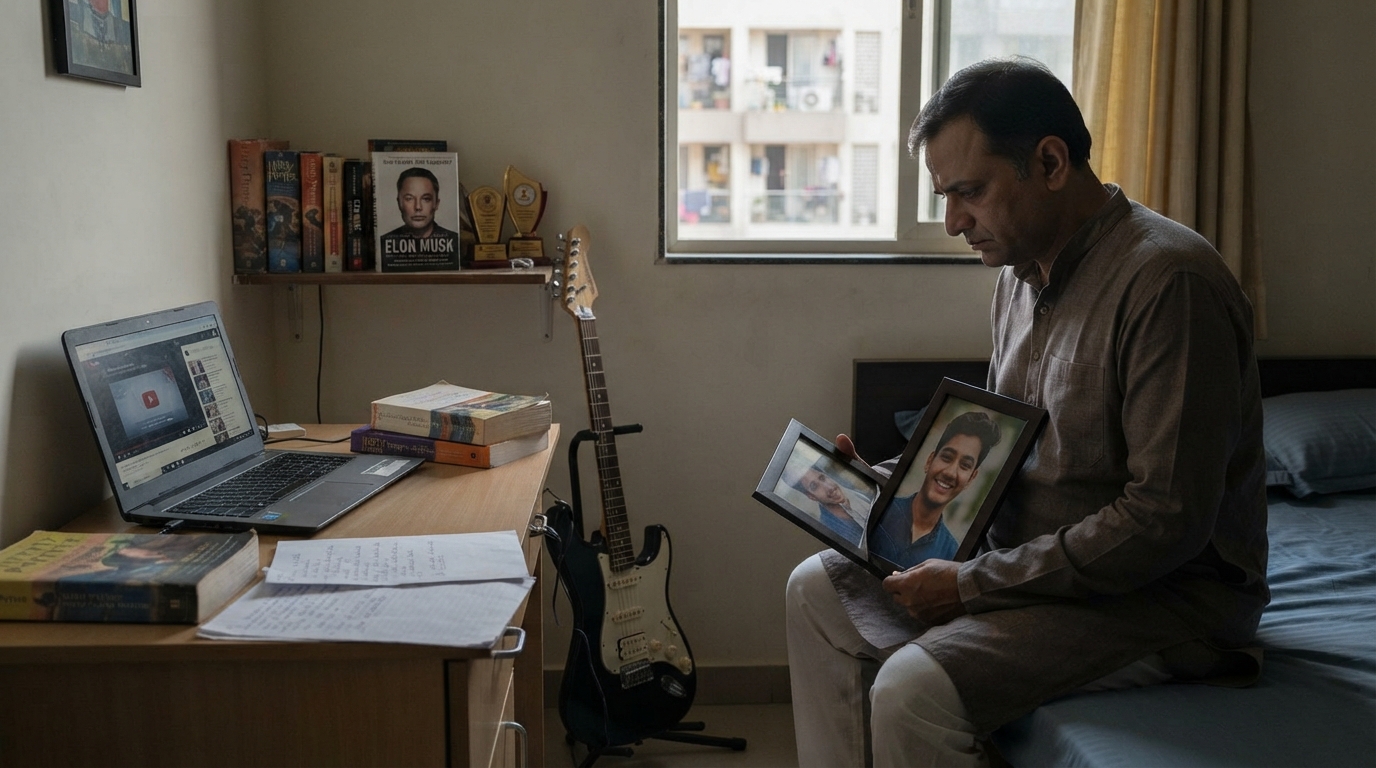
"What was my fault?" This question echoes the tragic end of young lives in India, a consequence of the recent exam paper leak scandal.
Just three days before he was scheduled to retake India's medical entrance examination, 17-year-old Kahaan Patel tragically ended his life, leaping from the sixth floor of his family's Ahmedabad apartment building. When his family entered his room on the morning of June 18, it appeared as though he had just stepped out. His laptop was open, textbooks and notes were scattered, and his electric guitar was plugged in. Amidst his Harry Potter novels, a book on Elon Musk, and academic trophies, his father, Prashant Patel, quietly noted, "The only thing missing was Kahaan."
Kahaan is one of at least 21 students who died by suicide, reportedly distraught after the National Eligibility cum Entrance Test (NEET) was canceled due to a paper leak, forcing nearly two million students to re-sit the exam. These deaths fueled a significant youth uprising in Delhi in July, where thousands, led by the satirical Cockroach Janta Party (CJP), demanded accountability for the repeated examination failures. The protests ultimately led to the resignation of Education Minister Dharmendra Pradhan.
Beyond the political fallout, families like Kahaan's grapple with the profound question of how an exam scandal escalated into a matter of life and death. For Prashant Patel, the story began with his son's dream of becoming a doctor, a path no one in their family had taken. Kahaan's parents restructured their lives to support this ambition, moving from Surat to Ahmedabad so Kahaan could attend a better school and focus on his studies. His father, a lawyer, commuted between cities while Kahaan lived with his mother, Veena, and younger brother, Rihaan. "He took that decision himself," his father stated, "We only supported him."
Kahaan was a well-rounded teenager, excelling in football, devouring fantasy novels, enjoying science fiction, and teaching himself hard-rock guitar. He had recently obtained a US visitor visa, eagerly anticipating a return to Disneyland after his exams. He had already demonstrated his academic prowess, performing well in a practice NEET attempt after the 2024 paper leak, which reassured both him and his teachers of his capabilities. On May 3, after taking the exam, he called his father, exclaiming, "Daddy, I am so happy. I am feeling free, relaxed. I'm going for dinner with my friends. I'm enjoying." Prashant Patel recalled telling him, "This is your time. Enjoy."
Then came the news of the paper leak. Despite his parents' efforts to shield him, Kahaan's friends from coaching classes were already discussing it. He cut short a farmhouse holiday, rushing back to retrieve notes and textbooks he had already given away, preparing for a potential retest. When the government announced the retest, his father remembers, "That was when he became angry." Kahaan repeatedly questioned, "Is this a system? Is this how it works? What is my fault? What is the fault of students who gave the exam honestly? Why is the government taking it so casually?" His father tried to reassure him, "I told him, 'This is the system. What can we do?'" Now, he wonders if his words conveyed comfort or resignation, speculating, "Maybe he was disappointed. Maybe he was suffering inside."
There were no outward signs of distress. On the evening of June 17, Kahaan cheerfully video-called his grandfather, who had just arrived in Melbourne, asking for Puma football boots, Levi's jeans, and jackets. Later, he spoke to his father, who offered a final reassurance: "I told him, 'You proved yourself once. You don't have to prove yourself again.'" Hours later, Kahaan was dead. Only afterward did friends reveal how deeply the scandal had affected him. "He kept asking why the people responsible couldn't take the right decisions," his father recounted. "He used to say, 'Is this a joke for our ministers to conduct examinations like this?'"
Kahaan's family was not alone in their grief and questions. Approximately 770km away, in Rajasthan's Jhunjhunu district, another family faced an equally devastating loss. Pradeep Kumar, 23, was the only student in his village preparing for NEET. His father, Rajesh Kumar, a small farmer, and his mother, who had never attended school, envisioned Pradeep becoming one of the first in their family to enter the professional middle class. "He would tell me, 'I want to serve people so much that they will remember me,'" Rajesh shared. To fund this dream, Rajesh sold land and borrowed over a million rupees ($10,480; £7,804) from a bank, with coaching in Sikar, a major exam preparation hub, costing a fortune.
In 2022, Pradeep moved to Sikar for coaching, sharing a rented room with his older sister, Babita Kumari, who was preparing for police recruitment exams. His two previous NEET attempts showed steady improvement, bringing a government medical college within reach. Then came his third attempt in May this year. The paper leak, the exam cancellation, and the order for a retest meant Pradeep would have to sit NEET for a fourth time. By then, his life was a rigorous 16-hour cycle: waking at 4:30 am, coaching, self-study until 9 pm, sleep, and repeat. He even refused to own a mobile phone, telling his father, "I'll buy one after I'm selected. Phones distract me." His only indulgence was a small collection of inexpensive wristwatches bought from roadside shops.
After taking the exam on May 3, Pradeep emerged smiling, telling his father, "This time my selection is guaranteed." The family planned to leave Sikar and celebrate in their village. Instead, the paper leak surfaced. "We'll have to prepare again," Pradeep stoically told his father. On the morning of May 15, Rajesh sent milk and homemade curd to Sikar, as he had done almost daily for four years. Pradeep called to confirm its arrival. He bought fresh okra and told his sister, "Go and have your bath. When you come back, we'll cook." When she returned half an hour later, the room was locked. In that short time, her brother had taken his own life. "He never told me anything," Rajesh lamented. "He seemed happy."
Rajesh's voice hardened when he spoke of the leak. "I sold my land to educate him. Those who have money buy question papers. Those who study honestly are left behind." He then uttered words that have consumed him since: "The government snatched away my son. If the paper had not leaked, Pradeep would be alive today. He would have been celebrating."
Kahaan and Pradeep came from vastly different Indias. Kahaan, the son of a lawyer, lived a life split between two cities, dreaming of Disneyland. Pradeep, the son of a farmer, mortgaged his family's future for his education, postponing even a mobile phone until he became a doctor. Yet, both fathers are left with the same agonizing question: how did children who believed they had earned their future lose faith in the very system designed to reward them?
For weeks after Kahaan's funeral, Prashant Patel was consumed by grief. It was the students' protests that finally drew him out. He traveled to Delhi twice in July to join them. "I wasn't there for compensation," he stated. "I wanted accountability." The weeks of protests culminated in Education Minister Dharmendra Pradhan's resignation on July 25. The government expressed sympathy for the families and promised "maximum compensation in accordance with the rules and regulations."
However, for Prashant Patel, the true legacy of the movement lay elsewhere. He witnessed students return to the streets after police action on July 20. "I wanted to thank them because they had become Kahaan's voice. If these children can come back after being beaten and still fight for justice," he said, "that gives me strength." His son, he noted, never found that voice. "Kahaan didn't speak out," he reflected. "Instead, he took his own life." He paused, then added, "The other children spoke." He then shared the words he wishes every parent and every government would heed: "Our duty is to hear the voices of the young before they fall silent."