

What it's like to chase solar eclipses around the world
For many, a total solar eclipse is a once-in-a-lifetime experience. But for a dedicated few, it's a deep passion.
**The Global Pursuit of Solar Eclipses: A Deep Dive into a Celestial Obsession**
On Wednesday, parts of Europe will experience a rare daytime darkness as the moon temporarily obscures the sun, casting a shadow across the continent. While this event will be a once-in-a-lifetime spectacle for many, for a dedicated few, the pursuit of eclipses has evolved into an all-consuming passion.
Mark Griffiths, equipped with two high-spec cameras, a specialized telescope, and a drone, embarked on a two-day journey from Cheshire to Galicia, Spain – a prime location for viewing the eclipse. His drive, which included a stop in France for night sky photography, underscores the lengths to which eclipse chasers will go.
Griffiths's celestial fascination began six years ago with a trip to Shetland to witness the northern lights, an endeavor thwarted by dismal weather. Undeterred, he soon found himself captivated by the thrill of observing and documenting the sky's most dramatic occurrences. Since then, he has filmed the northern lights numerous times, even leading tour groups to Iceland monthly, and has photographed various auroras, eclipses, and bioluminescence. This, however, marks his inaugural total solar eclipse.
"I kept wanting more," Griffiths explains, likening Europe's first total solar eclipse in over 25 years to "what the World Cup is to football" for enthusiasts. He candidly admits, "I'll be honest, it's like an addiction now." Speaking the day after his extensive drive across England, France, and into Spain, with only brief pauses for photography and a few hours of rest in Bordeaux, he confesses, "I'm quite sleep deprived."
The path of this total eclipse commences at the tip of Siberia, arcs across the Arctic Ocean, and traverses parts of Greenland and Iceland. It then extends over a stretch of the northern Atlantic before reaching northern Spain and concluding in the Mediterranean. Other European regions will experience a partial eclipse. Despite the total eclipse lasting only a few minutes, this brevity does not deter dedicated hunters from crossing continents to witness it.
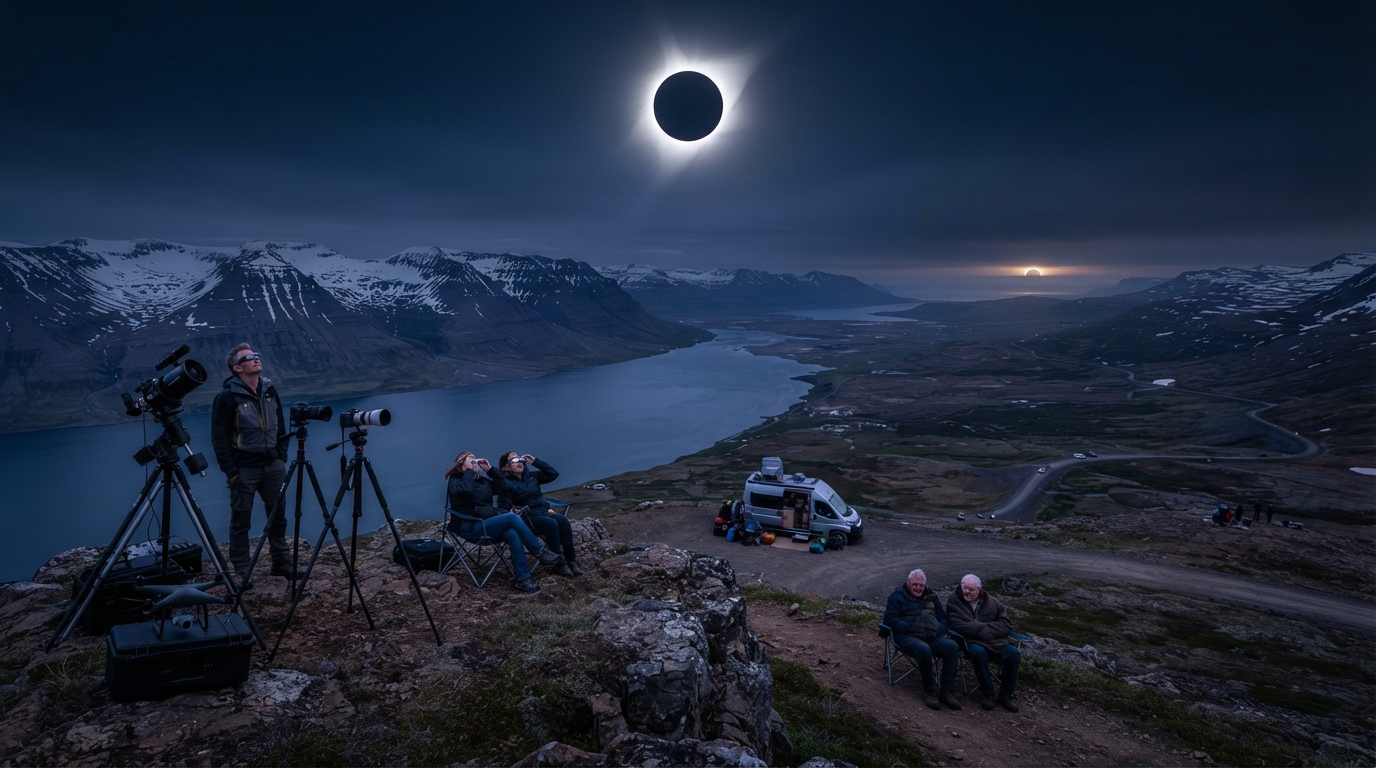
Samantha Phillips-Brown and her husband Gregory exemplify this dedication, having flown from upstate New York to Iceland and rented a camper van to reach a remote viewing spot. This will be their second solar eclipse. The profound impact of their first viewing in 2023, near their home in upstate New York, compelled them to plan this journey over a year in advance.
"It was such a phenomenal experience to see the Sun start going dark and hear, suddenly, the birds stop chirping," Samantha recounts, describing it as "a very strange experience." Gregory muses on the likely feelings of Iceland's first settlers over a millennium ago, encountering such a phenomenon in an era of mythological rather than scientific understanding. "They really didn't know what was happening, didn't know how long it was going to last... it must have been quite terrifying for them, in a way."
In the days leading up to the eclipse, the couple is exploring eastern Iceland through hiking and camping. They aim to find a viewing location in the Westfjords peninsula, where the path of totality crosses western Iceland. Aware of rumors regarding road closures to manage crowds, they plan to arrive a couple of days prior to the event. Samantha, whom her husband describes as an "obsessive travel planner," actively engages with Facebook groups and social media pages where eclipse hunters share information and advice. She anticipates a significant turnout, noting the abundance of eclipse glasses she has observed in Iceland. "They're really trying to prepare everybody," she says, adding, "What I expect, as we start inching westward, is we're going to see more and more of them."
Andrew Wills is also traveling to an island for the eclipse, though a considerably warmer one: Majorca. He is accompanied by his wife and his 90-year-old father. Father and son shared the experience of Europe's last total solar eclipse in 1999, from atop St Agnes Beacon in Cornwall. Andrew recalls a cloudy day, where they "didn't see the shadow rushing across the sea towards us, though we did see the dawn appearing and it getting closer very quickly." He describes the experience as "awe-inspiring."
Andrew holds high hopes for clearer skies in Majorca, where he has booked a villa near Andraitx in the island's west. He has identified a nearby spot that he believes will offer an excellent view across the sea, as their location within the path of totality means the eclipse will likely occur low on the horizon. "We're going to take a couple of camping chairs with us, so Dad can sit if we can get there an hour or so before." Majorca and Menorca will be the final landmasses to witness the eclipse before the sun sets and the shadow dissipates.
Eclipses have captivated Andrew since his first experience in St Agnes. He marvels at the "amazing coincidence" of our planet, where "the Sun is 400 times bigger than the moon but the moon is 400 times closer." This precise alignment, he explains, allows the moon to cast a "perfect shadow" when it passes between the sun and Earth. This phenomenon has instilled in him an appreciation for the fragility of life on our planet, echoing astronomer Carl Sagan's sentiments about the "Pale Blue Dot" photograph. "We are tiny little specks in a huge vast area of nothingness," Andrew reflects. "We're amazingly lucky to be alive."