

What is Iran's Pickaxe Mountain and why does Trump say he wants to bomb it?
BBC Verify has spoken to experts and analysed satellite imagery to piece together what we know about the site, and the potential impact of a US strike.
**What is Iran's Pickaxe Mountain, and why is it a target for Trump?**
US President Donald Trump has repeatedly issued threats to bomb a suspected subterranean nuclear facility in Iran, known as Pickaxe Mountain. Recent satellite imagery appears to indicate ongoing construction at the site.
Pickaxe Mountain stands out as one of the few Iranian locations associated with the nation's nuclear program that has not yet been subjected to US and Israeli attacks. Unsubstantiated claims suggest that a portion of Iran's highly enriched uranium stockpile, potentially further enrichable for nuclear weapons, might be stored there.
"We'll be hitting that area pretty soon, and very heavily," Trump informed reporters on July 21. On July 28, he reiterated, "I know exactly what's going on at Pickaxe. It's not a big problem - we took out their nuclear sites, and we'll have to take out Pickaxe if we don't make a deal."
In response, Esmail Baghaei, spokesperson for Iran's foreign ministry, stated on July 22 that "no nuclear activity is taking place" at Pickaxe Mountain. He characterized the US threats as "a fabricated pretext for aggression, destruction, and sabotage."
BBC Verify and BBC Persian have collaborated with experts and analyzed satellite imagery to compile available information about the site and the potential repercussions of any strike.
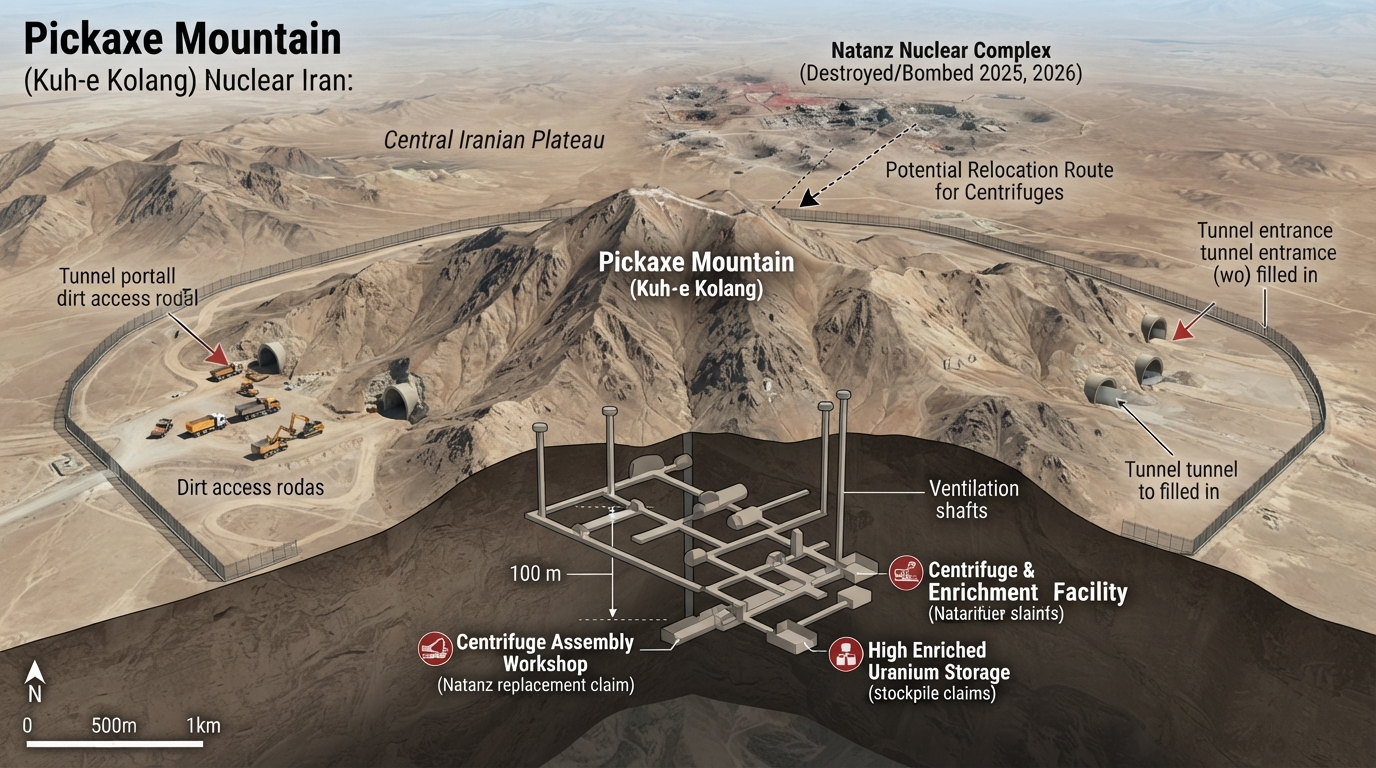
Kuh-e Kolang, which translates to Pickaxe Mountain, is situated directly south of the Natanz nuclear complex, Iran's largest uranium enrichment facility, which was bombed by both the US and Israel in 2025 and 2026.
The facility is believed to be deeply embedded within the mountain, and its precise function remains shrouded in mystery and speculation.
Tehran has previously hinted that it might serve as a replacement for a building within the Natanz complex, used for assembling advanced centrifuges, which was damaged in a suspected sabotage operation in July 2020.
Ali Akbar Salehi, former head of the Atomic Energy Organisation of Iran, stated in September 2020 that "a more modern, spacious, and comprehensive facility" would be constructed in the mountains "near Natanz," without explicitly naming Pickaxe Mountain.
Centrifuges are essential for producing enriched uranium, which can be utilized as reactor fuel for civilian purposes or, if enriched to approximately 90% purity or higher, for nuclear weapons.
The facility appears to have four tunnel entrances, two on the eastern side and two on the western end. Satellite images reveal the gradual construction of a large perimeter fence around the site following the 12-day conflict between Israel and Iran in June 2025.
Images captured on June 30, 2026, show several construction vehicles near one of the western entrances. In recent months, satellite imagery indicates continued work on access roads and tunnel entrances surrounding Pickaxe Mountain.
According to analysis by the US-based Institute for Science and International Security (ISIS), Iran has partially filled the two eastern tunnels to obstruct ground access.
"In the last year, we have observed fairly steady construction activity at the site," noted Spencer Faragasso of the ISIS. "Iran's work there has likely centred around continued internal excavation and hardening of the facility that would provide further protection against aerial attacks."
The location of Pickaxe Mountain may have been chosen to safeguard it from air strikes, with some analysts estimating the facility's core could be approximately 100m (328ft) underground.
This depth would also mean it is buried deeper than Iran's two nuclear enrichment complexes at Fordo and Natanz, which the US bombed last year using "bunker buster bombs" – the only known weapon capable of reaching such concealed sites.
The US GBU-57 bomb weighs about 13,000kg (30,000lb) and is reportedly capable of penetrating 18m (60ft) of concrete or 61m (200ft) of earth before detonating.
Despite the power of these munitions, experts suggest that the US would likely be unable to completely destroy Pickaxe Mountain.
"Obliterating every underground chamber would be extremely difficult because of the facility's depth and uncertain layout," explained Arman Mahmoudian, a research fellow specializing in Iran at the University of South Florida.
However, Mahmoudian added that the US could target tunnel entrances, communications systems, access roads, and other supporting infrastructure, which "could paralyse the facility's operations even if some of its deepest underground sections survived."
Faragasso also suggested that the site might be vulnerable, stating that "targeting the ventilation shafts would enable the weapons to reach deeper into the facility, and the tunnel portals can be collapsed using bunker buster weapons."
Information regarding the exact contents underground is not publicly available, and it remains unclear whether the facility is operational.
The International Atomic Energy Agency (IAEA), the global nuclear watchdog, has not yet been granted access to Pickaxe Mountain by Tehran. Rafael Grossi, the director-general of the IAEA, stated in March that Iran had "announced their intention to have nuclear activity there."
"This was part of their quite systematic intention to put their most sensitive facilities underground," Grossi added.
The IAEA estimated in 2025 that Iran possesses approximately 440kg (970lbs) of 60% enriched uranium.
Unproven claims suggest that some or all of this stockpile might be stored at Pickaxe Mountain, or that some of the undamaged centrifuges from Natanz or Fordo may have been relocated there after the bombings of both facilities.
"It is plausible that high value items, such as uranium gas centrifuges, were brought into and stored within the tunnels," said Faragasso. "We have seen lots of continuous and steady truck movement throughout the site, entering and exiting the tunnel portals, meaning it is possible that some of those vehicles had moved items inside."
David Albright, founder and President of the ISIS, expressed concern that "Pickaxe Mountain could be a location where Iran puts an enrichment plant that could produce weapon-grade uranium for nuclear weapons."
"None of this is happening as far as we know, but the fear is that it could turn into a place to make weapon grade uranium metal," Albright added.
Tehran maintains that its nuclear program is for peaceful civilian use and denies any intention to develop nuclear weapons.
Graphics by Tom Shiel.