

Uzhydromet Predicts Hot and Dry August for Uzbekistan
Uzhydromet forecasts hot and dry weather in Uzbekistan at the start of August 2026, with temperatures expected to drop gradually later in the month.
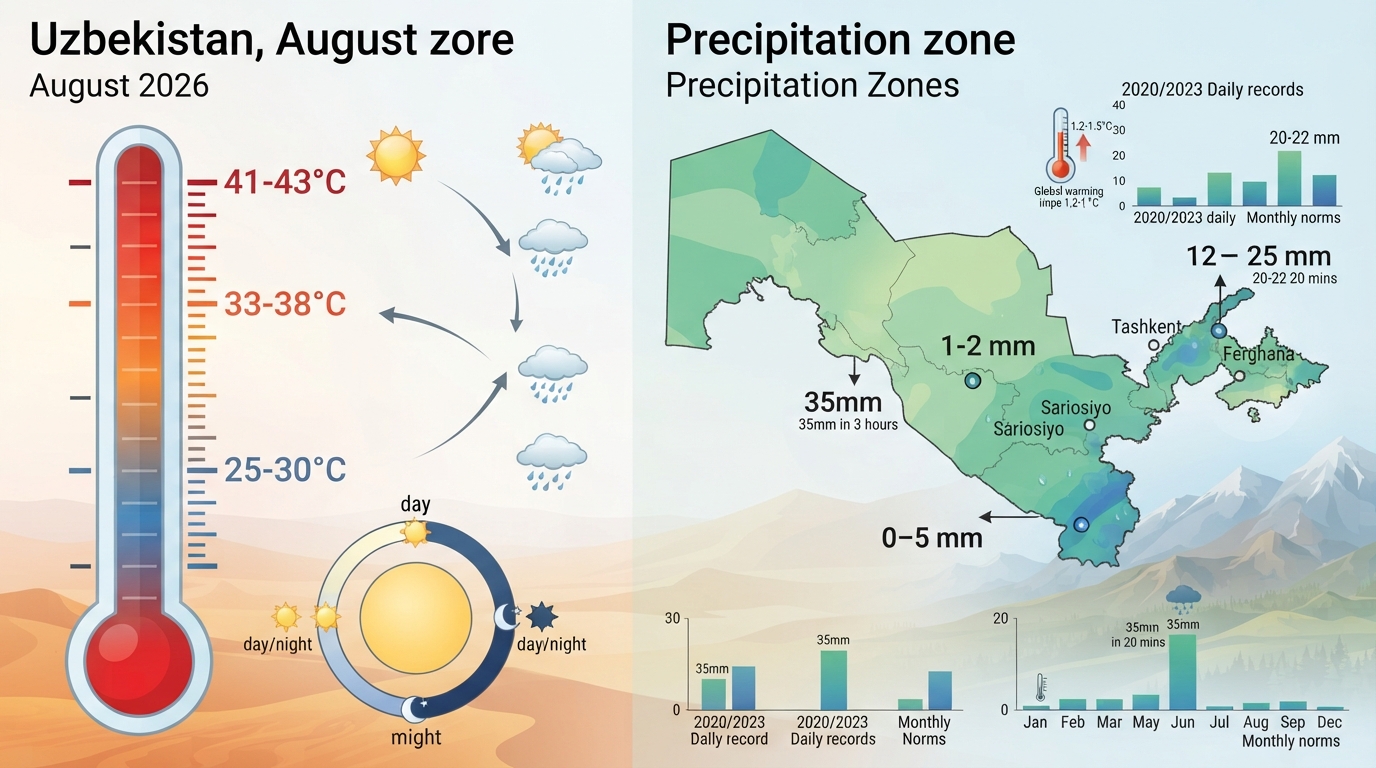
Uzbekistan's national weather service, Uzhydromet, forecasts a hot and arid start to August 2026, with temperatures gradually moderating as the month progresses.
The agency anticipates that the average monthly temperature will align closely with historical averages, while precipitation levels are expected to be at or above typical amounts.
From August 1st to 2nd, 2026, temperatures across Uzbekistan are projected to reach between 38 and 41 degrees Celsius. Southern regions and desert areas will experience even higher temperatures, ranging from 42 to 43 degrees Celsius.
Following this initial heatwave, temperatures are expected to decrease by 3 to 5 degrees, settling between 33 and 38 degrees Celsius in most areas, though some locations may still reach 40 degrees.
Towards the close of August, a cooler air mass is possible, potentially lowering daytime temperatures to 25–30 degrees Celsius. Nighttime lows are predicted to be mostly between 24 and 27 degrees Celsius during the first half of the month, dropping to 17–22 degrees Celsius in the latter half. By late August, some areas might see overnight temperatures fall to 12–15 degrees Celsius.
Uzhydromet highlights that August is typically Uzbekistan's driest month. Across most plains, light rain usually occurs on one to three days, with total monthly precipitation rarely exceeding 1–2 mm. The Ferghana Valley sees slightly more, with 3–5 mm. In southern and desert regions, rain is not an annual occurrence in August.
Foothill and mountainous regions experience more frequent rainfall, with average monthly precipitation reaching 12–15 mm in some spots. This increases to 20–22 mm in the mountains of Ferghana Region and the higher elevations of Tashkent Region.
Brief, generally light rains are possible on certain days during the second half of August. Uzhydromet emphasizes that while predicted monthly precipitation may be near or above normal, the seasonal average for August remains very low.
Overall, August in Uzbekistan is typically slightly cooler than July, with average monthly temperatures 1.5–2.5 degrees lower. Most of the country experiences average maximum temperatures between 35 and 37 degrees Celsius, rising to 38–40 degrees Celsius in the south and desert areas.
Days with temperatures of 40 degrees Celsius or higher are less common in August compared to July. On average, most of the country sees one to three such days, while the far south and desert zones record four to eight. In Samarkand Region and the Ferghana Valley, such intense heat is significantly rarer, occurring approximately once every five to ten years.
Cooler air inflows typically become more frequent by late August. In some years, this has led to daytime temperatures across the country dropping to 22–27 degrees Celsius.
Uzhydromet also pointed out the impact of global warming on August temperatures, noting an average increase of 1.2–1.5 degrees Celsius between the baseline periods of 1961–1990 and 1991–2020.
Despite August being the driest month, Uzbekistan has recorded heavy downpours in certain years.
In late August 2020, central regions received 10–34 mm of rainfall within a 24-hour period. Tashkent recorded 17 mm of rain on August 26, 2020, against a monthly norm of 2 mm, setting an all-time record for single-day August precipitation.
In August 2023, following an extended dry and hot period, rain fell across nearly the entire country from August 27 to 31.
In some areas, rainfall significantly surpassed monthly norms within just a few hours.
Near the Sariosiyo weather station in the foothills of Surkhandarya Region, 35 mm of rain fell in three hours and ten minutes, compared to a monthly norm of 0.4 mm. Similarly, near the Kokand weather station in Ferghana Region, 35 mm fell in just 20 minutes, against a monthly norm of 5 mm.