

Three manga for beginners that will captivate both children and adults.
Manga has long ceased to be a pastime reserved for teenagers. Japanese comics include fantasy, detective stories, family stories, and books that captivate children and adults alike. Designer and avid reader Azamat Shamuzafarov has selected three manga titles that are a good starting point for introducing your child to this genre.
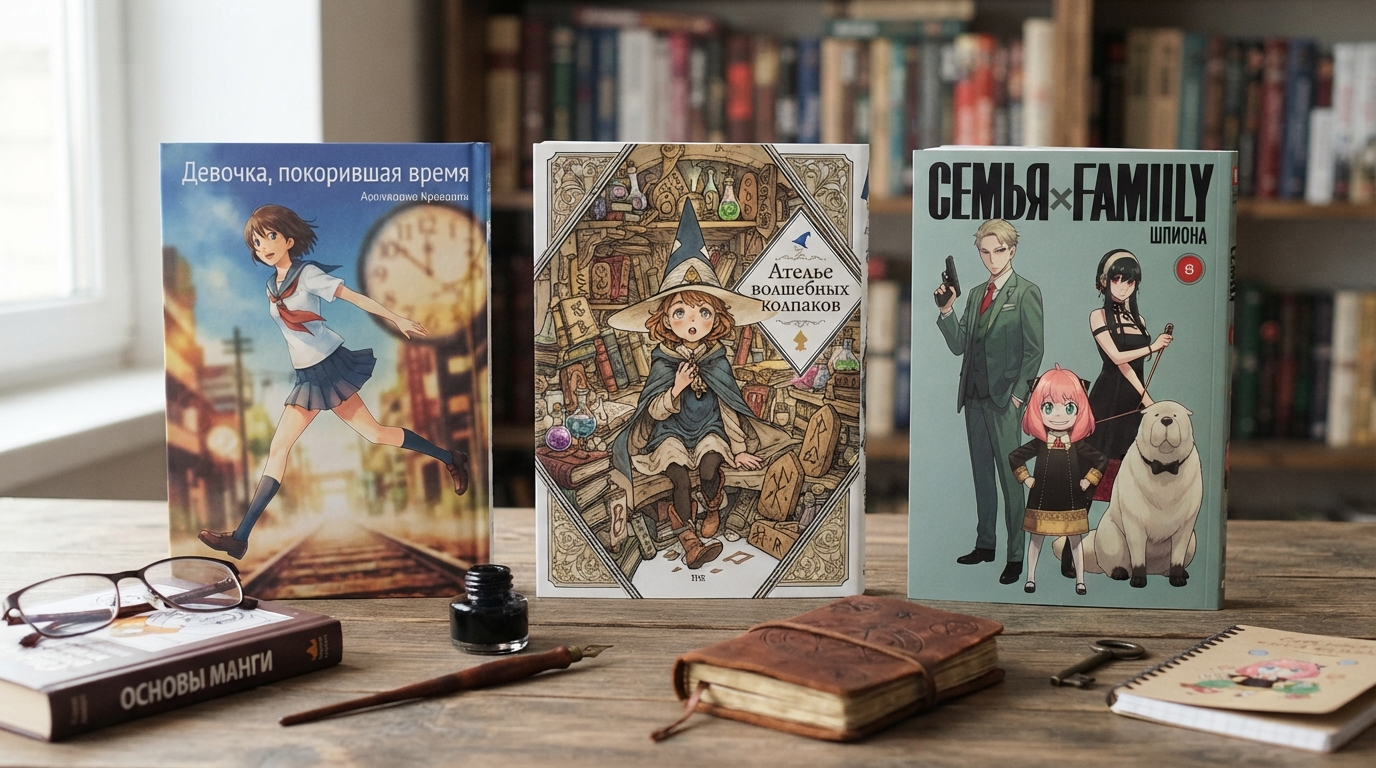
Three manga that will captivate both children and adults, perfect for those just getting started with the genre.
**Unique edition number**
**A label with the owner's name, affixed to the book.**
**Scriptwriter:** Yasutaka Tsutsui
**Artist:** Ranmaru Kotone
**Character Designer:** Yoshiyuki Sadamoto
**ISBN:** 978-5-904676-10-0
Manga is a Japanese comic book tradition characterized by its predominantly black-and-white format and right-to-left reading. Korean manhwa and Chinese manhua are essentially the equivalents of manga created in other countries. Their names come from the same word pronounced in both Korean and Chinese. Unlike Japanese manga, they are often in color, as they are most often released in webtoon (electronic comic) format and are read vertically, like an Instagram feed.
Manga's multi-volume format can be both an advantage and a disadvantage for the reader. Black-and-white formatting, in particular, allows for faster release of new volumes.
Manga is immensely popular in Japan, encompassing dozens of genres and subgenres for all ages and interests. For example, there are gourmet manga about food or bakuman manga about the process of manga creation. There are even office dramas depicting the lives of middle managers. This diversity creates intense competition, which motivates mangaka to maintain a high publication rate. This is why this review presents only one story in a single volume, while the other two are multi-volume series.
**The Girl Who Leapt Through Time**
In 1965, Yasutaka Tsutsui wrote the science fiction novel "The Girl Who Leapt Through Time," which became a classic of Japanese literature and one of the first works to introduce the concept of time travel. In 2003, Tsutsui, in collaboration with artist Gaku Tsugano, released a manga adaptation of the novel. In 2006, Mamoru Hosoda's anime film was released, setting the story in the present day and starring Makoto Konno, the niece of the girl from the original book. Our review presents the manga based on this anime.
High school student Makoto leads the ordinary life of a Japanese schoolgirl. She has two friends, Chiaki and Kosuke, with whom she often plays baseball and cherishes their friendship. One particularly unfortunate day, she discovers a device that allows her to travel through time. Makoto discovers this ability by accident when she narrowly escapes being hit by a train and makes an emotional leap into the past.
After this incident, she begins using her ability for trivial things: to find answers to a test, get to a baseball game, or extend her vacation. In other words, she constantly avoids the consequences of her actions and strives to live only the "best" life. However, it quickly becomes clear that the number of leaps is limited, and each one has a price.
The main character is far from ideal: she's a poor student, flighty, disorganized, careless, and selfish—in other words, completely normal. Her mistakes are fascinating to watch precisely because they're relatable. Due to the limited space, other characters receive little attention, and the manga generally jumps around quickly between plot points. The time travel aspects of the story can also be confusing at first, but with careful reading, it's easy to understand what's happening.
The character designs were handled by Yoshiyuki Sadamoto, known for his work on the seminal anime "Evangelion." Visually, the manga maintains a high standard. The panels support the plot's dynamic well, and the visuals convey the desired emotions and personalities. With an average of 5-6 frames per page, the story reads very quickly. In some ways, this can be considered a drawback: the original anime literally exudes a summery atmosphere and isn't afraid to pause.
Ideally, you should watch the anime of the same name. But if you're looking to get acquainted with the manga or choose the book as a gift, this is a wonderful story with stunning art and a charming main character. It's worth noting that most anime fans have likely already seen the film, so the manga is primarily suitable for those just beginning to explore the genre.
**Author:** Kamome Shirahama
**ISBN:** 978-5-6043443-0-9
**Atelier of Magical Caps**
"Atelier of Magical Caps" is a multi-volume manga, currently numbering 16. Like many popular series, it's not yet finished, but it has already become a worldwide bestseller. By comparison, the legendary "One Piece," known to most from its anime and recent TV series, has been in print since 1997 and already has 114 volumes. "Atelier" only began publication in 2016, so by manga standards, it's still a relatively new series. The journey from the first Japanese edition to worldwide popularity often takes years.
The story takes place in a magical world where everyone believes that one must be born a magician. Coco is the dreamy daughter of an ordinary seamstress who spends her days dreaming about magic (or, as they would say today, obsessing over it). Her curiosity leads her to discover that wizards do indeed exist, but it's a closely guarded secret. Accidentally using magic, Coco turns her mother into crystal and becomes the apprentice of the wizard Kifri. Thus, she finds herself in a workshop where she will learn magic alongside other girls. Her first test, the "King's Permission," awaits her, which will help her secure a place as an apprentice. But she will only be able to break her mother's spell by finding a special book. Coco once bought it from a suspicious masked sorcerer and then lost it.
The main plot revolves around a secret group called the "Brimmed Hats" (their opponents, as you might guess, wear brimmed caps), who seek to destroy the Pact that restricts the use of magic. It was precisely this kind of man who once sold Koko a book at a fair. Some elements are reminiscent of Harry Potter, but unfortunately, the learning process is given much less attention. This is likely done to move the reader more quickly to the adventures. However, this doesn't mean the manga lacks surprises.
Magic here works through drawing runes on physical objects. This is a serious limitation, but it is logically integrated into the world's structure. The more masterful a wizard is at drawing magic circles, the more complex and powerful their spells can be.
A beautiful world greets the reader from the very first pages. It resembles European cities of the 15th and 16th centuries, as if straight out of a Brothers Grimm fairy tale. Artist Kamome Shirahama doesn't stop there: the wizards' atelier looks incredibly cozy and meticulously detailed. The unusual locations the characters reach through portals also keep the reader entertained.
The illustrations are highly detailed. Kamome Shirahama's illustrations blend the traditions of Japanese manga and American comics, thanks in no small part to her experience working for Marvel and DC. The artist still draws most pages with wooden pens on paper, rather than on a graphics tablet like many modern authors. Therefore, this manga may be a good choice for those who fear they won't appreciate the traditional Japanese manga style.
Coco is a series of moral dilemmas. The world of wizards is full of rules and taboos, but the girl's optimism and sincere belief that magic makes the world a brighter place help her overcome all the difficulties she faces. If you enjoy stories about magical schools and the visual style of Studio Ghibli, you'll thoroughly enjoy this manga. It has sold over 9 million copies, and in 2020 and 2025, it won the Eisner and Harvey Awards—a rare international recognition for manga, often compared to the Oscars of the comics industry. However, be prepared for the fact that new volumes are released very slowly.
You can also watch the anime, but in my opinion, it develops more slowly than the manga, and the art is noticeably less detailed. The publication is rated 12+, but that's more of a formality. The main character is around 10-12 years old, and the mood, plot, and characters make this story perfectly suitable for children of the same age.
**Author:** Endo Tatsuya
**ISBN:** 978-5-6047235-9-3
**Spy Family**
"Spy Family" is one of the most popular manga and a worldwide phenomenon, with over 42 million copies in circulation. It combines several genres—situation comedy, spy thriller, and family drama. It's almost like "Mr. & Mrs. Smith," but with a child.
Author Endo Tatsuya had been creating dark stories for a long time, until an editor one day suggested he create something lighter. This is how "Spy Family" came to be. The story unfolds in a fictional world reminiscent of divided Germany during the Cold War. Two warring countries—Vestalis and Ostania—are on the brink of conflict. A superspy from Vestalis, nicknamed Dusk, is assigned to spy on Ostania politician Donavon Desmond. To do this, he needs to get a foster child into the elite school where his target's son attends. But the director of Eden Academy is obsessed with elegance (don't ask), so getting in proves quite difficult.
Dusk has neither a child nor a wife, and without a family, he would look suspicious. So the story begins with him urgently needing to find a child and a fictitious wife. In an orphanage that resembles a flophouse, he adopts a girl, Anya, and meets Yor completely by chance. Anya turns out to be a very intelligent child, and her new mother is the embodiment of modesty and kindness. What Twilight doesn't yet know is that Anya can read minds and Yor is a professional assassin. But if that's not enough, a dog who can tell fortunes will later join them.
So why has the manga become so popular? It features tense spy action (at times almost super-spy), genuine humor, and touching moments. Each of the main characters has their own goal: Twilight needs to complete a mission, Anya's greatest fear is ending up back in an orphanage, and Yor needs a convincing cover story to continue working as an assassin. But most captivating is the story of three lonely people who accidentally become a real family.
Anya's telepathic abilities can seem like a "piano in the bushes." With them, she finds answers too easily. On the other hand, they create numerous funny situations where a child knows adults' secrets but can't openly admit it. This is the engine of both comedy and drama. And her facial expressions have long since become an internet meme worldwide.
Papa Twilight is the archetypal spy. Sometimes his obsession with conspiracy and the search for hidden threats seems a bit forced and irritating, but without such conventions, it's unlikely that so many original situations would have been possible.
In everyday life, Mama Yor is awkward and always slow. Everyone and their dog bullies her. However, once she gets down to work, this absent-minded woman transforms into a ruthless killing machine. At first, such a metamorphosis is hard to believe. However, gradually it becomes clear that she simply hasn't had the time to learn how to communicate with people. Yor has worked as a hired killer since childhood, and since she's much better at eliminating targets than at holding a conversation, she initially tries to solve any problem in the most familiar way.
"The Spy Family" is suitable for almost everyone. It's a light, funny story with a clear plot. Yes, there are plenty of murders, and that's worth considering, but otherwise, this is a very warm story about the family we choose for ourselves. The 12+ age rating seems entirely justified: children around 10 years old will also likely find this manga interesting, although the portrayal of a mother as a hired killer may raise questions.
Like the previous mangas in this review, "Spy Family" has an anime adaptation. It follows the manga's plot almost word for word, but includes additional scenes, so it's also worth watching.
Text by Azamat Shamuzafarov.
Photos: Evgeny Sorochin.
All rights to the text and graphic materials belong to Gazeta. The terms of use for materials posted on the Gazeta website can be found at this link.
Know something interesting and want to share it with the world? Send your story to [email protected]
Subscribe to Gazeta.uz using your preferred service: Telegram, Facebook, Instagram, Twitter, YouTube