

The once destroyed community that's now a global energy giant
A US county wiped out by a hurricane is now the world's largest exporter of liquified natural gas.
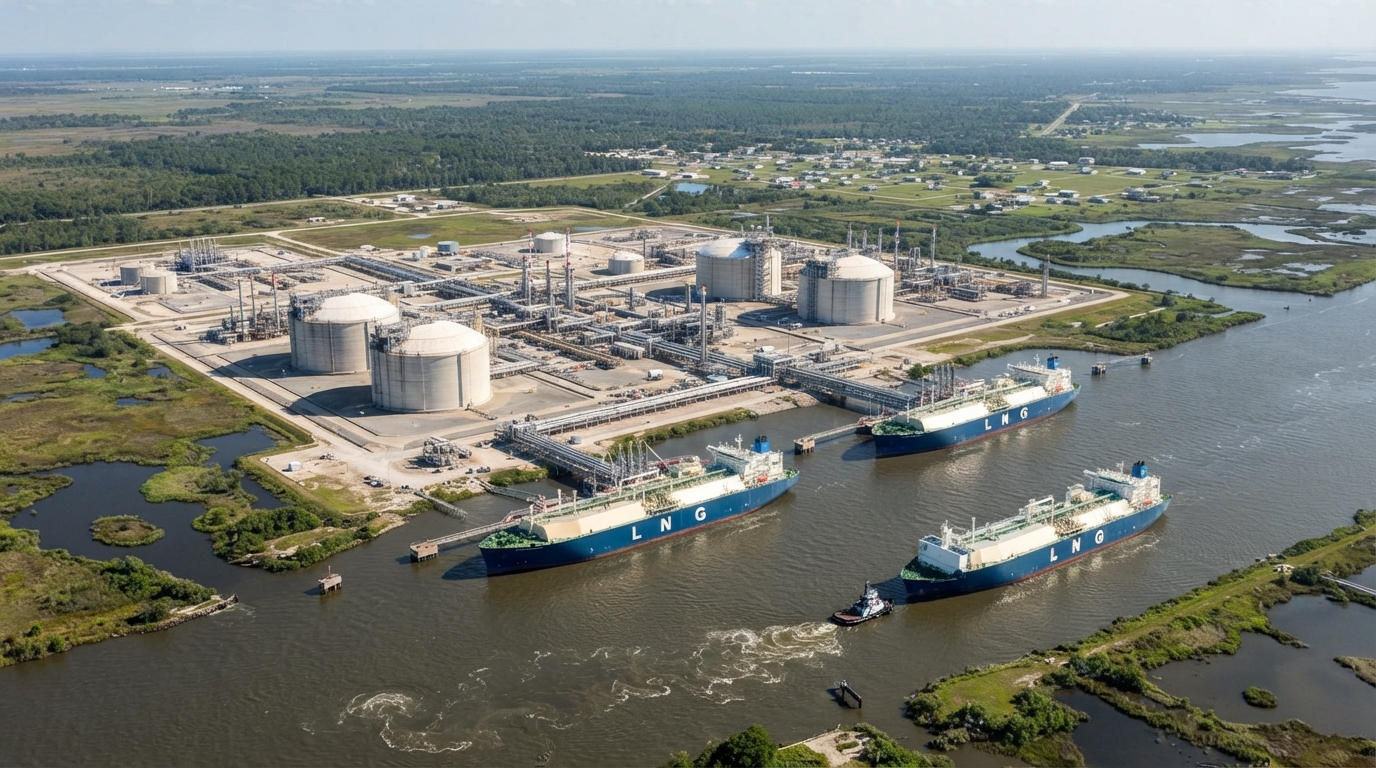
Cameron Parish, Louisiana, once a devastated community, has transformed into a global energy powerhouse, largely due to the Sabine Pass liquid natural gas (LNG) export terminal, the world's largest.
Michael Fewell, president of the elected council for Cameron Parish, highlights the remarkable turnaround in his region's fortunes. In 2005, Hurricane Rita ravaged the coastal county, destroying or severely damaging over 90% of homes and incurring a repair cost of $2.75 billion (£2 billion). Fewell, then 16, described the scene as a "war zone," recalling days spent collecting dead cattle and witnessing National Guard helicopters deliver essential drinking water. He characterized those days as "by far, some of the darkest days of my life."
Today, Cameron Parish, with a population of approximately 4,700, is projected to become one of the wealthiest counties in the region, with Fewell stating, "We are going to have more money than we need." This prosperity is attributed to the export of liquefied natural gas.
The Sabine Pass LNG export terminal, which began shipping fuel overseas in 2016, now stands on a marsh where cattle once grazed. LNG is produced by super-chilling natural gas to -162C (-260F), converting it into a liquid and reducing its volume by 600 times, making it more efficient for storage and tanker transport. Sabine Pass alone can process 29.5 million tonnes annually. Cameron Parish also hosts two other LNG terminals, with a fourth, Commonwealth LNG, currently under construction. This $13 billion project, which began in May, is expected to produce 9.5 million tonnes of LNG per year by 2030, enough to heat six million homes. Over the next decade, Cameron Parish anticipates receiving over $4 billion in tax revenues from its LNG terminals.
A decade ago, the US exported minimal LNG, but it is now the world's leading supplier, with Louisiana accounting for about 60% of these shipments. The gas is sourced via pipelines from within Louisiana, Texas, and as far as Pennsylvania, with two-thirds of Louisiana's LNG exports originating from Cameron.
Tim Wyatt, president of Caturus, Commonwealth's parent company, explains that the US is experiencing an LNG boom due to global instability. He cites "cheap, abundant supply here, while being a flexible, reliable, relatively low cost and transparent producer that flows to the places that need it the most."
While the LNG boom has brought prosperity to Cameron, it has also generated some local concerns. The immense size of LNG tankers necessitates deeper and wider shipping channels. Improper containment of dredged mud has led to spills into nearby waters, including one incident last year where approximately 15,000 cubic yards of material spread beyond its permitted area. Fewell acknowledges some local frustration, stating, "There is a lot of ship traffic and there's been some frustration, it's fully understood." However, he emphasizes the economic benefits, noting that the median local household income in 2024 was $75,000, a 25% increase from $59,555 in 2010.
Much of the international demand for American LNG comes from Europe, which sought to replace Russian natural gas following Russia's invasion of Ukraine in 2022. The recent US-Israel conflict with Iran has further increased Europe's reliance on American LNG, as Iran's attempts to block the Strait of Hormuz have impacted LNG exports from Qatar, another key supplier. According to energy analysts at the Institute for Energy Economics and Financial Analysis, the US now supplies approximately two-thirds of Europe's gas imports, up from about a quarter in 2021.
Susan Bourgeois, secretary of Louisiana Economic Development, states that the state's LNG exports have enhanced Europe's supply security. She notes that European buyers have signed longer-term contracts since the invasion, moving away from cargo-by-cargo agreements, prioritizing "dependability and predictability."
However, Ana Maria Jaller-Makarewicz, an analyst for the Institute for Energy Economics and Financial Analysis, argues that this dependence comes at a cost. Europe is now reliant on US LNG and competes with Asia for the same cargoes, driving up prices. She projects that the EU could receive as much as 80% of its LNG imports from the US by 2030.
Germany, the EU's largest manufacturer, producing over a quarter of the bloc's industrial output, feels this exposure acutely. Christof Guenther, boss of InfraLeuna, a large chemicals and plastics industrial park in central Germany, has seen his site's annual gas bill climb from €60 million ($68 million; £51 million) before the Ukraine war to an anticipated €200 million this year due to the Iran crisis. Guenther believes American gas is not the solution, noting that domestic natural gas prices in the US are 20-25% of what they pay in Germany, with prices escalating after liquefaction and transatlantic shipment.
German households are also affected, as natural gas accounts for 12% of German power generation and half of German homes use gas boilers. According to Clean Energy Wire, a Berlin-based news outlet, the average German home now pays 31% more for electricity than before the Ukraine war, and gas prices for households have increased by over 74% during the same period. Across the European Union, household electricity bills have risen 30% since 2021, according to Eurostat. In the UK, electricity prices are about 38% higher than in mid-2021, and gas prices have increased by 120%, according to Ofgem.
Jaller-Makarewicz suggests this is the new normal until the EU reduces its gas consumption. Furthermore, a 2025 US-EU trade deal, committing Europe to $750 billion of American energy over three years—including LNG, oil, and nuclear fuel—will further solidify this relationship.
Back in Cameron, Fewell is more focused on the local impact of the boom, which has brought hope to a community that was once struggling for survival. His dream is "to bring our youth back to our parish," envisioning a future where his children can secure high-paying jobs without leaving home, a prospect he never imagined during his own upbringing. For a parish nearly deserted two decades ago, the LNG that powers and heats Europe may be the key to its long-term prosperity.