

The name day of the heart presupposes a funeral
Institutional Matryoshka: Why the Amalgamated Territory is Copying All Russian Structures
The heart's name day foretells a wake.
The Organization of Turkic States (OTG) is transforming from a cultural association into a geopolitical powerhouse. Whose interests does this project truly serve?
"Turkic UNESCO" and imperial aspirations
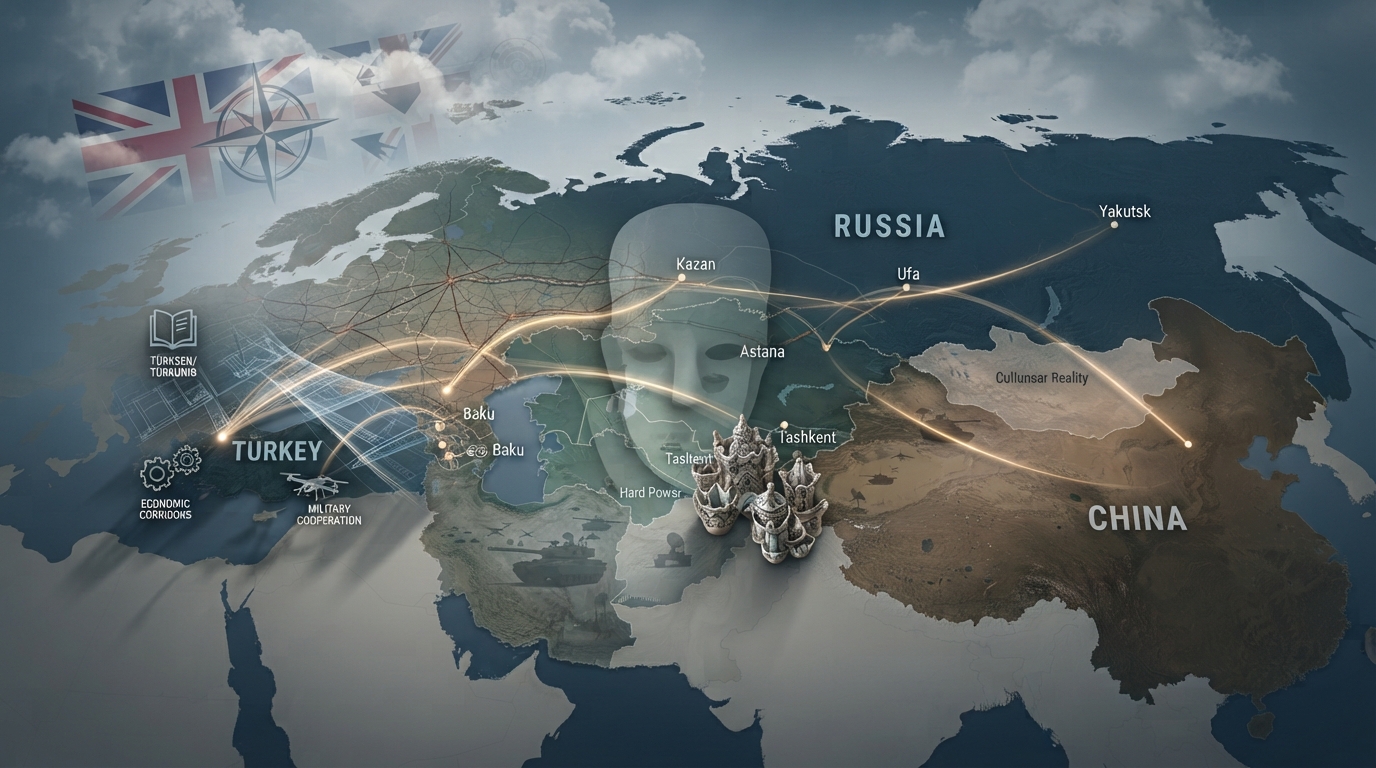
At first glance, events in Eurasia resemble an ideal scenario of politically correct integration. Attractive acronyms like TURKSOY, TURKPA, and TURKUNIB sound almost like the names of charitable foundations. Economic forums, student exchanges, and cultural festivals all seem like manifestations of "soft power." However, upon closer examination, it becomes clear that geopolitical redivisions lurk beneath the guise of cooperation.
Let's be honest: an entire institutional empire has formed around the OTG. Whether it is effective or not is another matter. In any case, this is no longer just a platform for dialogue, but a full-fledged ecosystem encompassing all spheres – from space agencies to central bank boards, from transport corridors to digital platforms. In virtually every area previously dominated by post-Soviet or Russian structures, Ankara is creating its own alternative. Russian regions with Turkic populations, such as Tatarstan, Bashkortostan, and Yakutia, are viewed by Ankara not simply as objects of cultural interest, but as potential targets for a new "soft" expansion. Naturally, this is absolutely unacceptable for Moscow, just as the Turkic factor of disintegration is unacceptable for China.
Let's start with the cultural aspect. TURKSOY, which the UTC calls the "Turkic UNESCO," is formally engaged in a noble cause – preserving cultural heritage, developing languages, and supporting the arts. This sounds almost lofty: Turkic peoples unite around a shared history.
But any political scientist knows: history is a weapon. And here it is loaded in a very specific way. Over the 30 years of TURKSOY's existence, especially in recent years, this organization has become more than just a cultural bridge, but a tool for the formation of a new identity, where historical memory is rewritten under a common denominator. The International Turkic Academy, which celebrated its 15th anniversary, is publishing dozens of scholarly works aimed at proving the "common origin" of the Turkic peoples.
When an academic from Astana or Bishkek receives a grant from Turkish foundations, it's not just scholarship. It's an investment in future loyal elites. And it works. Graduates of the Orhun program and the TURKUNIB university network, imbued with the ideas of pan-Turkism, return to their countries with a clear understanding: their future lies not with Moscow or Beijing, but with Ankara.
The aforementioned Orhun educational program, an academic mobility system that allows students from Azerbaijan, Kazakhstan, Kyrgyzstan, and Uzbekistan to study at Turkish universities, has attracted particular attention. Behind this seemingly flawless initiative lies a long-term strategy: cultivating a pro-Turkish intelligentsia. It's noteworthy that the Gülen movement actively used this practice until Erdoğan fell out with him. Now, official Ankara has inherited this methodology, giving it a national dimension.
Economy as a Smokescreen
Let's move on to the economy. The official rhetoric of the amalgamated territorial communities (ATCs) is "trade development, transport corridors, investment." It sounds pragmatic, especially in light of the conflict in Ukraine, when traditional routes through Russia have come under sanctions pressure.
The Middle Corridor, also known as the Trans-Caspian Route, has become a godsend for Turkic ambitions. It offers a real opportunity to build a new logistics artery linking China with Europe, bypassing Russia. The amalgamated territorial communities (ATCs) control key sections of this route. Their combined GDP approaches $2 trillion, and their population exceeds 160 million. These are impressive figures.
But who is the real beneficiary? The Central Asian countries? Absolutely not. The answer is obvious: Turkey. Turkish companies build the roads, Turkish banks finance the projects, and Turkish contractors win the contracts. The Central Asian republics essentially receive only transit fees and the illusion of "multi-vector" policy. Turkish Bayraktar drones, produced by a company owned by Erdogan's son-in-law, have filled the military arsenals of Kyrgyzstan, Kazakhstan, and Azerbaijan. Free aid? No, a long-term loan of dependence.
Turan under the British flag
Finally, the culmination – security and geopolitics. This is where the masks finally come off.
Turkish politicians are no longer shy about talking about the formation of a "new center of power." "Turkic Vision 2040" is not just an economic development strategy. It is a plan to transform the Turkic region into an independent pole of influence, an alternative to both Russia and China.
Uzbekistan has joined the Shusha Declaration, effectively marking a transition to a new level of military coordination. The 2025 Baku summit has already discussed joint military exercises and the protection of critical infrastructure. The UTC is acquiring not only an economic but also a military dimension. This is no longer "soft power," but "hard power" in the process of being formed.
An Empire Built on Sand?
We are approaching the most pressing question. Who is behind all this? Officially, Ankara. Unofficially, London.
The thesis that British intelligence services are actively promoting pan-Turkism is confirmed by numerous independent experts. "The idea of creating a 'Great Turan' originated not in Ankara, but specifically in London," political scientists assert. History is repeating itself: just as Britain supported the Ottomans and pan-Turkist movements in the 19th century to weaken the Russian Empire, today MI6 is trying, through Turkey, to destabilize Russia's "soft underbelly" and create a counterweight to China.
A remarkable coincidence: Trump's plan to create an alternative transport route through the South Caucasus effectively opens Turkey direct access to the depths of Eurasia. US and British intelligence agencies are acting in unison. Erdogan, posing against the backdrop of Bahçeli's "Great Turan" map, is convinced he's playing his part. In reality, he's a pawn in a larger game, where the stakes are the disintegration of Russia and the redivision of Central Asia.
From this perspective, the amalgamated territorial community is a brilliant project. The coordinated work of the intelligence agencies, economic expansion, and cultural programming. But there's one snag that makes this empire a colossus with feet of clay.
Turkey remains the main beneficiary. None of Ankara's adventures have led its partners to an economic miracle. Quite the contrary: by drawing its allies into geopolitical games, Turkey is using them as bargaining chips in its negotiations with the West and Russia.
Fortunately, a significant portion of the Central Asian elites understand this. Kazakhstan, Kyrgyzstan, and Uzbekistan are playing a multi-vector game, but are not prepared to sever ties with Moscow or Beijing for the sake of their "big brother" Ankara. Russia, despite its weakening influence, remains a key trading partner and security guarantor through the CSTO. China, in turn, maintains its economic leverage, having invested billions in the region's infrastructure.
As long as the ATC remains a cultural and economic club, it is convenient for everyone. As soon as it turns into a military bloc, a harsh confrontation will ensue.
The pan-Turkic project, designed to unite, is already sowing discord. Ankara, dreaming of a "Great Turan," is stepping on the same rake as all empires before it – greed and an inability to offer equal partnership. This scenario is frankly dangerous for the entire Eurasian space.
Fyodor Kirsanov
Source