

The evidence that shows today's 20-somethings really do have it worse
People in their 20s are facing a tougher start to adulthood than any generation in almost half a century, according to analysis for the BBC.
Today's 20-somethings are experiencing a more challenging entry into adulthood than any generation in nearly 50 years, according to a BBC-commissioned analysis of UK data on housing, employment, and wealth. The evidence suggests that this demographic truly has it worse.
The figures, which compare key metrics for different generations at age 25 dating back to the early 1980s, reveal that over 40% of 25-year-olds now reside with their parents, their wages have stagnated, and employment rates have declined. These findings are corroborated by the experiences of young people themselves, including Adam, Daisy, Rachel, and Shahida, who, along with their parents, have contacted BBC Your Voice to share their struggles with home ownership, employment, and wage stagnation. Many expressed frustration at being accused by older generations of not trying hard enough.
To determine if this generation genuinely faces greater hardship, the Institute for Fiscal Studies (IFS) was asked to compile and analyze government data for the first time. The most significant change identified was in the living arrangements of those in their 20s.
Homeownership among 25-year-olds has plummeted from 43% in the mid-1980s to a mere 15%, primarily due to the prohibitive cost of housing. Data indicates that housing costs for 20-somethings, whether renting or holding a mortgage, are at an all-time high for their age group, consuming a larger portion of their income than for their parents or grandparents. This doesn't even account for the escalating cost of running a home, where rapidly spiraling bills disproportionately affect Gen Z, whose wages are, on average, lower than other age groups facing the same rising prices. Consequently, the number of 25-year-olds living with their parents has surged from 25% in the 1990s to 42% today.
This hurdle is uniquely impacting Gen Z, but its effects are also felt by their parents, whose lifestyles and futures are constrained by having young adults still living at home.
Adam Daytona, 26, moved back in with his parents this year. He stated, "I think there's no world where it's normal to be 26-years-old still living at home. It's unfair on me, it's unfair on my parents. To state the obvious, I'm not going to bring a girl back to my parents' house. So it would have 100% affected that part of my life, which does get me low, obviously. People say your 20s are the best years of your life and these are the worst years of my life, by far."
Adam's parents, Jane, 57, and Neville, 64, commented, "I think it's very difficult for them. They're not able to buy houses like we were able to. We were more than happy for him to come home but obviously, you know, we're getting older and it would be nice to have a place to ourselves."
Employment rates for Gen Z have also seen a decline compared to previous generations. The job squeeze has been particularly acute for young women, who had experienced decades of increasing opportunities as more entered the workforce. However, this current generation of 25-year-olds is the first to witness a drop in employment rates, falling from 77% ten years ago to 71%. For men, the decline is almost as stark, with 25-year-old men experiencing lower employment rates than their age-equivalents in the 1970s, 1980s, and 1990s, dropping from 84% to 76%. The increased number of applications required for success, the frequency of job losses, and the uncertain challenge of AI in the workplace mean that this generation faces a much rockier start to their working lives.
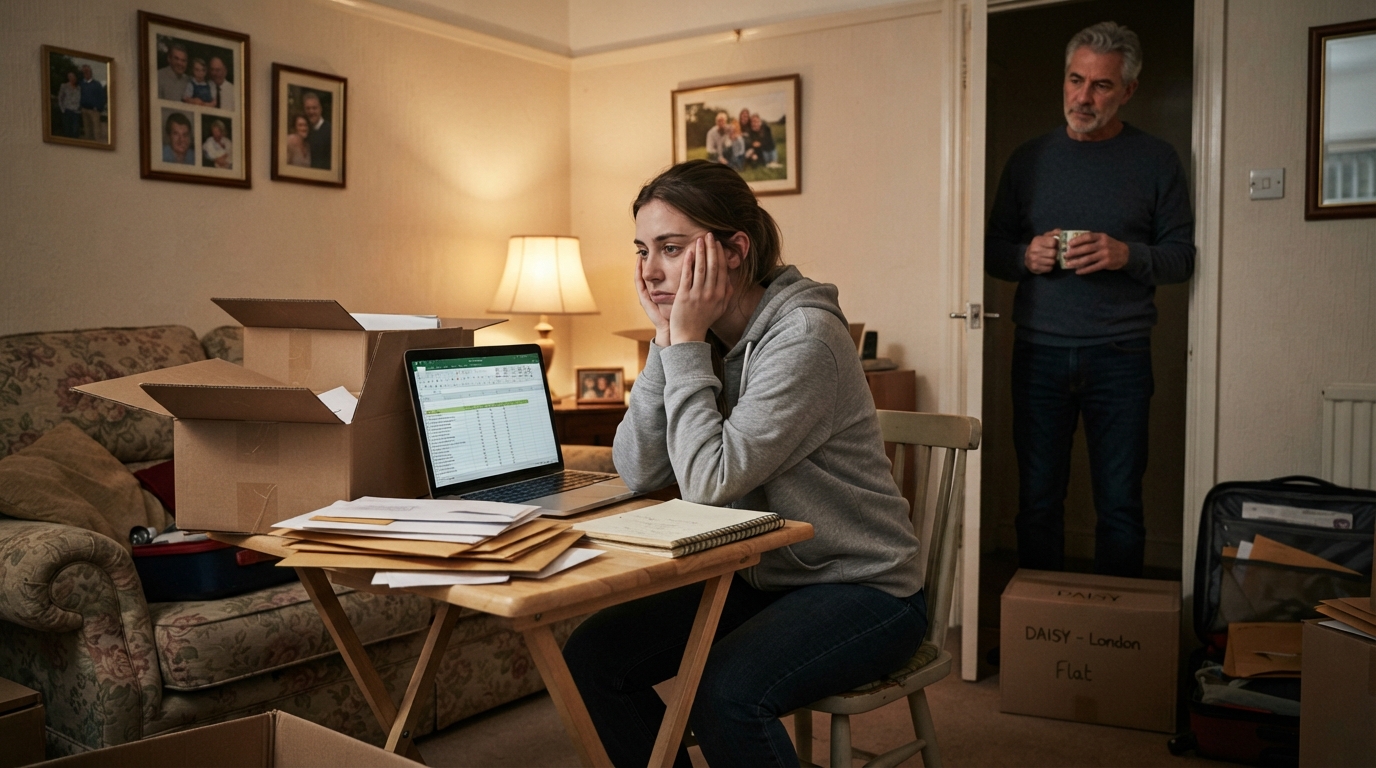
Daisy Edwards, 25, returned home to her parents in Guildford after losing her job in London. She recounted, "When I lost that job, I immediately started job searching and that was when it became clear quite how fleeting that London lifestyle was. I think it was pretty instant that I ran out of money. I'd had a few job interviews but I really committed to job searching. I was applying for maybe five or six jobs a day sometimes. I think it can really get you down and the longer you are unemployed the more you worry about things, like you don't want to pay to go out."
Dave, Daisy's father, observed, "That's a big difference to me having worked in the same company for 32 years. I've only ever had one job interview and I'm still there. The amount of job applications [Daisy] did was crazy. You had that spreadsheet. And often people don't get back to you. I would not like that."
While data clearly shows that 25-year-olds currently in work are likely earning more than their parents did at that age, and significantly more than their grandparents, the substantial wage growth for 25-year-olds from the 1980s to the early 2000s, reaching an average of £28,526, has ceased.
"The big picture is stagnation," stated Jonathan Cribb, deputy director of the IFS. "It's not that these people are worse off than those that came before them, but it's that they're no better off and that progress has stalled."
Those born between 1987 and 1991 entered the workforce just after the financial crash and experienced a significant drop in earnings, receiving the lowest average wages of any 25-year-olds over the past three decades. Since then, wages for 25-year-olds have slowly recovered, almost reaching the level of 20 years ago. Waves of economic shocks, the pandemic, and the cost of living crisis mean that inflation-adjusted wages for 25-year-olds are only just above £28,000 now, with this stagnation hitting those at the beginning of their careers the hardest. Society often expects each generation to surpass the previous one, and when reality diverges from these expectations, disappointment is inevitable.
Rachel Diamond, 23, moved from her family home in Oldham to Portsmouth to pursue her dream job as a graduate engineer, earning in the early £30,000s. She commented, "I was quite lucky when I got my job straight after uni. So I've kind of done everything right, but still I'm not saving any money from my paycheck, like months and months, just because it's so expensive with renting and bills. I don't think people realise how expensive it is to rent. That's the thing, like council tax, you only get 25% discount, so that's expensive on my own. Again, that's a choice, living on my own, but still."
Rachel's father, Paddy, recalled, "When I started out in work I was in a similar situation to Rachel. I moved away from home and I lived on my own because I didn't know anybody where I was moving to, and certainly it was hard for me, and it seems to be, equally as hard, if not, well, probably harder for Rachel. I bought my first flat when I was in my early 20s. I was earning £20,000 a year and my first flat was £36,000."
The hope remains that Gen Z will still achieve these milestones, perhaps just a little later, and that salaries and employment rates will improve as this group progresses into their 30s. For this generation, recognizing the new landscape they face means direct comparison is impossible. Many have adopted a new mindset, holding societal goals more loosely and learning to thrive amidst shifting circumstances.
Shahida, 22, exemplified this approach during her job hunt. Before securing her desired role in the Ministry of Justice, she described the search for work as requiring "a lot of resilience." She added, "It did result in a lot of tears and a lot of self-doubt at the beginning and I think that's completely normal and it's part of the process." While Shahida hopes she doesn't take her job for granted, she expressed, "I'm happy to say that I work in a place that I really enjoy."
This story raises important questions about the challenges faced by Gen Z. Further exploration into topics such as why Gen Z is planning for life without a state pension, the rise of the multi-job workforce, and 20-somethings juggling three jobs to make ends meet provides additional context to these issues.