

“Tashkent is a city of many layers.” Software developer Maria Shinkareva on relocating from Saint Petersburg, restoring a Soviet-era apartment, and learning Uzbek
Maria Shinkareva is a development lead in IT, a traveler, and someone who loves restoring old apartments. Three years ago, she and her husband moved from Saint Petersburg to Tashkent. As part of the Incomers project, she talks about building a life in a new city, learning Uzbek, discovering local culture, and why she sees Tashkent as a city of many layers.
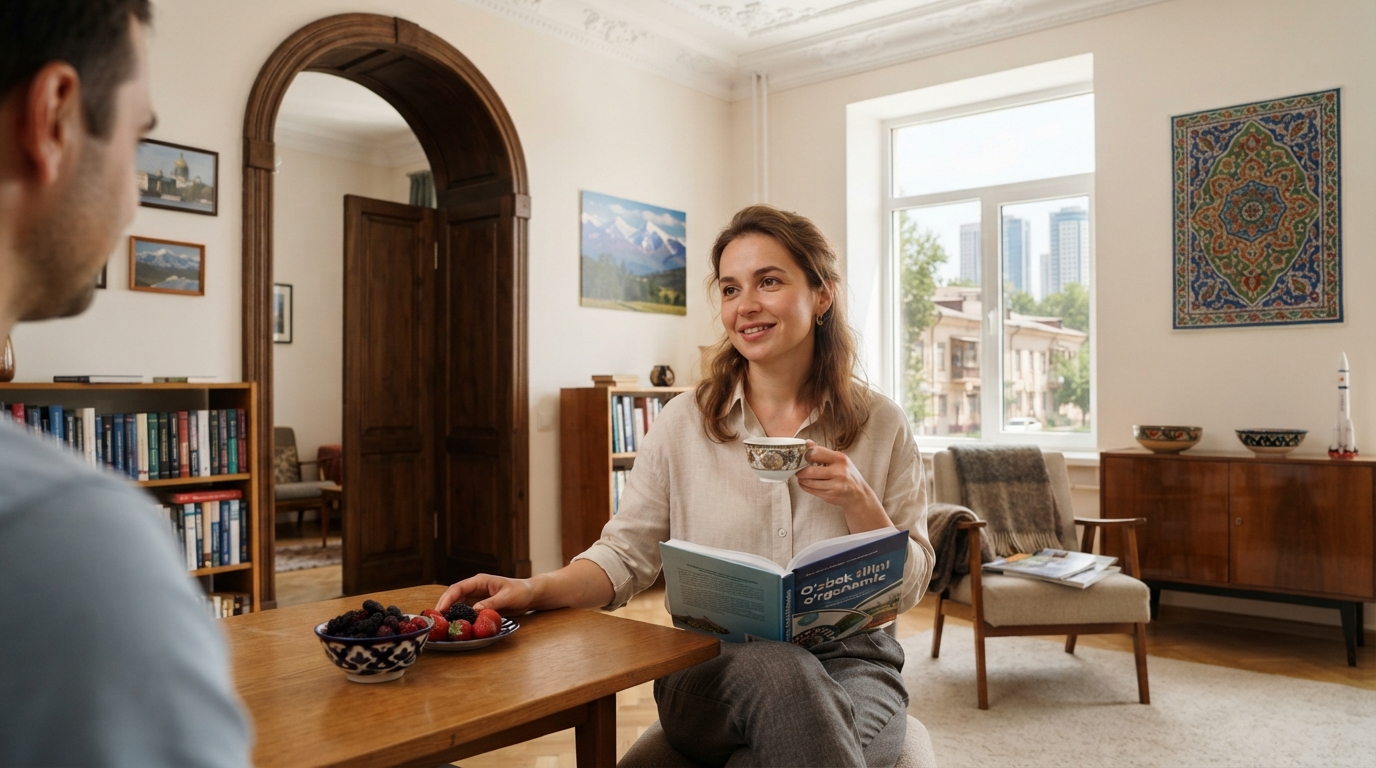
"Tashkent is a city of many layers," states software developer Maria Shinkareva, reflecting on her move from Saint Petersburg, the restoration of her Soviet-era apartment, and her journey learning Uzbek.
"The Incomers" is a collaborative initiative by Gazeta and New Uzbekistan University. This project stems from a natural curiosity about expatriates who have chosen Uzbekistan as their home. Through these dialogues, the aim is to understand their reasons for coming and staying, what they cherish about the country, what they learn from Uzbekistanis, and the changes they hope to witness.
I was born and raised in Shymkent, a small city in southern Kazakhstan, located 120 kilometers from Tashkent. Both cities share very similar climates.
My father was born in the Far East, but his family's roots trace back to Central Asia, specifically Talas in Kyrgyzstan, dating to the era of Catherine the Great. My grandfather was fluent in five Central Asian languages.
My mother hails from Shymkent. Her aunt, a Russian language and literature teacher, resided in Tashkent, while her uncle, a doctor, lectured in psychology at a university. As a teenager, my mother frequently visited them, making the city familiar to her by the time she enrolled at Tashkent State University (now the National University of Uzbekistan named after Mirzo Ulugbek) to study mathematics. She later transferred to the Shymkent Technological Institute.
As a child, I also visited Tashkent when border crossings were relatively easy. We would go to see my aunt's family.
I completed my schooling in Kazakhstan, in a class of just eleven students. Many were of mixed heritage, meaning the number of nationalities actually surpassed the student count, including Germans, Tatars, Koreans, Uzbeks, Russians, and Poles.
Growing up, multiculturalism was my norm.
At 17, I moved from Shymkent to Saint Petersburg. I enrolled at the Baltic State Technical University “VOENMEKH” named after D.F. Ustinov, often referred to as the “Saint Petersburg Bauman” (a nod to the Bauman Moscow State Technical University). I spent five years in the Department of Plasma Gas Dynamics at the aerospace faculty, specializing in hydroaerodynamics.
In essence, hydroaerodynamics is the study of how liquids and gases move, with applications in aviation, space exploration, and construction. For instance, launching a rocket requires calculating airflow around its body. When designing a high-rise building, understanding wind's impact on its structure is crucial. Any object moving through air or liquid necessitates these types of calculations.
During my studies, I worked with Navier-Stokes equations, fluid flow, and turbulence.
I graduated with honors.
At the graduation ceremony, I had the privilege of firing a cannon at the Peter and Paul Fortress, an honor reserved for the faculty's top graduate.
Postgraduate study was the natural next step, but I recognized my lack of patience for academic research. More importantly, I had no desire to pursue it.
A scientist is someone capable of working for extended periods without immediate results.
Thomas Edison experimented with thousands of approaches before inventing the light bulb, which demands a completely different mindset. After graduation, my options were to join a scientific research institute and gain clearance for classified projects, or to pursue an independent path. As it turned out, research institutes exclusively hired Russian citizens, and at the time, I only possessed a residence permit. While my citizenship was being processed, I began working in commercial IT, a field not particularly prestigious back then. And that's how it captivated me.
My husband, Alexander, has dedicated his entire career to game development. In 2022, East Games invited him to Uzbekistan for an internship as they were expanding their office. Soon after, he was offered the opportunity to lead and build the development team from scratch, which is every manager's dream.
He asked, "Shall we live there for a couple of years?" I replied, "Sure, no problem."
Back in Russia, I worked across various IT companies, including Yandex.Money Walley, VKontakte, Mail.ru, Arrival, and the esports organization Virtus.pro. I held diverse roles, from individual contributor positions to management. Several of these companies were international, entailing work trips to Serbia, Kazakhstan, and Israel.
After moving to Uzbekistan, I joined Playrix, one of the world's largest mobile game developers. I led the release team for an app with 600 million installs. The work was relentless, leading to severe burnout. I left the company with immense relief, deciding to take some time off to clear my head.
While browsing a local community group, I came across a developer vacancy at Road24. Uzbek language skills were listed as a requirement, and initially, my application wasn't even considered. However, they invited me for an interview anyway.
"We require knowledge of Uzbek," they stated firmly.
"O'zbek tilini ozgina bilaman, o'rganayapman [I know a little Uzbek, I'm learning]," I responded.
"O! Gap yo'q! [Oh! No problem!]," they exclaimed, visibly surprised.
Language invariably opens doors.
Road24 is a driver-focused app in Uzbekistan. While widely known for traffic fines, it has evolved into a comprehensive ecosystem for drivers, boasting 7 million installs and 3 million active monthly users, almost entirely without marketing expenditure.
I joined a year and a half ago and was entrusted with the entire development function. We launched an auto-signal feature that allows users to contact a car owner by plate number without revealing their own phone. We integrated parking services, added insurance purchasing, and developed a unified protocol for OSAGO, compulsory third-party liability insurance, covering all insurance companies. We launched Yordam, a roadside assistance service offering tow trucks and tire fitting at fixed prices. And we built a car marketplace. One large holding company spent a year and a half developing a similar app with a team of 60. Our team of three accomplished it in three weeks.
The company comprises approximately 20 individuals in total, most of whom are Uzbekistanis. This is a deliberate choice. We are building for people who live here, so it's important that the team actively uses the product.
When you build something you use every day, you almost always make it better.
Most of the team speaks three languages; some speak only Uzbek. The dynamic works. There are individuals from traditional backgrounds alongside those with entirely secular outlooks. Somehow, we make it work.
We share the same world and we make it work.
That said, the CEO and I took time to find our rhythm. We are both direct, both willing to emotionally argue for our positions. The main disagreement revolved around schedules. He believed in discipline and showing up at nine. I believe in accountability for output, not hours spent in a seat.
I have no interest in "monitor guards."
Eventually, we resolved it and made it official. People had already been coming in a little later, but now it is formalized. At 10 a.m., we conduct a standup: everyone joins, syncs on tasks and blockers, then works in a way that suits them best. I grant the team as much freedom as possible. In return, I expect results.
Over the past year, many acquaintances have reached out with questions about Uzbekistan. How do payment systems operate? What is the tax situation like? How does one enter the market? New legislation continues to emerge, including frameworks based on English law, which is attracting foreign companies.
I have spent time in the UAE and Saudi Arabia, and while they are currently popular with high salaries, I find them genuinely uninteresting places to live. I would only relocate there for a truly exceptional job offer, the kind that arises once in a career. Tashkent is the opposite. Every weekend, my friends and I coordinate: where are we going, who has plans?
The issue is never having nothing to do. It is having too many options.
Competition fosters improvement. Consider what happened with Russian banking apps. The banks pushed each other to develop superior products, resulting in one of the world's most sophisticated financial app ecosystems. When companies compete instead of hindering each other, everyone benefits.
Once it became clear we were staying in Tashkent, we began seriously considering purchasing a property. Our IT visas permit non-residents to buy property without a minimum price threshold. We looked at an apartment near the Northern Station, then walked into a 1939 Stalin-era building on Nukus Street—and something just clicked! It's hard to explain, but we both knew immediately. Three days later, we had signed. We moved in six months after that, in August 2024.
Renovations have always been my outlet.
I've been doing them my entire life: my own apartment in Saint Petersburg, my mother-in-law's place, my parents' home in Shymkent. I love bringing old buildings back to life. I can spend hours watching DIY and upcycling videos online.
Finding an apartment with a finished renovation you wouldn't want to redo is nearly impossible. Everyone has their own taste. And I have a very specific vision for how things should look: completely clear countertops, no hanging utensil racks, a proper storage room, a separate walk-in wardrobe. Starting from scratch is simply easier, and significantly cheaper.
The doors proved to be the most challenging aspect. We wanted to restore the originals, but the workers we hired were unreliable. They were enthusiastic at first, but then started skipping days, juggling multiple sites, losing track of time. I eventually asked my mother if I could borrow my father for a week. He's a builder, and nobody gets away with cutting corners around him. In that one week, they painted every room, installed two walk-in wardrobes, hung all the doors, and grouted all the tiles. We finally moved in.
Some time later, through what Uzbeks call *tanish-bilish* (connections through mutual acquaintances), we met Bakhtiyor-aka, a craftsman widely known within a small circle of informed individuals.
He immediately understood when I expressed my desire not to discard the original door. He sourced larch floorboards, joined them together, and produced a countertop that cost a quarter of what a solid piece would have. He restored a mirror for us. He is currently constructing a sideboard from pieces found at the Yangiabad market. Now, we share him with friends on a rotating basis. We message each other: "Are you done with Bakhtiyor-aka? Can I have him back?"
A community of 500 people has formed around the renovation project in a Telegram group.
We share tips and recommendations on where to find things, and what to avoid. Everything exists in Tashkent; you just need to know where to look. After a renovation, you often end up with leftover paint, tiles, or fittings that someone else could use. In Russia, this kind of exchange is common on Avito. Here, that culture doesn't really exist yet.
Tashkent is a city of layers.
There's Eski Shahar, the Old City with its traditional *mahallas* (residential neighborhood communities). There's the sleek, modern Tashkent City district. There's the quieter, more lived-in Nukus Street, the Gospitalny bazaar, the Ankhor canal. The city is a melting pot where everything converges. I love being part of that mix.
I don't quite feel like I belong here yet, but I no longer feel like a tourist either.
Four years in, I've become a little bit "Tashkenti." What makes this city unique is that it was once crisscrossed with canals and *aryks* (irrigation channels). Even now, on the hottest days, the air along the Ankhor drops noticeably, and I wish there were more places like it, with water and trees.
When friends visit, I take them on my favorite route. We start at Ming Urik, then walk to the building at 45 Amir Temur Avenue, an architectural landmark from 1927 that local residents saved from demolition. From there, along Taras Shevchenko Street to the Zhemchug building, then along the Ankhor canal past the old nomenklatura apartment blocks to Navrus Park. And always: Khast Imam, the Kalkauz mahalla with its canals, and the Chorsu bazaar. The route can total around 30,000 steps, and my guests often finish it completely exhausted.
I often observe low-rise historic buildings being demolished to make way for high-rises. It happens across different parts of the city. And yet, these are precisely the kinds of buildings that attract tourists—the way they do in Darkhan, for example.
They should be preserved and restored, not torn down.
Tashkent is a walkable city if you have something to compare it to.
In Saudi Arabia, the nearest pedestrian crossing can be five kilometers away. Kuala Lumpur and the UAE are not designed for walking, and the heat exacerbates the issue. Here, I can reach all my favorite spots on foot without any effort. Shota Rustaveli Street has been properly renovated. You walk along it, and it's all green.
People say the city is tilting toward cars: too few traffic lights, too many uncontrolled crossings. That's true. Could it be better? Yes. Should it be? Absolutely. Pedestrians vastly outnumber drivers in this city, and it ought to reflect that.
Driving should be costly and inconvenient; public transport should be genuinely good; and walking should be accessible to everyone.
I take the metro myself sometimes. It gets me from A to B, and that's sufficient.
I tried Uzbek language classes, but I found they focused too much on grammar and vocabulary that rarely appears in real-life conversations. So, I conducted my own research instead. I asked several non-Uzbek people who spoke the language fluently how they had learned it. Three patterns consistently emerged: military service, studying in an Uzbek-language college group, or simply growing up in a *mahalla*. Of those, the one that suited me most was simply talking to people.
I posted on Threads saying I was looking for an Uzbek-speaking friend to walk around the city and practice the language with. I received around a thousand replies! One of them was Umida: vivid red hair, highly educated, works at an embassy, deeply versed in Uzbek literature and culture, and currently appearing on an Uzbek-language reality show. After our first meeting, I had nearly a full reading list.
Something I've noticed about Tashkent is how little distance there is between people.
In Saint Petersburg, people are more like coconuts: hard on the outside, soft once you get through. Here, there's no shell to crack. You run into someone a couple of times, and you can already invite them for a walk or to come over. I love that.
Speaking the language changes things.
Not that people become more hospitable, but there's a warmth that comes through. At the market, when I speak Uzbek, people treat me differently. More respect, more willingness to help.
For now, I learn as I go, a word or two a day. My colleagues are happy to fill in gaps and share bits of culture along the way. Uzbek-language content has started appearing in my feeds too. I've even attempted local films.
The first one I ever watched was back in 2009, in Saint Petersburg—*Super Kelinchak*. I still recommend it to anyone wanting an entry point into Uzbek culture. I also remember *Fatima va Zuhra*, *Tashlandiq*, and old Soviet films set in Tashkent.
For reading, I love Dina Rubina's novella *On the Sunny Side of the Street* and the series based on it, which follows people evacuated from blockaded Leningrad to Tashkent. The story unfolds on Amir Temur Avenue. They arrived at the Northern Station, walked down that street, and searched for rooms. I read the book and watched the series back in Saint Petersburg, never imagining I would one day live right there. Quite a coincidence. There is also Abdullah Qodiriy's novel *Days Gone By*, which opens at Ming Urik, the very same spot where my favorite walking route for guests begins.
I assumed moving here would hold no culinary surprises. I was wrong.
*Shivit osh*, *manpar*, *mastava* are dishes I had never even seen before.
*Sumalak* isn't really a thing in Kazakhstan. Neither is *nishalda*. Cross the border into Kazakhstan, and you find *kumiss* and *shubat* sold along the roadside. In Uzbekistan, *kumiss* is far less common, but I love how *ayran* is made here: *suzma* thinned with water, served over ice with basil, apple, and cucumber. I've taught everyone I know to make it that way.
I've loved cooking since childhood. Growing up in Shymkent, I was constantly sent to the bazaar with a list that always included *morkovcha* and glass noodles from the Korean stalls. You can find all of that here too. At home, I cook sous vide meat and make soups with Thai tom kha paste. The kitchen is one of my favorite rooms in the apartment.
I shop around. Korzinka for soy milk and tofu, Chinese grocery shops for dried soy protein *fuchu*, and the Gospitalny market for edamame. I am pescatarian. I don't eat meat. Never liked the taste, the smell, or the texture. My mother took me to doctors until I was six, until one of them finally told her: "Leave the child alone. Let her eat what she wants."
In a country where national cuisine is built largely around meat, the Uzbek phrase I use most often is: "*Go'shtsiz bormi?*" [Is there something without meat?] It's not a problem, though. I get plenty of protein.
My favorite dish is *manty*.
I make them with potato for myself and with finely diced meat for everyone else. That tradition dates back to Saint Petersburg, when my mother saw me off to get married, she brought a *manty* steamer and a *kazan* (traditional Central Asian cooking pot) all the way from Kazakhstan.
When my parents visit, I try to impress them with molecular gastronomy restaurants, the kind of sushi bars that are currently popular. My father always compliments the food, then adds, without fail: "Still, our own food is the best."
For everyday meals, I love what my colleagues call *milliyki*: simple, no-fuss restaurants serving traditional food. My regulars are Anjir, the kurutob place on Shota Rustaveli Street, Bukhara Premium, and Afsona on Shevchenko. I also stumbled across a spot on the Ankhor near the Olympic Glory Museum. You push through some overgrowth and find yourself at the old Al-Aziz shashlik spots right by the water.
Uzbekistan has so many regions, each with its own food culture, and that deserves to be celebrated and shared more widely. In Khiva, we took a class on making *shivit osh* and Khorezm-style bread. In Bukhara, we learned to make green plov with basil and liver. Tashkent could use more of that.
People say: don't confuse tourism with emigration. Honestly, I cannot point to anything here that has been genuinely difficult. Before moving, my husband and I had traveled a lot and learned to adapt quickly. We feel that Tashkent has everything you need for a comfortable life—even the director of our favorite clinic in Saint Petersburg has since opened a joint practice here with a local doctor.
My husband found a Warhammer community here. They hold painting days and travel to competitions in Kazakhstan. I joined a philosophy club from Threads, where we discuss philosophical ideas and theories, sometimes for six hours straight.
Who knows where I will be in ten years. But while I am here, I want to help build IT alongside local teams, grow the DIY community, keep learning Uzbek, and absorb as much of the local culture as I can.
The idea of "bloom where you're planted" has never resonated with me.
I have been to 58 countries and lived in Kazakhstan, Russia, and even spent a month stranded in Oman during COVID. Every place has left something behind, shaped the way I see the world. That, I think, is the most interesting thing that can happen to a person.
— The first Uzbek word you learned?
— I already knew some Kazakh, so I arrived with a basic set: "Assalomu alaykum" [hello], "Yaxshimisiz?" [how are you?], "Charchamayapsizmi?" [are you tired?], "Tuzukmisiz?" [all good?], "Mayli" [okay/alright], "Xo'p bo'ladi" [agreed/okay].
— Favorite season in Tashkent?
— Spring, without doubt, when Isabella strawberries and mulberries come into season. I cannot walk past a mulberry tree without stopping. Autumn is wonderful too; it runs long and warm here. And I love winter for skiing and snowboarding in the mountains.
— An Uzbek dish you still haven't got used to?
— *Tuxum barak*. I tried it at a wedding in Khorezm and again in Tashkent. *Shivit osh* I loved immediately. *Tuxum barak*, not so much.
— How has Tashkent or Uzbekistan changed you?
— Here, it feels completely natural to message a stranger: "We have so much in common. Want to grab a coffee?" and actually meet up. Getting to know someone on a tour or at a bar and staying in touch is just how things work.
My friends and I have even developed our own tradition. We hold a "Gap" (a traditional Uzbek social gathering where members take turns hosting) every Friday. And *tanish-bilish*, in the best sense, has become second nature. In whatever the situation, the first thought is always who you know, who might have advice, or who could help.