

Spain threatens retaliation if Italy fails to lift border controls after Ceuta crossings
Spain said Italy had been "unjustified" for taking border action after the mass crossing of migrants from Morocco last week.
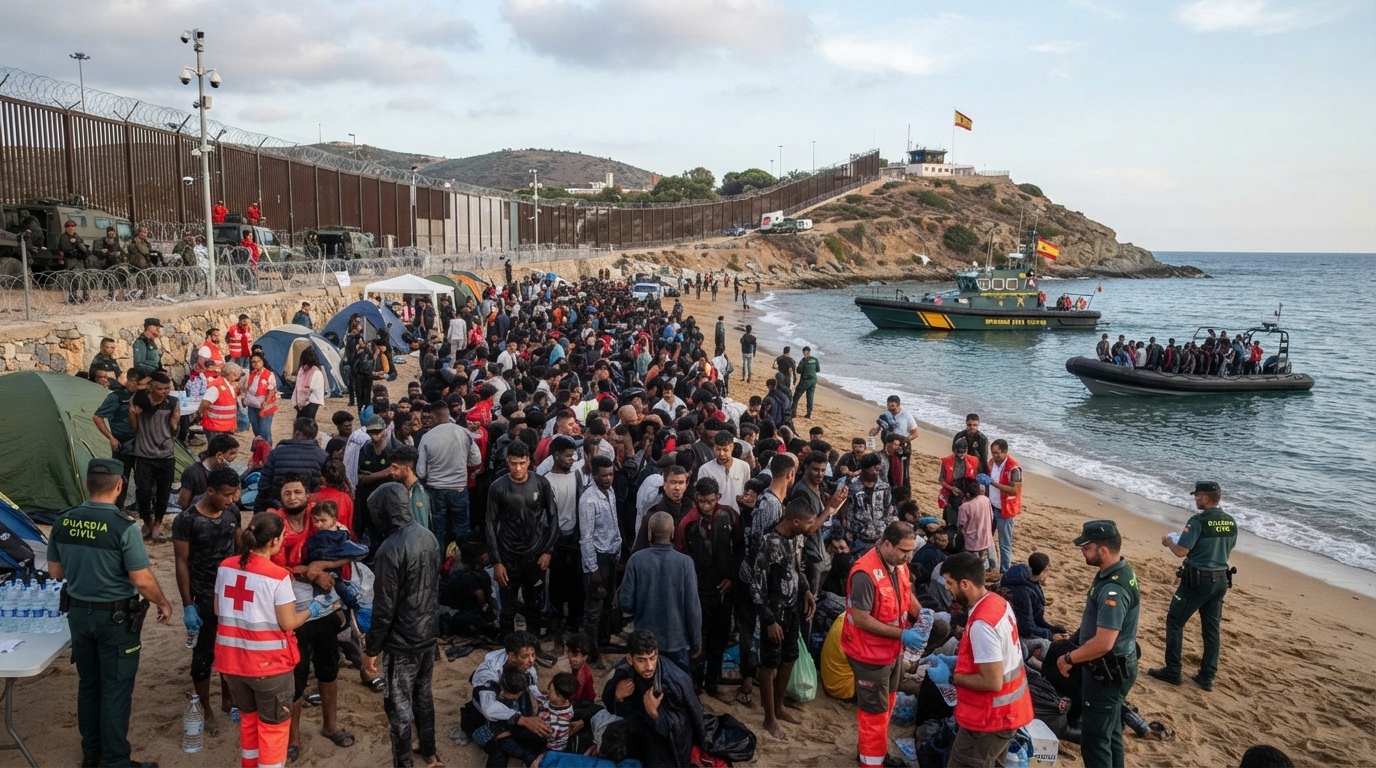
Spain has issued a warning of retaliatory measures against Italy if it does not revoke the border controls implemented in response to the recent influx of migrants into the Spanish exclave of Ceuta.
Images showed hundreds of migrants gathered on a Ceuta beach, awaiting aid.
Last week, approximately 78,000 migrants from Morocco reached Ceuta by sea within a span of hours on Thursday and Friday. Following these crossings, which reportedly resulted in around 100 fatalities, Italy partially suspended its Schengen agreement with Spain. This suspension involved closing maritime and air entry points and strengthening land border security.
On Friday, Spain condemned Italy's actions as "unjustified" and "discriminatory against the Spanish population," demanding their reversal by Sunday, August 9. Spain stated it would enact "proportionate measures to protect the interests and dignity of its citizens" if Italy failed to comply, though the specific nature of these reprisals was not disclosed.
(Video footage showed migrants returning to Morocco after thousands entered Spain's Ceuta on July 30.)
Italy, which does not share a land border with Spain, justified its partial suspension of the EU's border-free Schengen arrangements by citing a need to prevent migrants who had entered Ceuta from traveling onward to Italy. Madrid rejected this explanation, labeling it as based on "spurious arguments" lacking factual basis, given that the migrants in Ceuta had no means of entering the Schengen area. Spain also noted that the vast majority of migrants have already returned to Morocco.
Italy has yet to respond to Spain's demands.
The events of last week have further strained relations between Spain's socialist leader Pedro Sanchez and Italy's conservative leader Giorgia Meloni, who has consistently advocated for stricter migration policies within the EU.
The precise reasons behind the mass attempt by tens of thousands of migrants to cross into Ceuta remain unclear. However, EU Migration Commissioner Magnus Brunner has suggested that criminal networks spreading disinformation are responsible, a view shared by the Spanish government.
These crossings occurred after Spain's Supreme Court ruled that migrants intercepted at sea while attempting to reach Ceuta or Melilla cannot be summarily returned to Morocco. The two exclaves have long been a source of diplomatic tension between Spain and Morocco, as Morocco does not acknowledge Spanish sovereignty over them.
The sheer number of people swimming to Ceuta simultaneously has raised questions regarding the lack of intervention by Moroccan border guards.
The Ceuta crossings have also created a diplomatic rift among EU nations that are part of the open-border Schengen area. Italy's decision to suspend its agreement received support from Finland and Denmark, while the Czech Republic proposed a temporary suspension of Spain's membership.
Morocco, for its part, has attributed blame for the crisis to Spain's Supreme Court. An unnamed Moroccan government source reportedly told local media that "the deterrent element of the system collapsed and the dam gave way, not under the weight of the criminals, but of a judge's decision."
Meanwhile, Moroccan media reports indicate new online calls for coordinating another mass border-crossing attempt, similar to the one preceding last week's influx.
As of Friday, nearly 1,400 minors, including "very young boys and girls," remain in Ceuta following last week's crossings, according to Spanish Youth Minister Sira Rego. She stated, "There was a situation in which the system was overwhelmed, but it is now being brought under control. It is true that there are many boys and girls, and the procedure takes time. We wanted to make clear that we have prioritized the most vulnerable cases."
(The EU has called for stronger borders after the Ceuta migrant crossings. Spain's PM has blamed traffickers after 60,000 migrants reached Ceuta from Morocco. The crisis has also generated a political storm, amplified by social media.)