

Saudi Arabia's dilemma as it tries to stay out of US-Iran war
The kingdom faces a choice of whether to keep hitting back as a deterrent or to try to de-escalate the situation.
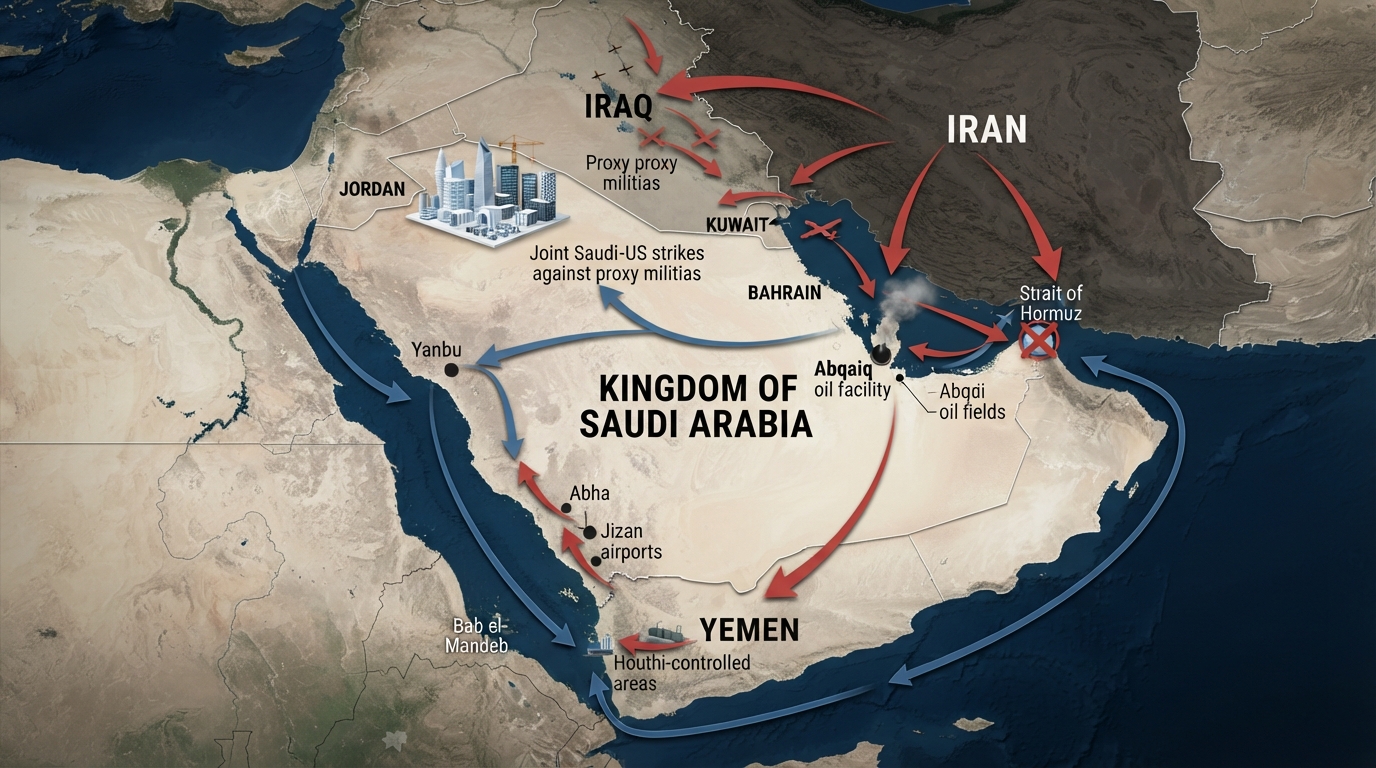
Saudi Arabia finds itself in a precarious position, striving to remain disengaged from the ongoing conflict between the US and Iran. This challenge comes as the nation pursues its ambitious "Vision 2030" agenda, spearheaded by Crown Prince Mohammed Bin Salman.
Since the US and Israel initiated hostilities against Iran on February 28, Saudi Arabia has largely sought to avoid direct involvement. However, recent attacks from three distinct fronts have prompted a shift in their stance. This week, Saudi forces collaborated with the US in joint strikes against Iranian-backed proxy militias in Iraq, believed to be responsible for drone attacks on the Kingdom.
The current dilemma for Saudi Arabia is whether to continue retaliating as a deterrent or to seek de-escalation, potentially through financial incentives to adversaries.
To understand the dynamics of the conflict, it's essential to outline the key players. The five-month-long conflict in the Gulf and wider Middle East broadly involves two sides.
On one side is Iran and its Islamic Revolutionary Guard Corps (IRGC). Their allies include the Houthis in Yemen, a tribal group that seized control of much of the country in 2014. Also supported by Iran are Iraq's Popular Mobilisation Forces, a paramilitary group accused of 30 drone strikes on Saudi Arabia and now targeted in return. Hezbollah in Lebanon, though currently subdued, remains a significant force.
Opposing this alliance is the US, with its formidable Central Command (Centcom) forces, alongside varying degrees of support from Gulf Arab states and Jordan. Israel, a close US ally, is not actively participating in this particular conflict.
Iran has recently focused its drone and missile attacks on Jordan, Kuwait, and Bahrain, in addition to targeting commercial shipping attempting to navigate the Strait of Hormuz while circumventing Iran's new regulations. The involvement of Iraqi militias and the Houthis in Yemen is a relatively new development, highlighting the risk of the region becoming further entangled in a widening conflict without a lasting peace agreement between the US and Iran.
Several factors underpin Saudi Arabia's efforts to avoid a full-scale conflict. Crown Prince Mohammed Bin Salman's "Vision 2030" aims to diversify the Kingdom's economy away from oil dependence, fostering modern domestic industries to create jobs for its burgeoning youth population. This initiative relies on attracting foreign investment and developing vulnerable infrastructure like data centers. Such goals are jeopardized by persistent threats from Houthi drones across its southern border or ballistic missiles directly from Iran.
A stark reminder of this vulnerability occurred in September 2019, when an Iranian proxy militia in Iraq launched a drone fleet at two vital Saudi oil facilities, Abqaiq and Khurais. While initial suggestions pointed to Houthi involvement, evidence at the scene indicated the attacks originated from the north. This incident, which temporarily halved Saudi oil exports, served as a critical wake-up call regarding the susceptibility of its national infrastructure. On Monday, satellite imagery confirmed the Abqaiq oil facility was again struck by drones from Iranian proxy militias in Iraq.
Oil remains the cornerstone of the Saudi economy. In February, Iran retaliated against US and Israeli attacks by effectively closing the Strait of Hormuz, a crucial shipping lane through which 20% of the world's oil and liquefied natural gas transits. In response, Saudi Arabia maximized oil exports—approximately five million barrels per day—via its east-west pipeline to its Red Sea export terminal at Yanbu. From there, tankers transported the oil south into the Arabian Sea and on to Asian markets.
However, on July 13, Saudi Arabia bombed Sanaa airport near the Yemeni capital. Yemen's Saudi-backed government claimed responsibility, stating its intent to prevent an Iranian plane from landing. In retaliation, the Houthis attacked Saudi regional airports at Abha and Jizan. More concerning for Riyadh, the Houthis have begun targeting Saudi shipping in the Red Sea, making passage through the narrow Bab El Mandeb strait at the southern end of the Red Sea extremely hazardous. This, in turn, threatens to choke off Saudi oil exports to Asia.
Saudi Arabia's seven-year campaign to subdue the Houthis proved unsuccessful, leading to one of the worst humanitarian disasters of our time. In 2022, an uneasy truce was reached with the Houthis, reportedly involving payoffs. Yet, Saudi Arabia, the region's wealthiest nation, now faces renewed drone and missile threats from its southern neighbor, concurrently with attacks from Iraq to the north—a scenario not envisioned in the "Vision 2030" plans.