

Roadworks company fined €1.2m after father and two children died in lough
John Mullan and his two children died after their car went off the road and plunged into Lough Foyle in 2020.
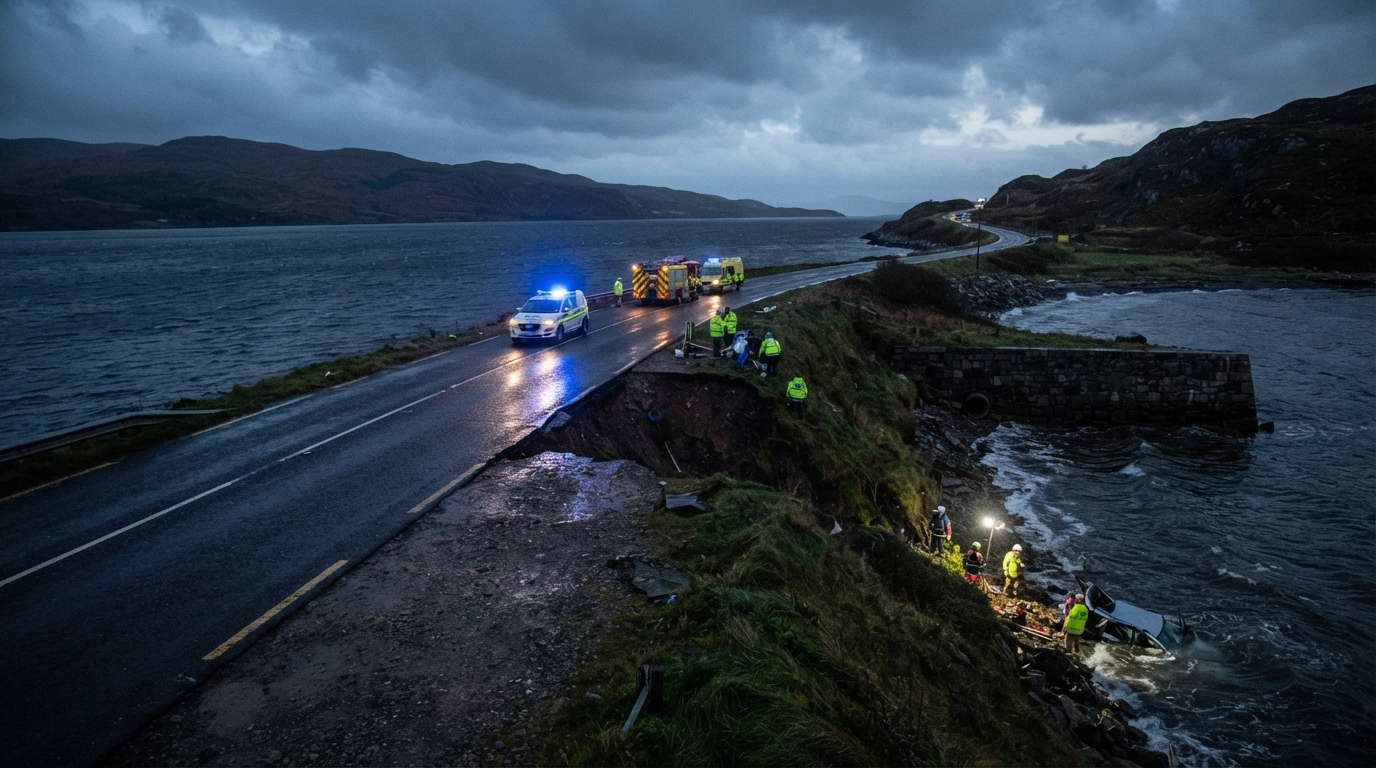
A roadworks company has been fined €1.2 million at Letterkenny Circuit Criminal Court after pleading guilty to health and safety breaches that led to the deaths of John Mullan, 49, and his two children, six-year-old Amelia and 14-year-old Tomás.
Judge Roderick Maguire stated that the fatalities were a direct result of the failures of Whitemountain Quarries Limited. The incident occurred in August 2020 when the family's car veered off the road at Quigley's Point in County Donegal and plunged into Lough Foyle.
John Mullan's wife, Geraldine Mullan, who survived the crash, described her immense pain and loss, calling it "a preventable road traffic accident." The judge emphasized that the company failed to properly manage the roadworks and protect the public, leading to the tragic loss of three lives. He acknowledged Geraldine Mullan's "great dignity" in court despite her "unbridled grief and loss."
Whitemountain Quarries Limited, now part of the Breedon Group, admitted to violating the Safety, Health and Welfare at Work Act 2005 during the R238 Greenbank Project at Three Trees, Quigley's Point.
Declan Carr, CEO of Breedon Ireland, offered a "clear and unequivocal apology," stating, "I know nothing I say can change your loss… we will carry the responsibility for it. I am truly, truly sorry."
Outside the court, Geraldine Mullan reiterated that her grief would be unending. The Mullan family had been returning home on August 20, 2020, after a day out in Londonderry when the accident occurred.
The court heard that the front passenger wheel of their car slipped onto the hard shoulder within the roadworks area. As Mr. Mullan tried to regain control, the car skidded across the road, went over an embankment, and entered Lough Foyle. A Forensic Collision Investigator's report confirmed that the car itself was not a contributing factor to the collision. A national storm warning was in effect in the Republic that evening.
Ms. Mullan testified that her heart was "broken into pieces" and her pain was "immeasurable." She told the court in her impact statement, "There is no end to my grief, I will never get over our accident. It will live with me for the rest of my days." She recounted the terrifying screams of her husband and children as their car plunged into Lough Foyle, overturned, and settled on the seabed.
She described being sucked out of the car's window into the water, then swimming back to the vehicle and attempting to cling to it, only to be pushed against a sewer pipe by strong waves. She climbed onto the car, screaming for her family, and tried to flag down passing vehicles. She noted that 20 to 25 cars drove by before a passing family finally raised the alarm.
Ms. Mullan was taken in a wheelchair to identify the bodies of her husband and children. "I remember I made a sign of the cross on each of their heads and kissed them once more. The night, its sounds, imagery and tragedy have not left me. It never will," she stated.
She shared that her husband, John, was due to turn 50 three weeks after the tragedy, and some of his presents remained unopened. "He made me feel safe and whole. I was a single parent when I met John. I thought I had found my happily ever after and I had, but I didn't get to keep it," she said. She expressed missing "everything about him," including his voice, music, holidays, date nights, and the way he made her feel like his "whole world."
Speaking of her son, Tomás, she said he filled her heart with love and pride, calling him her "firstborn, a beautiful boy and the light of my life." She noted his instant connection with John when he entered their lives, describing them as "two peas in a pod." She remembered Tomás, with whom she shared a love of photography, as "wise beyond his years" and someone whose "giggles could brighten any day." She highlighted his kindness, loving nature, and talent in music and sport, including playing the fiddle and accordion, and enjoying judo, chess, and sea scouts.
Her daughter, Amelia, was described as "a ray of sunshine" with "the most beautiful curls and a creativity that shone through everything that she did." Ms. Mullan cherished their "special mother-and-daughter time" on Sundays, lamenting, "What I wouldn't give for another Sunday morning with my little girl."
Ms. Mullan stated that she tried to save her family and that the night would haunt her forever. "Now, almost six years later, I still have flashbacks," she said, likening it to "a recurring nightmare or dream that I cannot wake up from."
Whitemountain Quarries admitted in court that it failed to manage and guide public traffic through the roadworks. The company had been resurfacing a 1.3km stretch of road for Donegal County Council. Despite adverse weather forecasts and being ahead of schedule, plans to resurface the hard shoulders were postponed until the following week.
The company acknowledged that its failure to manage traffic guidance resulted in the deaths of the three family members and Ms. Mullan's serious injuries, including multiple fractures. An engineer from Whitemountain Quarries had instructed a subcontracted company, responsible for the traffic management plan, to remove signage on the day of the incident, with Whitemountain Quarries indicating they would erect their own cones and signs.
The court heard that a stop-go system in place was lifted, and planned periodic spot checks over the weekend did not occur that night. Evidence presented revealed that the new road surface was at least 5cm higher than the hard shoulder, there were no central markings or visible cones on a section of the northbound carriageway, and the road had a very poor level of friction.
Whitemountain Quarries Ltd fully cooperated with the subsequent Health and Safety Authority investigation, had no prior convictions, and had not faced adverse attention since the incident. The company has since intensified its focus on health and safety.