

The country is home to some of the world's most unique species - but it is losing them at an alarming rate.
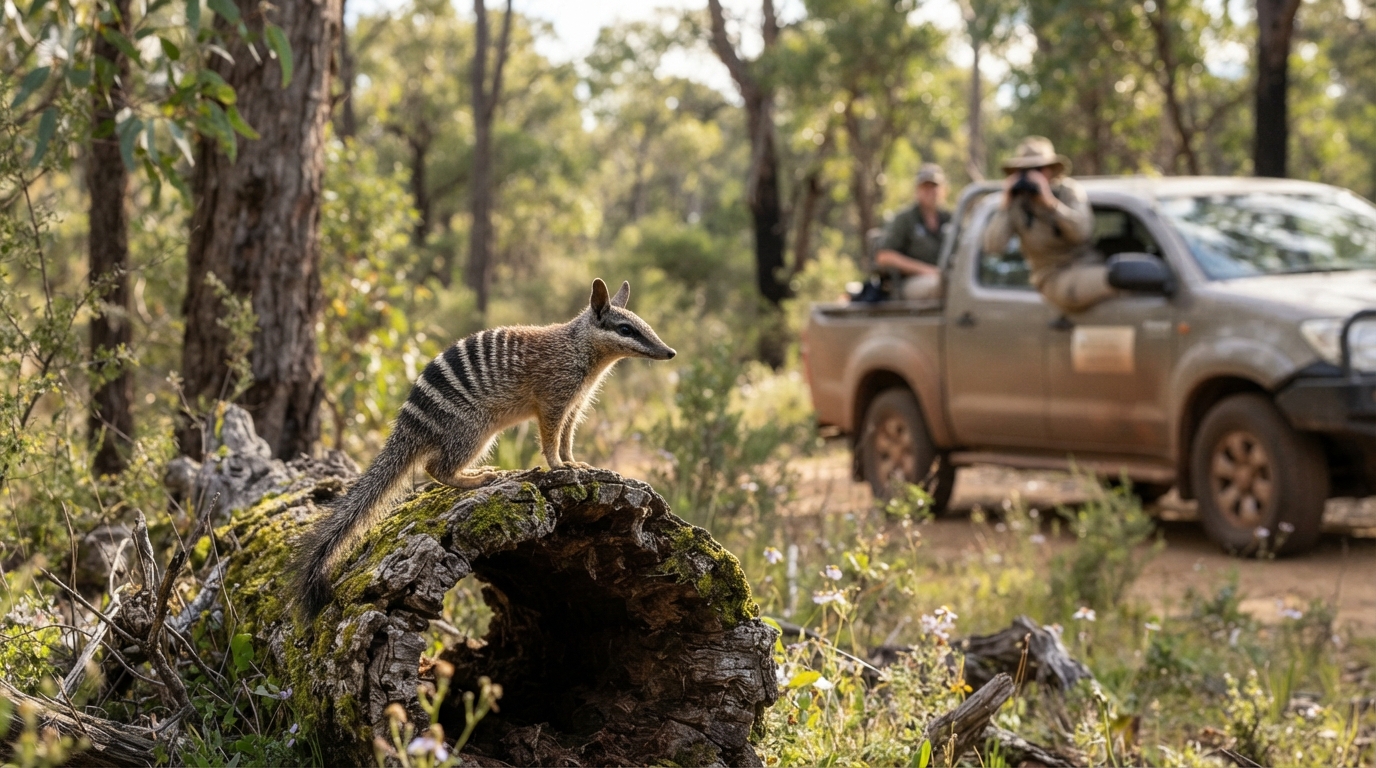
Australia, often called the world's extinction hotspot, finds a glimmer of hope in the recovery of one particular animal.
"Eyes peeled," the command rings out from the front passenger seat. We diligently scan the landscape—log ends, treetops, the spaces between low scrub and vibrant wildflowers—searching for a flash of stripes or a quick movement.
The elusive creature is the numbat, a rare Australian marsupial that appears to be a hybrid of a chipmunk and an anteater. Numbats once thrived across the southern half of the continent, but now Dryandra Woodland, located in Australia's southwest, is one of their last remaining strongholds.
As we slowly navigate the bush tracks, researchers explain how this annual expedition helps track the species' survival. Until recently classified as endangered, numbats have been making a comeback. The team's dedicated efforts have led to their removal from the international red list of threatened species—a rare positive development in a nation grappling with an extinction crisis.
This region of Australia is at the forefront of that crisis, serving as a final refuge for numerous species pushed to the brink by invasive pests, diseases, urban expansion, habitat destruction, and climate change. At one point, an endangered Carnaby's cockatoo soars above our vehicle. On a nearby island, one of the last remaining populations of the world's rarest marsupial, the Gilbert's potoroo, clings to survival. In the surrounding sapphire waters, the increasingly scarce Australian sea lion dives.
Dryandra Woodland is among the few places where wild numbats can still be found.
Australia has long been celebrated as a natural sanctuary, home to some of the planet's most unique plant and animal species, with over 80% found nowhere else. However, it has arguably become the global capital of extinction, losing approximately four species every decade, a decline that is only accelerating.
Dedicated volunteers and underfunded conservationists have been working to mitigate the growing array of threats, but experts fear that without urgent action and political resolve, the biodiversity Australia claims to cherish is headed for a catastrophe.
"It's not even a case of imagining it, it's happening in front of our own eyes," Professor Euan Ritchie tells the BBC.
Tony Friend has dedicated five decades to numbat conservation.
Spotting a rare creature in the wild is already challenging, but the numbat, a squirrel-sized master of camouflage, adds another layer of difficulty, explains Tony Friend, considered the godfather of conservation in Western Australia.
"They just slept in today," jokes Rob McLean, president of the Numbat Taskforce, a volunteer organization that significantly supports Tony's resource-limited work.
For two weeks each spring, as young numbats begin to emerge from their burrows, this team drives a daily circuit, recording every numbat sighting. They log GPS coordinates, measure the distance to the road, and use a complex formula to estimate the animals' density in these woodlands, which in turn informs broader population health assessments.
One person sits in focused silence at each window, another is positioned in the back of the pickup truck, ducking to avoid occasional tree limbs that branch out around us. Through the tree trunks, we catch glimpses of the cleared farmland that tightly borders this protected woodland. Along one trail, a machine detects and sprays feral cats and foxes with poison, a stark reminder of the dangers numbats face.
"This year's been a bit of a feast," Rob admits.
For hours, we cruise, observing parrots, wallabies, a goanna, and a couple of echidnas—but no numbats.
Tony arrived at Dryandra in the 1980s to find a numbat population of fewer than 50. Many of the threats then are the same ones driving extinctions across the nation today.
Vast areas of critical habitat are being cleared for development or industries such as farming, mining, and timber. Introduced pests—fire ants, cane toads, rabbits, foxes, and feral cats—leave a trail of destruction. Feral cats alone are estimated to kill three billion animals in Australia annually.
Invasive weeds like lantana are suffocating the Australian bush, chlamydia has pushed koalas to the brink of extinction in much of the country, and the skin-eating chytrid fungus has caused seven frog extinctions here, with more to come.
The changing climate is creating uninhabitable conditions for some species, such as native flying foxes, which are dying by the thousands due to extreme temperatures. For others, it eliminates their food sources or homes. Climate change also fuels natural disasters that incinerate and drown both plants and animals with alarming regularity. The infamous Black Summer bushfires of 2019-20, for instance, killed an estimated three billion animals. The subsequent years of record-breaking flooding were so widespread that their impact on wildlife is impossible to quantify.
The Carnaby's black cockatoo is another species barely surviving in southwestern Australia.
Many species once abundant across the continent are now confined to increasingly small and fragmented patches, with each impact compounding their vulnerability to the next.
Small, yet determined, efforts are underway to slow the momentum of decline. At Perth Zoo, as a young numbat devours its breakfast—custard with "termite sprinkles"—a keeper explains how this male's upcoming release at Dryandra will enhance genetic diversity. "When you get that feedback: your babies have got babies, it's very satisfying," says Vicki Power.
Breeding programs like this have also enabled the establishment of additional populations for various threatened species. However, many cannot survive in the true wild, where large-scale predator control remains an ongoing struggle. Instead, they are sent to fenced nature reserves, which themselves are high-maintenance endeavors facing issues like inbreeding and overpopulation.
Habitat protection and restoration projects have been increasing, but they are not keeping pace with destruction, particularly in the most critical areas. Scientists are also attempting to combat diseases, though this is an expensive and laborious undertaking that, for most species, only buys a little more time. Others are preserving genetic material in case methods for resurrecting extinct species are ever discovered.
Scientists agree that we are experiencing the world's sixth mass extinction event, the first caused by humans. Australia is at the forefront of this trend, leading the world in mammal extinctions and ranking high in the loss of other species classes.
"Despite Australia being one of the wealthiest countries per capita in the world and having more than its fair share of world-leading scientists… we have a truly awful record of conserving species," Ritchie states. "And things aren't getting better."
The Australian government's official extinction list stands at 67, but researchers are confident that at least 100 plant and animal species have been lost forever. They suspect the true figure is far higher, as the country continues to discover species that have already vanished.
While Australia's extinction rate has remained stable at approximately four species per decade, the number of threatened species is rapidly climbing, and the deterioration of many is accelerating. This trajectory has alarming ripple effects, experts warn. Australia's biodiversity "underpins everything," according to ecologist Jack Pascoe. This includes food production, tourism, construction—a significant portion of the economy. Potential scientific breakthroughs in medicine, agriculture, and even climate change adaptation could be stifled. For First Nations Australians, this decline also threatens their culture.
"We think of ourselves as custodians of all life on Earth… so there's a much more personal and social feeling of loss that comes when these things are not doing well or we lose them forever," says Pascoe, a man from the Yuin Aboriginal nation.
Although environmental protection is primarily a state responsibility, the federal government oversees matters of national importance. The Labor party took office in 2022, pledging no new extinctions under its watch, and has aimed to make nature protection a defining feature of its second term.
"It's well understood that nature is facing many challenges in the world today, both here in Australia, and overseas… we are losing biodiversity at an alarming rate," Environment Minister Murray Watt told the BBC in a statement. His party has significantly increased Australia's emissions reduction efforts and massively boosted renewable energy projects. Their work in pulling critically endangered mammals back from the brink has received some praise. The passage of revamped environmental laws last year was hailed as the most significant reform in a generation. The country also has an ambitious goal to halt and reverse biodiversity loss by 2030.
However, there is limited optimism that this will mark a genuine turning point. The new laws represent only the framework for change; the specifics are still being developed in the form of National Environmental Standards (NES) and a federal watchdog to enforce them. Many in the sector argue that the problem is not the available regulatory tools, but rather the political will to use them.
Successive governments have failed to adequately protect the environment over the past 30 years, Australia's longest-serving environment minister tells the BBC. This includes his own administration. "We should have done more too," says Robert Hill, who led the last major reforms in 1999 under John Howard's conservative coalition.
Vicki Power and Tony Friend have dedicated decades to saving the numbat.
Many of the challenges from Hill's era continue to plague leaders today. The nation's wealth has largely been built on its natural resources, often at the expense of the environment. These riches still underpin the economy and help fund government spending on essentials like healthcare and housing. Added pressure comes from industry and the competing interests of states, whose involvement in regulatory controls blurs accountability and increases bureaucratic hurdles. These battles leave even the most determined environmental advocates within governments bruised.
For example, last year, the Albanese government fast-tracked laws protecting salmon farming after lobbying by Tasmanian state officials. This move silenced internal opposition and disregarded advice from its own department regarding the A$1.4 billion (£733 million; $989 million) industry's impact on the survival of the Maugean Skate, an endangered ray.
"The axe falls on the environmental outcome if there's the alternative of an economic one," Hill says. "Even if [the federal government] does want to act, it's still got to have the political strength to turn its aspirations into reality."
The Albanese government passed legislation to protect salmon farming after lobbying by Tasmanian state officials.
There is also a belief that increased regulation alone will achieve little. Too much conservation work currently relies on philanthropic funding and dedicated volunteers, those in the sector say, with much more languishing due to a lack of money. The federal government directly spends about A$700 million on nature protection, a fraction of the A$33 billion—or 1% of GDP—that conservationists argue is needed. This is an eyebrow-raising figure, Paul Elton concedes, but one he argues is reasonable. According to his research, which the government disputes, over A$26 billion is still being spent on subsidies for activities like mining, intensive agriculture, and fuel, despite Australia signing global pledges to reduce them.
"For every dollar the government is spending on positive biodiversity conservation action, there's A$26 being spent on subsidies that are causing harm to nature," he tells the BBC. "That's a pretty stark imbalance."
Minister Watt did not directly respond to questions about conservationists' demands but stated: "We remain committed to long-term environmental recovery, in partnership with state and local governments, community and environmental groups."
While public sentiment is shifting, there is skepticism that the government will prioritize the environment amidst competing demands and compounding crises until voters compel them to do so.
"The community will say to you, we should spend a lot of money on the environment. And then if you say, 'Well, what are you prepared to sacrifice to ensure that funding base?', then they're no longer interested," Hill says.
In the face of so many challenges and what they perceive as limited progress, advocates admit it's difficult to maintain hope.
"We know what the problems are. We know how to address them. We know when we spend money on the environment, it pays back many times over," says Ritchie, a mammal ecologist. "It's like being a doctor and seeing all these sick people in the community and you know how to fix them, but no one will let you do that."
Volunteer 'Jacko' keeps watch from the back of the truck.
Small victories, like the future of the numbat, keep them fighting. There are now approximately 3,000 numbats nationwide, and in Dryandra, their numbers have increased tenfold. The animal was recently removed from the international endangered species list and is now classified as near-threatened.
After five hours, synchronized shouts of excitement finally erupt from the driver's seat and the back of the pickup truck. The source of the commotion stands frozen and alert at the end of a hollow log.
"It's not a competition," Rob says, chuckling as he points at his rival spotter: "But I beat him by a second."
The dam has broken. Over the next short while, we spot eight numbats, including two pairs of babies, blinking at us in the dusky light. This year's full count, Tony later tells me, is one of the best yet.
"But I remind people they're not out of the woods yet," Tony cautions. The relief over the numbat's revival is tempered by concerns that this success might make it harder to secure the funding and support needed to solidify these gains.
The woylie, or brush-tailed bettong, serves as a cautionary tale. It recovered slightly and was removed from the threatened list, only to be re-listed a decade later in a worse state.
"We can't walk away," Tony says, "and say 'no, they're fine,' you know?" "It's got to be accepted that continued work is needed to keep that animal on the planet."
Chlamydia could make koalas extinct. Can a vaccine save them in time?
The race to save 26 frog species in Australia. Video, 00:03:12
Can Australia curb its killer cats?
Endangered bird 'has forgotten its song'
Scientists hope to revive extinct Tasmanian tiger