

Nearly 390 participants to participate in International Olympiad in Informatics to be held in Uzbekistan
For the first time, the International Olympiad in Informatics will be held in Uzbekistan. 386 schoolchildren, delegation leaders, coaches and members of the international committee from more than 97 countries are expected to participate in it. Uzbekistan will be represented by 8 representatives selected from among 100 students.
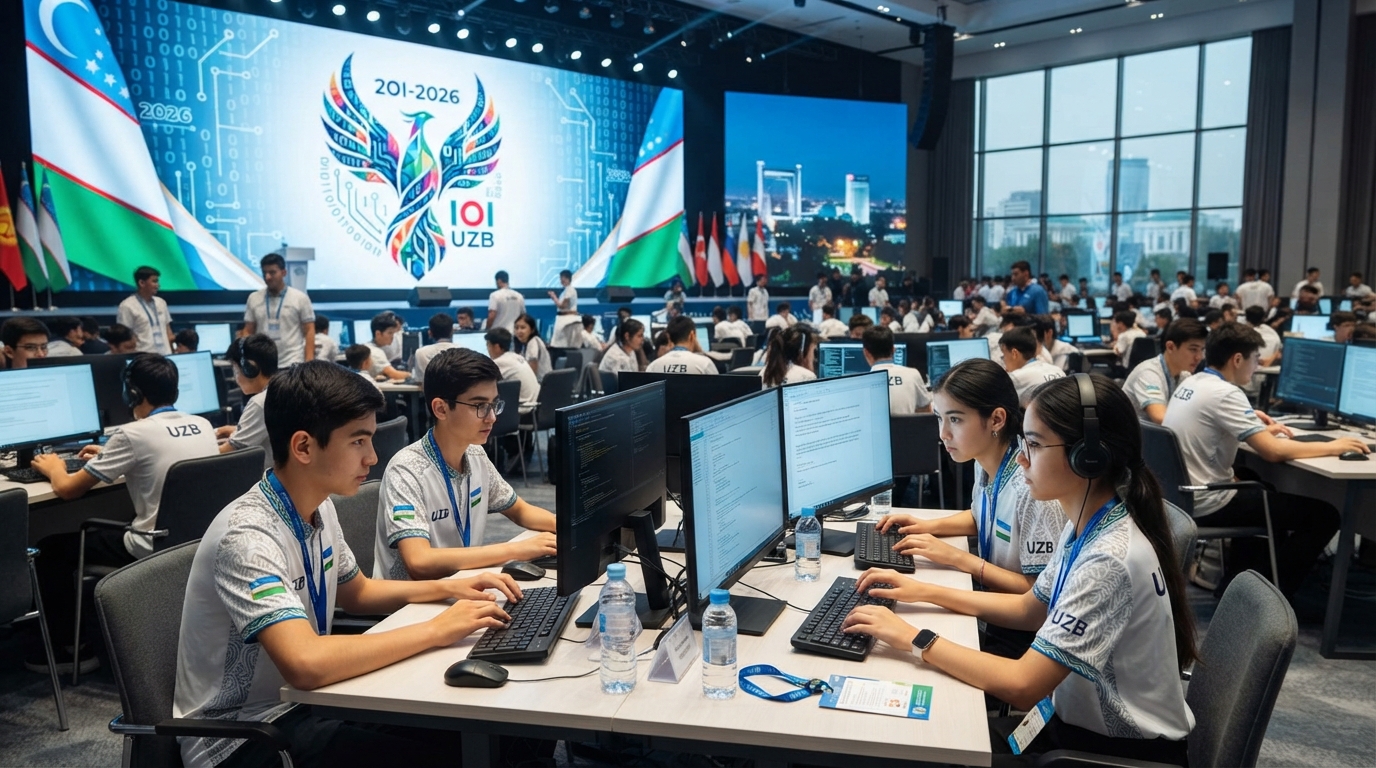
Uzbekistan will host the International Olympiad in Informatics (IOI-2026) for the first time from August 9 to August 16. This will be the 38th time this prestigious event has been held.
A total of 386 schoolchildren from 97 countries will participate in these intellectual competitions, a press conference in Tashkent reported on Thursday. The number of participants, including delegation leaders, coaches, members of the international committee and other guests, will exceed 900.
According to the press service of the Ministry of Digital Technologies, the preparation of the Uzbek national team began in November 2025. About 10 training camps were held with the participation of experts from Kazakhstan, Poland and Romania. At the end of the qualifying stages, two national teams of 8 participants were formed from 100 schoolchildren.
Uzbekistan’s bid to host the event was approved during the 35th Olympiad in Szeged, Hungary, from August 28 to September 4, 2023.
The IOI brings together high school students from different countries each year. They test their knowledge and skills in areas such as problem analysis, development of algorithms and data structures, programming, and testing.
Each participating country selects a team of four to defend its honor at the Olympiad. They compete for two days, accompanied by a team leader and his deputy. Each participant competes individually and tries to achieve maximum results by solving three algorithmic problems within five hours on each competition day.
The legendary hummingbird was chosen as the logo of the IOI-2026. Its body and wings are designed using geometric shapes, circuit-like lines, and binary numbers (0 and 1). The binary sequence in the logo represents the year and the host country.