

Millions opposed military rule in Myanmar. Is their dream of a revolution over?
Opponents of the junta hoped a revolution would remake Myanmar - but these are disheartening times.
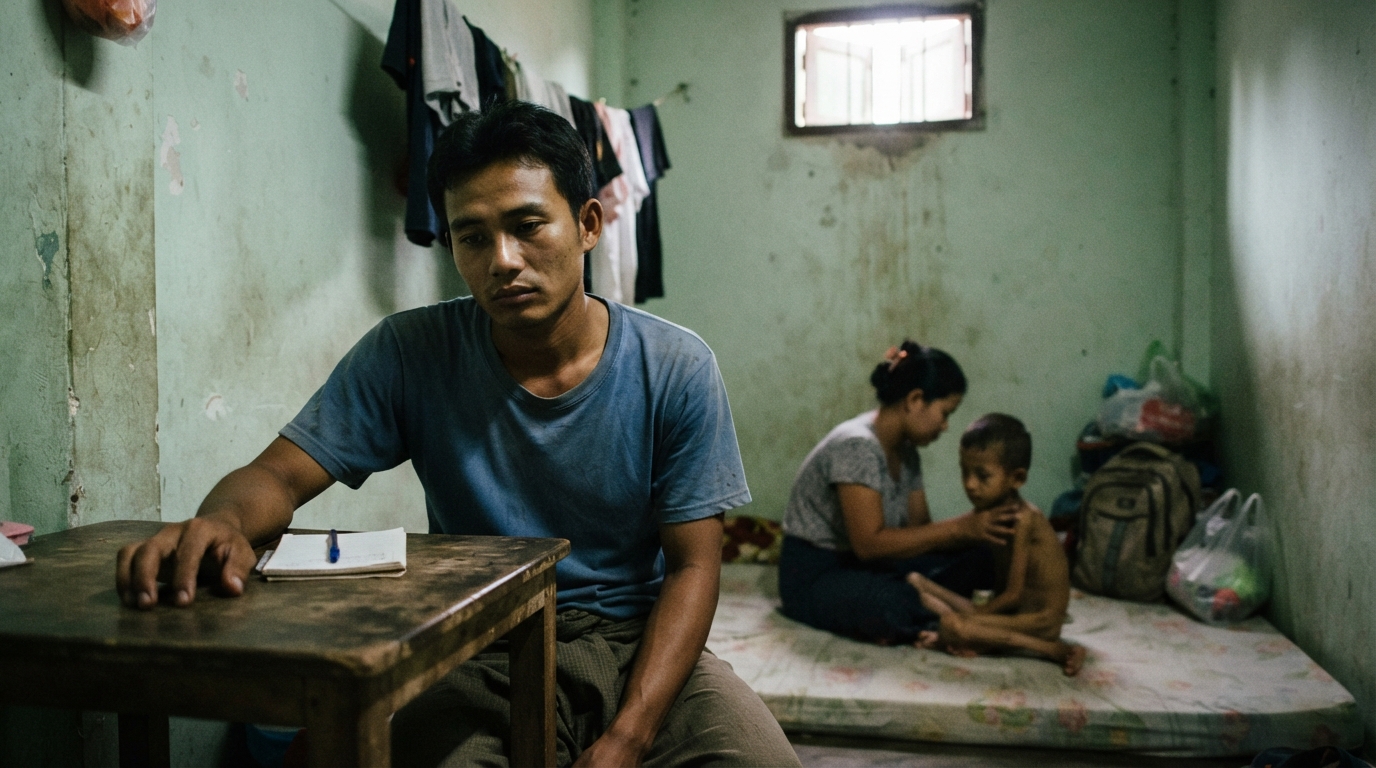
The dream of a revolution in Myanmar, once held by millions who opposed military rule, now appears increasingly uncertain for those who have sought refuge in Mae Sot, Thailand.
"One day we will get our freedom back," states a 22-year-old, who has dedicated much of his adult life to this fight. However, after five years of civil war in Myanmar, he has grown weary of the conflict and political struggle. "I want to help our people as much as I can. But I choose another way. A non-violent way."
This young man is among a significant number of people from Myanmar seeking sanctuary in Mae Sot, a Thai border town. He spoke to the BBC from a small, dimly lit room on a back street, part of a network of safe houses established by charities for new arrivals. Most arrive with very little, exhausted and traumatized by their experiences in Myanmar, and are highly vulnerable. Without legal status in Thailand, these safe houses are their only refuge.
At 17, he joined the nationwide protests against the 2021 military coup in Myanmar. When these protests were suppressed by the army, he, like many young demonstrators, traveled to an area controlled by ethnic insurgents for military training. He later returned to Yangon as part of an urban guerrilla squad, planting bombs outside targets such as police stations. "I thought then that non-violent protests were not the right way to get back our freedom."
He was soon apprehended and sentenced to seven years in Insein prison, known for its brutal treatment of inmates. Released last year, he fled to Mae Sot due to intense police surveillance of his family in Yangon. For their safety, he wishes to remain anonymous.
For the millions of Burmese who have risked their lives and left their homes to oppose military rule, these are disheartening times. They had envisioned a revolution that would transform Myanmar into a more democratic and inclusive nation, removing the armed forces from politics. Instead, they are witnessing the individual they hold responsible for igniting the civil war consolidate his power.
Last month, Myanmar's military ruler, General Min Aung Hlaing, received a red-carpet welcome from China's Xi Jinping. This marked a joint effort by both countries to rebrand his image from a "blood-stained dictator" to a civilian president, increasingly accepted, if not respected, by neighboring countries. Chinese diplomatic and military support has been crucial in helping the man who deposed Aung San Suu Kyi's elected government in 2021 recover from the catastrophic consequences of his coup.
Over the past year, the military junta has recaptured much of the territory it had lost to the hundreds of insurgent groups formed to resist the coup. A carefully orchestrated election earlier this year, from which major opposition groups were excluded, has allowed Min Aung Hlaing to present himself as a legitimate, elected leader.
This leaves those who had hoped for a different future effectively trapped in Mae Sot. The town, a primary trade gateway between Myanmar and Thailand, has always had a fluctuating Burmese population, which has swelled with refugees since the coup. However, they are rarely seen outside. Most are undocumented, having arrived unofficially by crossing the narrow Moei river that marks the border, and live in constant fear of arrest and deportation by Thai police. They also fear reprisals against family members back in Myanmar. One former army officer, who defected to the opposition three years ago, told the BBC she only dares leave her rented room in Mae Sot twice a month.
For recent arrivals, the safe houses offer short-term shelter, typically for a maximum of six months. These are mazes of small rooms with basic communal facilities, hidden in the city's smaller side streets. Behind every door lies a harrowing personal story.
The young urban guerrilla, imprisoned in Insein jail, described routine torture and sexual assault by guards. He also stated that prison was where he had a change of heart about the struggle. "I had hoped the revolution would be better. But they did not unite at all [the insurgent groups], they fought each other and I did not like that situation. I saw many casualties from the war, and I could not bear to see things like that." As the eldest child, he also felt he couldn't risk his life and abandon his family. "So I gave up the armed struggle – not only the armed struggle but other kinds of struggle too, like in politics. I want to help our people in another way." He has dedicated himself to teaching children in the safe house and supporting friends still in prison. "I try to give them hope that the revolution is not finished yet, and that we still have a chance to win."
Our presence in the safe house attracted other residents, each with a different story. There were former members of the people's defense forces fighting the junta, an official from Aung San Suu Kyi's National League for Democracy, and several young men avoiding forced conscription into the army. A common sentiment among them was that while they still believed in the revolution, after five years they were exhausted and needed to earn money for their families. Mae Sot was their only option.
Also present was Yin Yin Aung, a 20-year-old woman with her husband and young son. They had undertaken an epic 1,000-mile journey to reach Mae Sot from Sagaing, a region that has mounted strong resistance to the military coup and suffered terrible reprisals, including relentless air strikes. Her village, Htomar, was situated between a military base and an insurgent-controlled area. She recounted the day more than two years ago when soldiers occupied the village, firing weapons and driving the population before them. "When the phone signal was cut, we knew something was going to happen. I heard three gunshots, and saw people running between the houses shouting that an army column was coming. We could not carry much. My father took a bag of rice so we would have something to eat, and we ran until we reached a place deep in the forest and hills." There was nothing there, she added, so they had to drink river water, which they also used for bathing and as a toilet. They fell sick, and some died. They remained in the forest for six months. The soldiers left the village after one month, but Yin Yin says it had been thoroughly looted, with landmines laid around the houses. No one dared move back. During this time, she gave birth to her son, who has an abdominal hernia requiring surgery. Over several weeks, the family traveled south and east, arriving in Mae Sot six months ago. This is their second safe house; they had reached the maximum stay allowed in the first. They are trying to avoid renting a commercial room to save for her son's operation.
Not everyone is disheartened by the military's successes. In another safe house, we met a former Yangon bartender turned rebel, with his wife and two-month-old baby. They had left war-torn Karen State, where he is a member of the Cobra Column, one of the more effective opposition fighting units, and came to Mae Sot to have their baby. He seemed eager to return to the war. "I believe that the revolution we are fighting right now will succeed one day. Because they [the military] are fighting a war against the entire country. They are fighting a war against the very citizens they are supposed to protect and safeguard. There is no way they can win."
The Cobra Column fights alongside the Karen National Union, which is relatively well-armed and has been fighting the central government for nearly 80 years. Morale remains high there. However, other people's defense forces are struggling this year after Chinese pressure cut their supplies of weapons and technology. Meanwhile, the Myanmar military has benefited from training and new equipment from Russia and China.
Louis (not his real name), an entrepreneur from Yangon, left to join the insurgents in Karen State after the coup. "I thought it was my duty as a citizen, even though I was already 40-something years old. I thought if I don't join now, I will regret it for the rest of my life." He too was captured and imprisoned by the military junta but managed to persuade them he was an ethnic Karen combatant, not a member of the civil disobedience movement that emerged in response to the coup. This resulted in less harsh treatment. However, upon his release last year, he decided his family's needs were greater than those of the revolution. "For the first two or three years, we had high morale and were very motivated. But, since the war is dragging on for so long, a lot of people have other responsibilities that do not stop. Like me, my kids are growing up, they need a good education, a better life. A lot of people feel like this. We have changed under that pressure."
Inside Myanmar, rebels are losing ground as military forces conscript men into the army. Myanmar's coup leader, who initiated a brutal civil war, has become president. Many recruited to fight in Myanmar's civil war are children as young as 13. One activist has dedicated herself to extracting them from insurgent groups and bringing them to a refuge she created in an old house in Mae Sot, where she tries to provide them with work experience. The adjustment is difficult. The youngest boys have become conditioned to military life and still have family members fighting on the other side of the border. They feel it is their duty to be with them. "Sometimes I get depressed about the revolution," she says. "Before the coup there were villages which were friends, and now they become enemies because one supports the military and another supports the resistance." She believes it's time for them to change their strategy. "We have to prepare for a long fight for this revolution, not only with weapons, but also thinking about education and healthcare. There are many displaced people now in refugee camps. What are we going to do for them?"
Yin Yin Aung has been informed by a private hospital in Mae Sot that she must raise a deposit of 38,000 baht (approximately $1,140; £845) for her son's operation, a nearly impossible sum for her and her husband. Without official status, they have no access to Thailand's state-run health system. Ideally, she would like to return to her village, but states that as long as Min Aung Hlaing is in charge, she must remain in Thailand. "He is the very one who caused all of this to happen. So, if you ask whether we could live there with him still in power, we cannot. Because given the choice, I would prefer to bring my parents here."
Despite shedding his uniform, Min Aung Hlaing is not relenting in his war against the opposition. Last month, the UN Human Rights Commissioner reported a minimum of 702 civilian deaths between the election announcement last August and its conclusion at the end of January, most of them women and children, primarily killed by air strikes. Fragmented among hundreds of armed groups and starved of arms, the resistance has lost ground in recent months but still controls large parts of the country. Yet, diplomatic engagement by Myanmar's neighbors has so far yielded no meaningful concessions from the regime.
All of this leaves hundreds of thousands of Myanmar's war refugees, including those in Mae Sot, in a devastating limbo. Yin Yin Aung's home is now a small, dimly lit room with a very basic bathroom at the back. It is not much for a family of three. Those in the other 19 rooms live in similar conditions, all carrying the weight of their own terrible memories of the war. With no end to her exile in Mae Sot in sight, Yin Yin Aung will likely have to move again in six months.