

Lower taxes for banks, higher costs for customers? Finance Ministry institute proposes VAT on financial service commissions
A research institute under the Ministry of Economy and Finance has proposed a package of tax reforms that would introduce value-added tax (VAT) on commission-based financial services while reducing the corporate income tax rate for banks, mobile operators and several other industries.
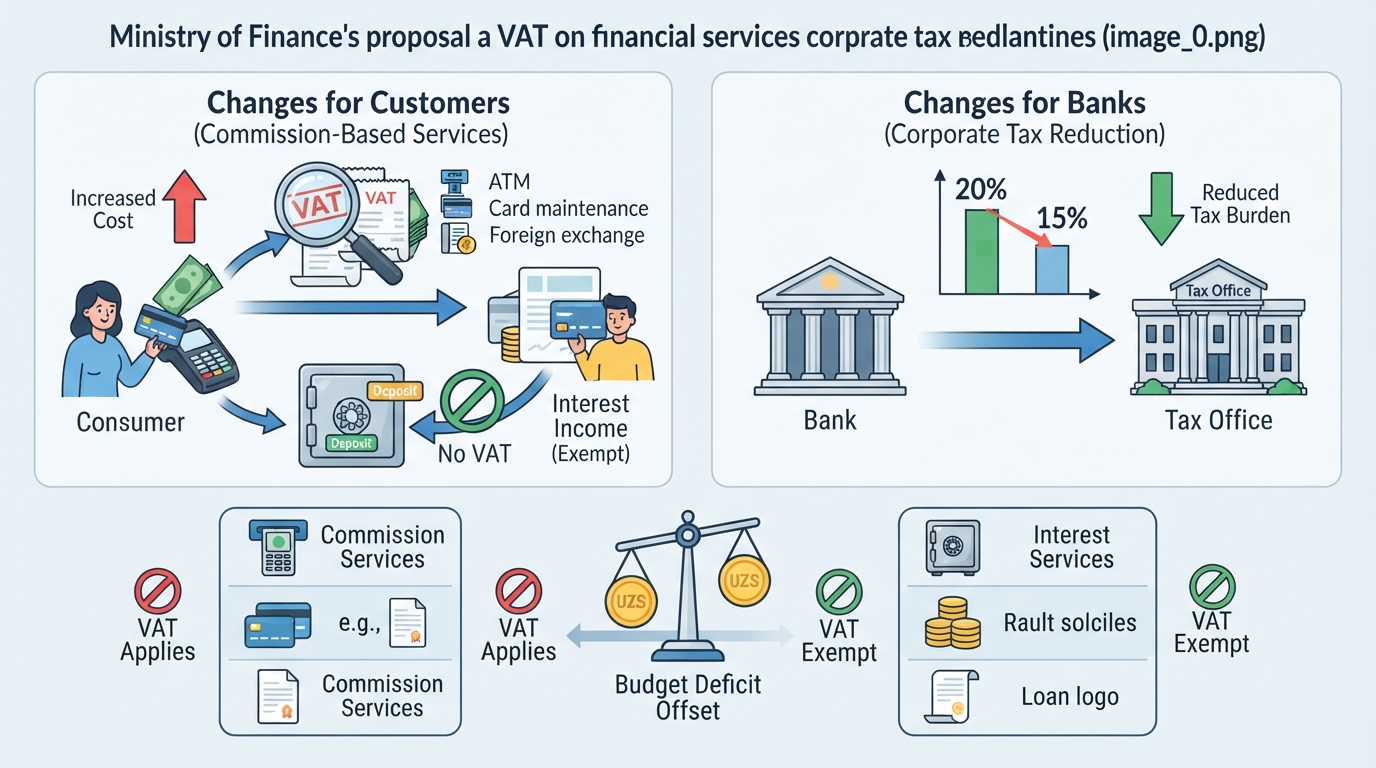
A proposal from the Ministry of Finance's institute suggests implementing Value Added Tax (VAT) on commissions for financial services, potentially leading to increased costs for customers, while simultaneously lowering taxes for banks.
These proposals were introduced during a fiscal dialogue hosted by the ministry on July 30. They are not yet law and would necessitate revisions to the Tax Code before implementation.
Under the proposed changes, the corporate income tax rate for banks, mobile network operators, manufacturers of polyethylene granules, markets, and shopping complexes would decrease from 20% to 15%.
The institute estimates that the resulting budget deficit of UZS 859 billion could be offset by applying VAT to commission-based financial services, which are currently exempt.
**Distinguishing Commissions from Interest**
The proposed reform aims to clearly differentiate between two categories of financial income.
Commission-based services, where customers pay a fixed fee for a specific service, would become subject to VAT. This includes charges for maintaining bank accounts and payment cards, settlement and cash services, merchant acquiring and payment processing, bank guarantees, letters of credit, foreign exchange commissions, payment system services, securities depository and exchange services, and the service component of factoring and forfaiting.
Conversely, interest-based (or margin-based) financial services would remain exempt from VAT. This category includes deposit-taking, lending, interest on loans, repurchase (repo) transactions, the interest component of financial leasing, the discount component of factoring and forfaiting, transactions involving shares, securities and financial derivatives, and the assignment of creditors' claims.
According to the presentation, this proposed approach aligns with international practices endorsed by the International Monetary Fund (IMF) and the Organisation for Economic Co-operation and Development (OECD), which generally subject explicit fees for financial services to VAT while exempting interest income.
**Potential Changes for Consumers**
If adopted, the proposal would most directly impact the cost of financial services that involve fixed commissions rather than interest payments.
For instance, fees for maintaining bank accounts or payment cards, processing payments, issuing bank guarantees, or charging commissions on foreign exchange transactions could become subject to the standard VAT rate. Should financial institutions pass this tax on to customers, these services could become more expensive.
Simultaneously, the proposal would not impose VAT on interest earned from bank deposits or paid on loans. Consequently, borrowers would not face VAT on loan interest, and depositors would continue to receive VAT-free interest. However, this is distinct from another proposal unveiled at the same fiscal dialogue, which would introduce a 5% income tax on interest earned from bank deposits.
**Potential Impact on Businesses**
For banks and several other industries covered by the proposal, the reduction in the corporate income tax rate would decrease their tax burden on profits.
Nevertheless, the overall impact would depend on how businesses react to the new VAT regulations. Financial institutions might pass the additional VAT costs on to customers through higher service fees, absorb some of the cost themselves to maintain competitiveness, or employ a combination of both strategies.
Companies heavily reliant on fee-based banking services—such as payment processing, bank guarantees, or foreign exchange operations—could also face increased operating costs if VAT is ultimately reflected in service charges.
**Part of a Broader Tax Reform Debate**
The institute contends that separating commission income from interest income would align Uzbekistan's tax treatment of financial services more closely with international practice, while enabling the government to compensate for revenue lost due to lower corporate income tax rates.
For now, however, these measures remain proposals. Any changes would require approval through amendments to the Tax Code before they could take effect.