

Leaked video shows Uzbek official ordering Soviet-era "board of shame" signs
Tashkent Times is an English language online-newspaper that brings all latest Uzbekistan news
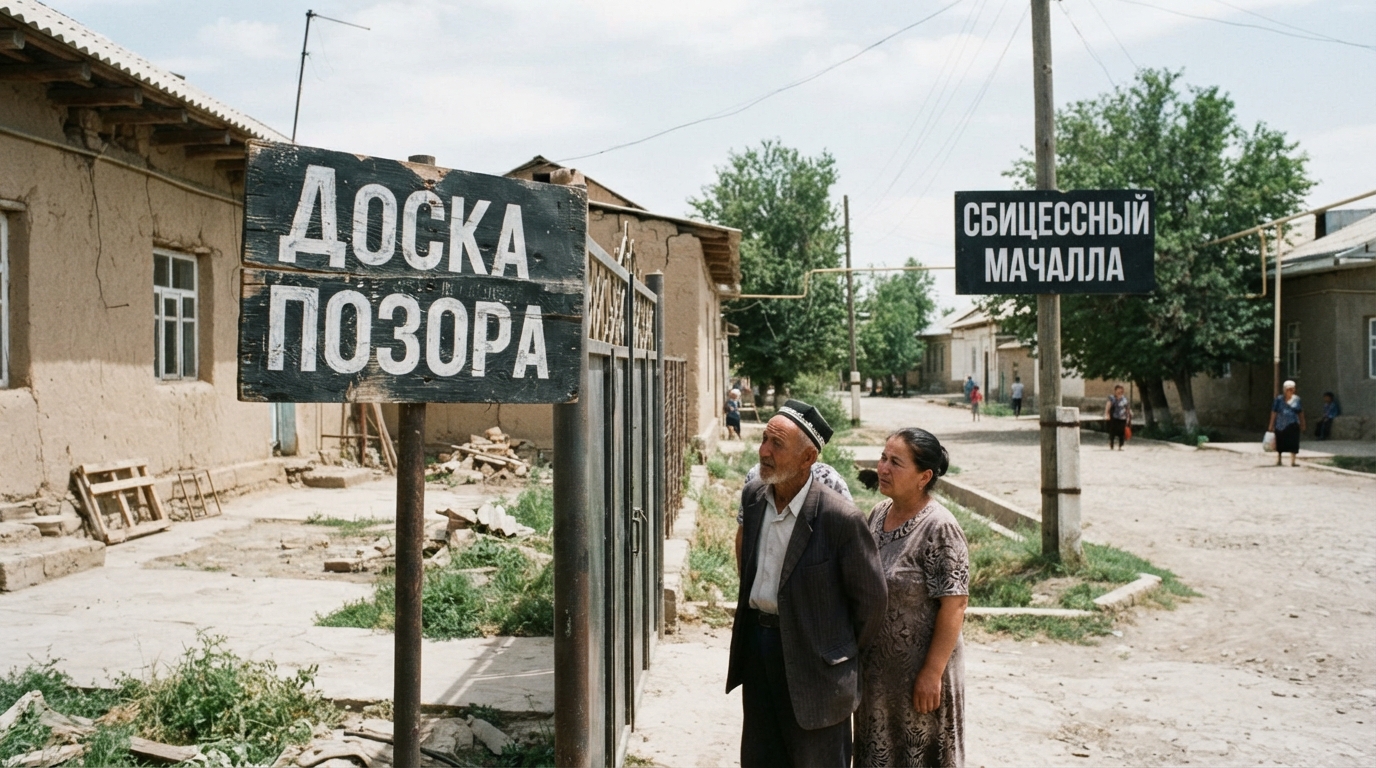
A recently leaked video from the Chinoz district in Uzbekistan's Tashkent province has brought to light a controversial directive from local mayor Sherzod Salikhov. The footage shows Salikhov ordering the placement of "Disgraceful Mahalla" signs throughout an entire neighborhood and threatening individual residences with "House of Shame" placards for untidy yards. This incident has garnered significant attention not only for its severe tone but also for its striking resemblance to a governance method deeply rooted in the Soviet era.
**A Familiar Mechanism**
The strategy employed by Salikhov—publicly identifying underperforming individuals, households, or entire communities to compel compliance—bears a direct historical link to the Soviet "Doska Pozora," or "Board of Shame." During the Soviet period, enterprises utilized a red "board of honor" to recognize exemplary workers and a black "board of shame" to highlight those who engaged in drinking, idleness, or otherwise failed to meet expectations. This was intended to commend high-achievers and admonish those who shirked their responsibilities. In its most extreme manifestations, this mechanism extended beyond individual reputation. In Ukraine and the Kuban province, a related practice known as the "black board" (chorna doshka) served as a propaganda tool for the Communist Party and is considered one of the instruments used during the Holodomor. This same blacklisting method was subsequently applied in Soviet Kazakhstan before evolving into an overt tool of repression against peasants.
**Why the Comparison Matters**
The parallels between Salikhov's actions and the Soviet-era practices are undeniable. Both demonstrate an inclination to transform a bureaucratic deficiency—whether it be grain quotas in the past or unkempt courtyards now—into public humiliation. Both also operate under the assumption that shame, rather than the provision of resources or open dialogue, is the most effective means of local governance. For critics, an elected or appointed official resorting to such tactics, even for something as seemingly trivial as landscaping, raises legitimate concerns about the potential resurgence of decades-old habits of top-down social control, albeit in new forms, across the former Soviet territories.
**Other Side of the Argument**
Conversely, officials employing this approach would likely draw a clearer distinction than the comparison suggests. Unlike the collectivization-era boards, which were backed by the full force of the Soviet state and carried genuine financial and even criminal penalties, the signage in Chinoz, as described, does not entail any formal punishment beyond public embarrassment. Furthermore, its objective is a narrow civic goal (the tidying of yards and streets) rather than the enforcement of political loyalty or economic extraction. Whether this distinction renders the tactic merely insensitive rather than a genuine "step backward," or whether the normalization of public shaming as a governance tool is itself the core concern regardless of the stakes involved, will likely remain a subject of ongoing debate.