

Kyrgyzstan, Tajikistan, Turkmenistan visa applicants may face U.S. deposits of up to $20,000
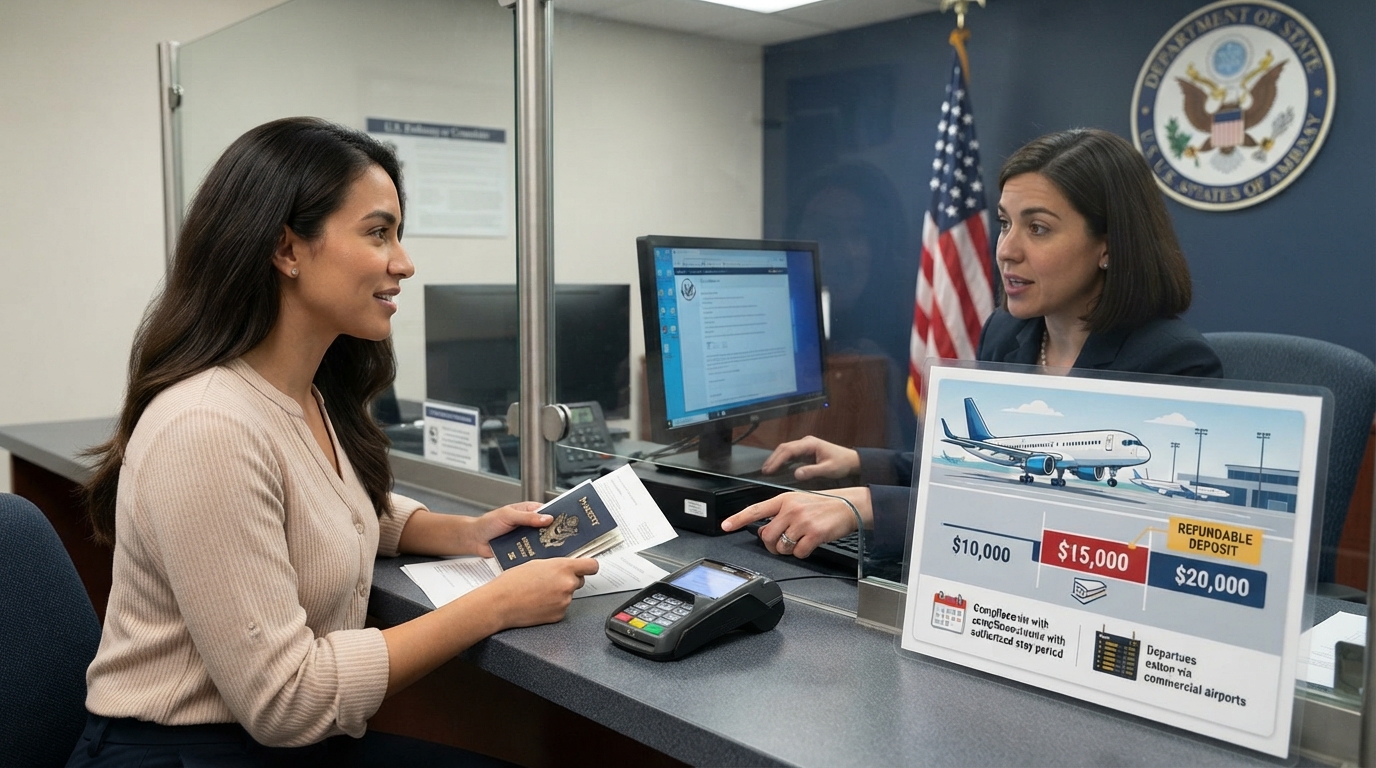
The United States is set to implement a permanent visa bond program starting August 3, 2026, which will mandate certain applicants from 50 nations, including Kyrgyzstan, Tajikistan, and Turkmenistan, to pay a refundable security deposit for business and tourist visas.
The U.S. Department of State confirmed that the program targets individuals applying for B-1 (business) and B-2 (tourist) visas. The revised regulations empower consular officers to demand a refundable deposit of up to $20,000, an increase from the previous maximum of $15,000.
This expanded visa deposit program now permanently encompasses citizens from 50 countries, such as Kyrgyzstan, Tajikistan, Turkmenistan, Mongolia, Georgia, Venezuela, and 30 African nations.
The specific deposit amount will be determined during the visa interview, based on the applicant's individual circumstances. Consular officers have the discretion to set the deposit at $10,000, $15,000, or $20,000, with $15,000 anticipated to be the standard amount in most instances.
The State Department clarified that the deposit is only required if explicitly directed by a consular officer. It can be paid by either the applicant or another individual, but payment does not guarantee visa issuance.
Refunds will be issued if the visa holder adheres to the terms of admission, departs the U.S. within the authorized stay, or if the visa expires unused. Applicants denied entry to the U.S. after receiving a visa are also eligible for a refund.
However, the deposit may be forfeited if the visa holder violates the conditions of their stay.
Under this program, participants must enter and exit the United States via commercial airports. Travel through land or sea border crossings, as well as charter or private aircraft, will not fulfill the requirements for participation in the visa bond program.
Kyrgyzstan previously participated in a one-year pilot initiative, where consular officers could require deposits of $5,000, $10,000, or $15,000. This pilot program included citizens from 50 countries, predominantly in Africa, along with Kyrgyzstan, Tajikistan, Turkmenistan, Georgia, and Mongolia.
This announcement follows several recent adjustments to U.S. visa regulations. The United States has also modified the validity periods and conditions for various visa categories, including those for students and journalists.
Under the updated rules, student visas are now valid for a maximum of four years, rather than for the entire duration of an academic program or employment. Graduate students are no longer permitted to alter their educational purpose or transfer to another institution without prior authorization. Furthermore, the period graduates can remain in the U.S. after completing their studies has been shortened from 60 days to 30 days.
The validity of journalist visas has also been reduced to 240 days, while visas issued to Chinese journalists are now limited to 90 days. China has criticized this decision, labeling the revised policy as discriminatory and demanding its reversal.