

Kazakhstan's annual inflation eases to 10.2% in July
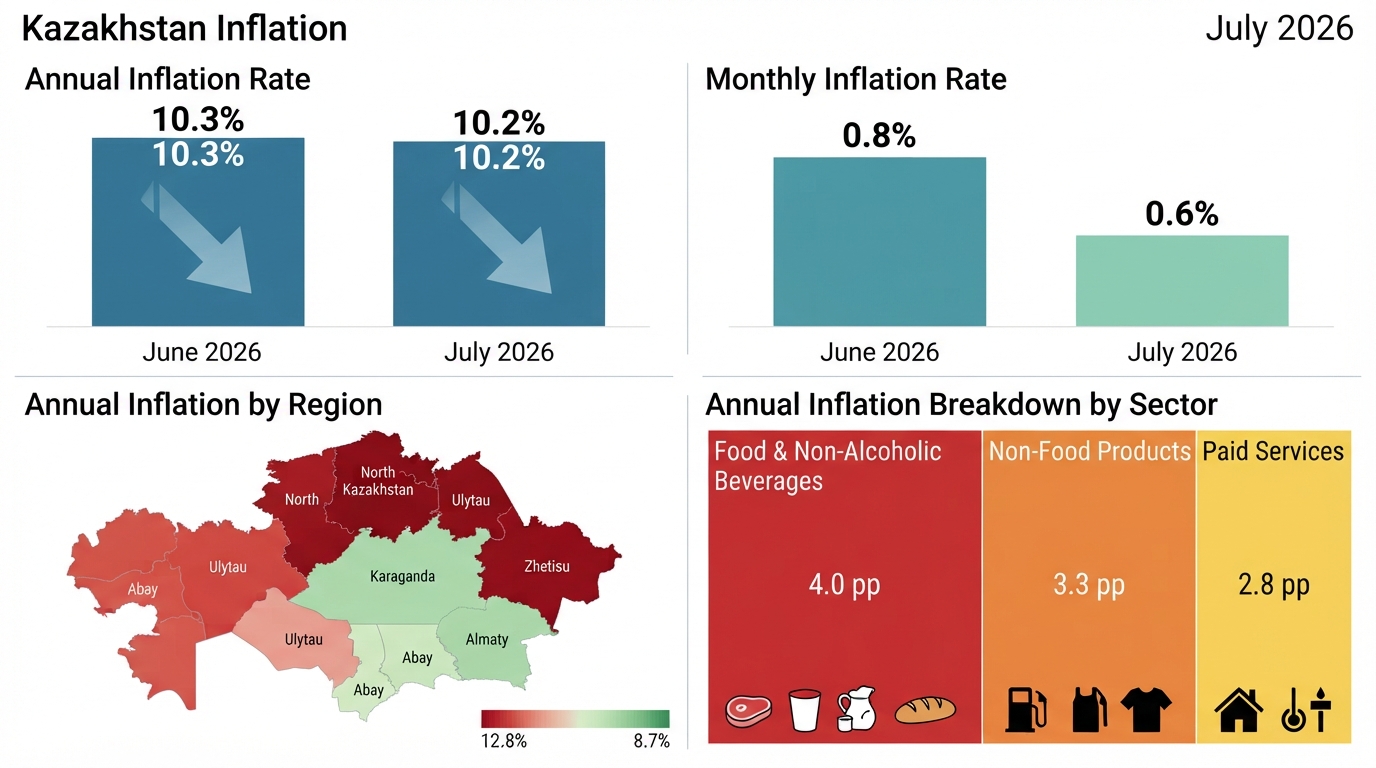
Kazakhstan's yearly inflation rate decreased to 10.2% in July 2026, down from 10.3% in June. Concurrently, the monthly inflation rate also saw a reduction, falling to 0.6% in July from 0.8% the previous month, as reported by the Bureau of National Statistics.
The primary factors contributing to the annual inflation were elevated prices across food items, non-food merchandise, and various paid services. Food prices experienced a 10.1% increase year-over-year, a slight drop from the 10.4% recorded in June. Non-food products saw an 11.7% rise, maintaining the same rate as the preceding month. Paid services, however, showed a minor acceleration, increasing to 9.2% from 9%.
Inflation rates varied geographically across Kazakhstan. The highest annual inflation figures were observed in the North Kazakhstan region at 12.8%, followed by the Ulytau region at 12.7%, and the Zhetisu region at 12.6%. Conversely, the lowest rates were documented in the Karaganda region at 8.7%, Almaty city at 9%, and the Abay region at 9.2%.
Food and non-alcoholic beverages were the most significant contributors to the annual inflation, adding 4 percentage points to the overall rate. Non-food products accounted for 3.3 percentage points, while paid services contributed 2.8 percentage points.
Delving into food products, meat and poultry prices saw a 15.8% annual increase, making the largest impact on food inflation. Sausages and processed meat products climbed by 15.9%, eggs by 14.2%, dairy products by 13.3%, soft drinks by 13.6%, and bread and bakery products by 9.6%. In contrast, fruit prices decreased by 0.8%, and vegetable prices fell by 10.2% compared to July 2025.
Within the non-food sector, petrol prices surged by 15.3% year-on-year. Clothing prices rose by 10.7%, footwear by 11.1%, detergents by 11.1%, and personal care goods by 13.1%.
Regarding paid services, property rental costs increased by 14.6%. Maintenance and repair of residential premises went up by 12.5%, gas supplied via distribution networks by 14.9%, and liquefied gas prices by 16%. Electricity tariffs saw a 7.8% increase, while cold water prices experienced a significant decline of 40.8% compared to the previous year.
On a month-over-month basis, consumer prices in July increased by 0.6%. Both paid services and non-food products each rose by 0.7% during the month, while food prices registered a 0.4% decrease.