

Italian "5+1" Format Experience: Human Capital Investment as Foundation of Strategic Partnership with Central Asia
An analytical article by Professor Filippo Costa Buranelli highlights how Italy's "5+1" cooperation format with Central Asia focuses on long-term institutional partnership, human capital, and public governance.
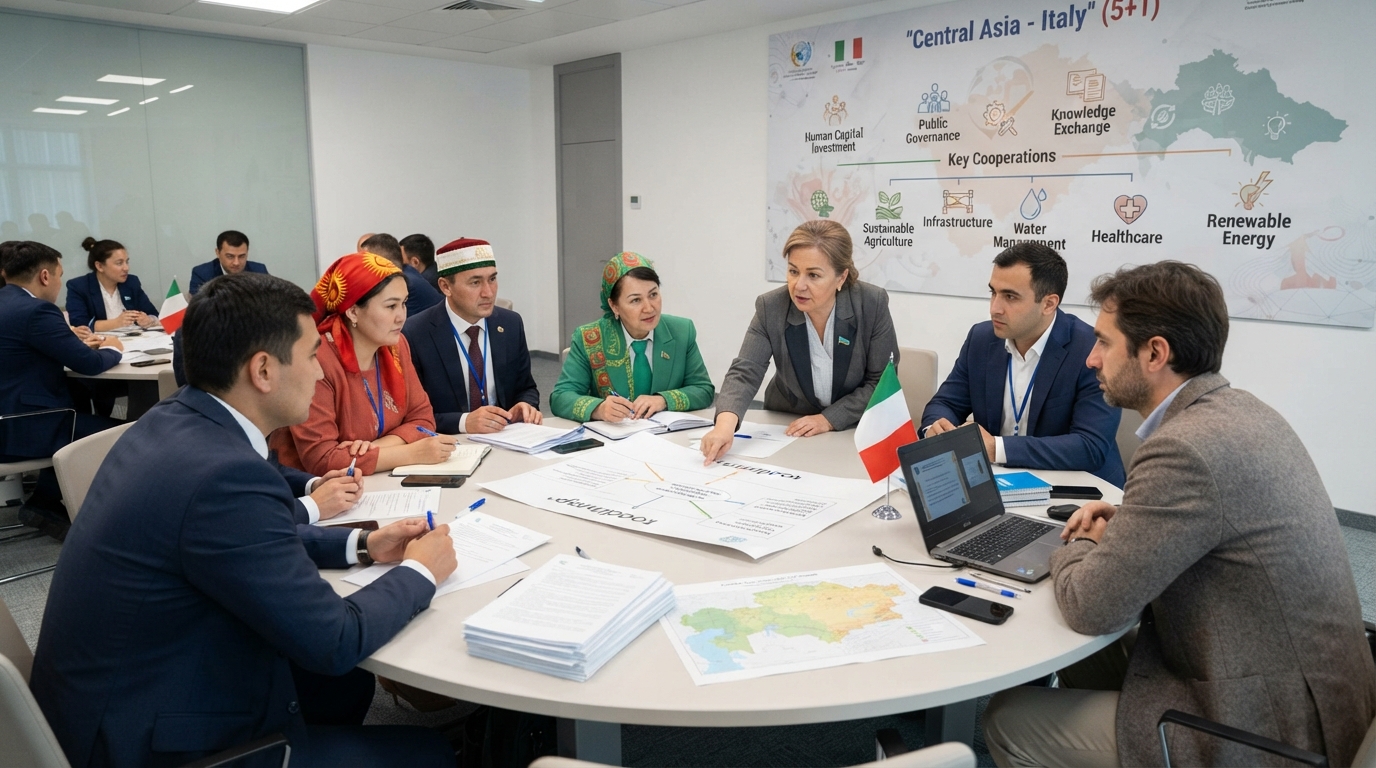
Italian "5+1" Format: Human Capital Investment Forms Basis of Strategic Partnership with Central Asia
Tashkent, Uzbekistan (UzDaily.uz) – Professor Filippo Costa Buranelli of the University of St Andrews has authored an analytical piece exploring the evolution of the "Central Asia – Italy" ("5+1") cooperation framework. The British academic suggests that this initiative signifies a departure from conventional diplomacy, moving towards an enduring institutional partnership rooted in human capital development and public governance.
The author observes that as Central Asia's global importance expands, Italy's engagement model with the five regional nations is gaining new depth. He believes that the "Schools of Policy," conducted from late May to mid-July 2026, illustrate an evolving cooperative strategy founded on equitable partnership, rather than a "donor-recipient" dynamic.
Under this program, 80 delegates from public administration academies in Kazakhstan, Kyrgyzstan, Tajikistan, Turkmenistan, and Uzbekistan engaged in educational activities designed to enhance professional skills and facilitate the exchange of expertise in public administration. The project is being executed at the behest of and with financial backing from the Ministry of Foreign Affairs of Italy, in alignment with the Joint Declaration signed in Astana on May 30, 2025.
Buranelli underscores that a significant achievement of the program is the establishment of a common expert domain and a standardized professional lexicon for interaction among civil servants and specialists from the participating countries. The "Schools of Policy" are an integral component of the BRIDGE initiative, which is coordinated by Ca' Foscari University of Venice.
The author states that the educational modules encompass a broad spectrum of subjects, such as sustainable agriculture, the advancement of transport and digital infrastructure, water resource management, healthcare, and renewable energy. In addition to lectures and technical workshops, participants collaboratively develop practical documents, including "roadmaps" for specific areas of collaboration.
The researcher points out that the experience validates the efficacy of institutional development as a cornerstone for economic integration, sustainable progress, energy transition, agricultural modernization, water management, and the execution of transregional transport projects.
In closing, Buranelli remarks that enduring partnerships are primarily constructed upon investments in institutions, knowledge, and human capital. He contends that the "Schools of Policy" experience demonstrates that the "Central Asia – Italy" format can yield concrete practical outcomes when supported by political resolve and effective expert collaboration, thereby laying a solid groundwork for continued cooperation between Italy and the Central Asian states.