

India's 'cockroach' protesters have wounds consistent with pellet-gun fire, say experts
Ballistic experts say the dozens of tiny round punctures are tell-tale signs of pellet gun injuries.
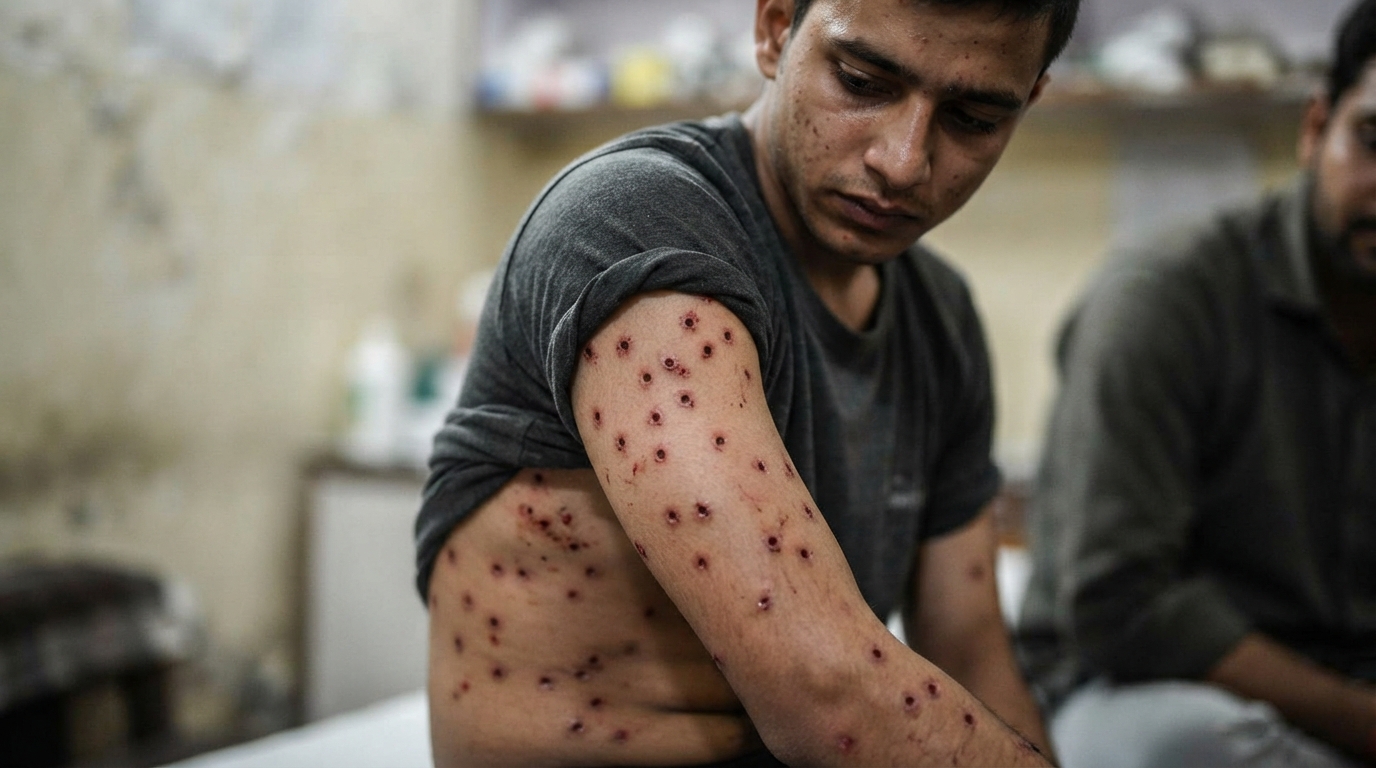
Experts indicate that the wounds sustained by India's "cockroach" protesters are consistent with injuries caused by pellet-gun fire. Sahil Lochab, who appeared alongside opposition leader Rahul Gandhi at a press conference, has numerous small holes across his face and body.
Independent ballistics experts have informed the BBC that some supporters of the Cockroach Janta Party (CJP) suffered injuries from pellet guns during a protest in the Indian capital last week.
*Warning: This report contains images that some may find disturbing.*
On July 20, central Delhi experienced significant violence as tens of thousands of protesters attempted to march to parliament, demanding education reforms and the resignation of the education minister. Police and paramilitary forces were observed brutally assaulting the crowds with wooden sticks, batons, and tear gas. Delhi Police reported 60 protesters and 118 of their personnel were injured, while the CJP claimed a much higher number of injured protesters.
In the aftermath of the crackdown, the government has not confirmed media reports regarding the use of pellet guns on protesters. However, the BBC has verified at least four instances where protesters received hospital treatment for wounds that experts attribute to pellet guns.
Pellet guns are shotguns designed for bird hunting, firing cartridges known as "birdshot" that contain 200 to 400 small metal pellets. When used against crowds, these pellets disperse widely, striking people indiscriminately. Such weapons are prohibited in several countries.
The BBC spoke with two injured men who believe they were hit by pellet guns fired by security forces. Photographs and videos of these two men, along with a third, were shown to two independent armament and forensic experts. A senior hospital official also confirmed a fourth man received treatment for pellet wounds.
Experts state that the numerous tiny, round punctures are characteristic signs of birdshot injuries. Philip Boyce, a UK-based ballistics forensic scientist, told the BBC, "The injuries depicted are definitely from a pellet gun," specifying the weapon as "a 12-gauge pump-action shotgun." He added, "These pellet injuries can actually be quite devastating, especially at close range. The injuries I see [in Delhi] are not at close range, they're at least 50 feet. But they can actually still be devastating and potentially life-threatening even from 100 feet."
NR Jenzen-Jones, director of Armament Research Services (ARES) in the UK, informed the BBC that "images and video from the protests show the police using shotguns for crowd control" and that photos of "injuries are strongly consistent with the use of birdshot." He further explained, "While shotguns are a common tool in the less-lethal arsenals of many states, Indian law enforcement agencies have a long history of employing shotgun cartridges loaded with small lead pellets - known as 'birdshot' - in crowd-control scenarios. When loaded with birdshot cartridges, shotguns are sometimes referred to as 'pellet guns'." Jenzen-Jones cautioned, "But these pellets are not safe. They can result in life-changing or, occasionally, life-threatening injuries. They also pepper the body with toxic lead, which can sometimes be difficult to remove safely."
This is why many countries have either banned or restricted their use. In the UK, Boyce noted that pellet guns are widely used for shooting birds of prey and are readily available, but he is "not aware" of any instance where they have been used for crowd control.
Shaikh Irshad Mansoori stated that scans revealed over 40 pellets in his body.
In Indian-administered Kashmir, where pellet guns have been used since 2010, official data compiled by Human Rights Watch indicates they have injured several thousand people, killed at least 17, and blinded dozens. If the use of pellet guns by forces in Delhi is confirmed, it would mark the first time India has deployed them against its citizens in the capital city.
Two of the young men interviewed reported being injured in Connaught Place, a major hub near parliament, after 4 pm local time on July 20. Mohit (name changed), a 28-year-old journalist, recounted to the BBC that upon seeing a security personnel aim a gun at him, he turned and ran. "Two-three seconds later, I felt a burning sensation on my right arm and back," he said. Mohit continued running despite searing pain until he reached a café, where he bought water and washed his wounds. "That's when I saw the tiny circular holes on my arm and upper back. I was completely freaked out."
An X-ray taken at Safdarjung hospital, where he was treated, shows small objects embedded in his arm and upper torso. Medical records shared with the BBC indicate 26 pellet wounds on his right elbow and four on his upper right back, with a diagram illustrating the objects' locations. Mohit said doctors advised against surgery due to potential worsening of his condition, but he worries about future damage from the lodged pellets and whether the scars will fade. "But after seeing photos of other victims who've been hit in the face, I'm feeling fortunate," he remarked.
Shaikh Irshad Mansoori, who works at a Gurugram-based firm, was less fortunate. He was walking from Connaught Place to Jantar Mantar, the main CJP protest venue, when "the police and RAF [Rapid Action Force, a paramilitary force] personnel began beating the crowd with sticks and firing tear gas, causing a stampede-like situation and panic." He recalled, "I was with a group of protesters and we were raising slogans when an RAF personnel pointed his gun at us. We didn't think he would fire, but then I suddenly heard a cracking sound nearby and pellets hit me on my left eyebrow and my chin." Other protesters attempted to stop his bleeding with clothing, hailed a passing vehicle, and took him to Lady Hardinge hospital.
Mansoori stated that scans revealed over 40 pellets in his body, including three deeply embedded in his neck, left eye muscle, and under his nose, which doctors advised removing. "Surgeons next morning removed seven pellets, but they had to leave the one in the neck as it was too risky to be taken out. They told me it's now part of your body. They've assured me that it would not cause any danger in future." More than 10 days later, Irshad reported still being "in some pain." A senior hospital official told the BBC that Irshad's injuries were caused by "pellet-type small particles," but declined to confirm if they were fired from a gun, stating, "That's for the forensics to say once they've examined these pellets."
When initial claims of pellet gun use emerged last week, Delhi police dismissed them as "completely false and misleading," asserting they did not possess such weapons. Since then, Indian media has reported that the shots were fired by the RAF, which reports to the paramilitary Central Reserve Police Force (CRPF). The BBC has contacted CRPF chief Gyanendra Pratap Singh and sent him questions via email, but has yet to receive a response.
A 28-year-old journalist, who wished to remain anonymous, shared his photos and X-ray with the BBC.
On Wednesday, government minister Jitendra Singh stated in parliament that no "bullets" were fired and only tear gas was used. However, he did not comment on the use of pellet guns. His remarks were in response to allegations by Rahul Gandhi, Congress party MP and leader of the opposition in the lower house, who demanded the sacking of Home Minister Amit Shah, as both Delhi police and CRPF report to Shah.
Last Saturday, Gandhi held a press conference with Sahil Lochab, a 19-year-old Delhi University student, who risks losing an eye due to pellet injuries. One side of Sahil's face and the back of his right arm are covered in tiny holes. Gandhi lifted Sahil's T-shirt to reveal dozens more wounds on his underarm and body. In a video chat with Gandhi and in media interviews, Sahil explained his support for the CJP protest, which focused on repeated paper leaks of key exams, because an exam he took last year to join the police force was canceled due to the same issue. He attended the protest with three friends but became separated in the chaos when police charged the crowd with batons. He was shot while marching towards the security forces with other protesters.
"I couldn't see who fired the pellet gun but it came from the side where the forces were," he said. "My right eye was swollen so much that it felt it had popped out of my face, I couldn't raise my right arm. I was bleeding profusely and some of the protesters took me to the hospital." He told Gandhi that his family had tried to dissuade him from attending the protest, but "I couldn't stop myself." Sahil concluded, "I want justice. Whoever did this to me doesn't deserve to be in power."