

Hundreds escape Greek wildfire by sea as blazes continue across Europe
Around 500 people, mostly tourists, are evacuated by boat from Agios Vasileios after becoming trapped.
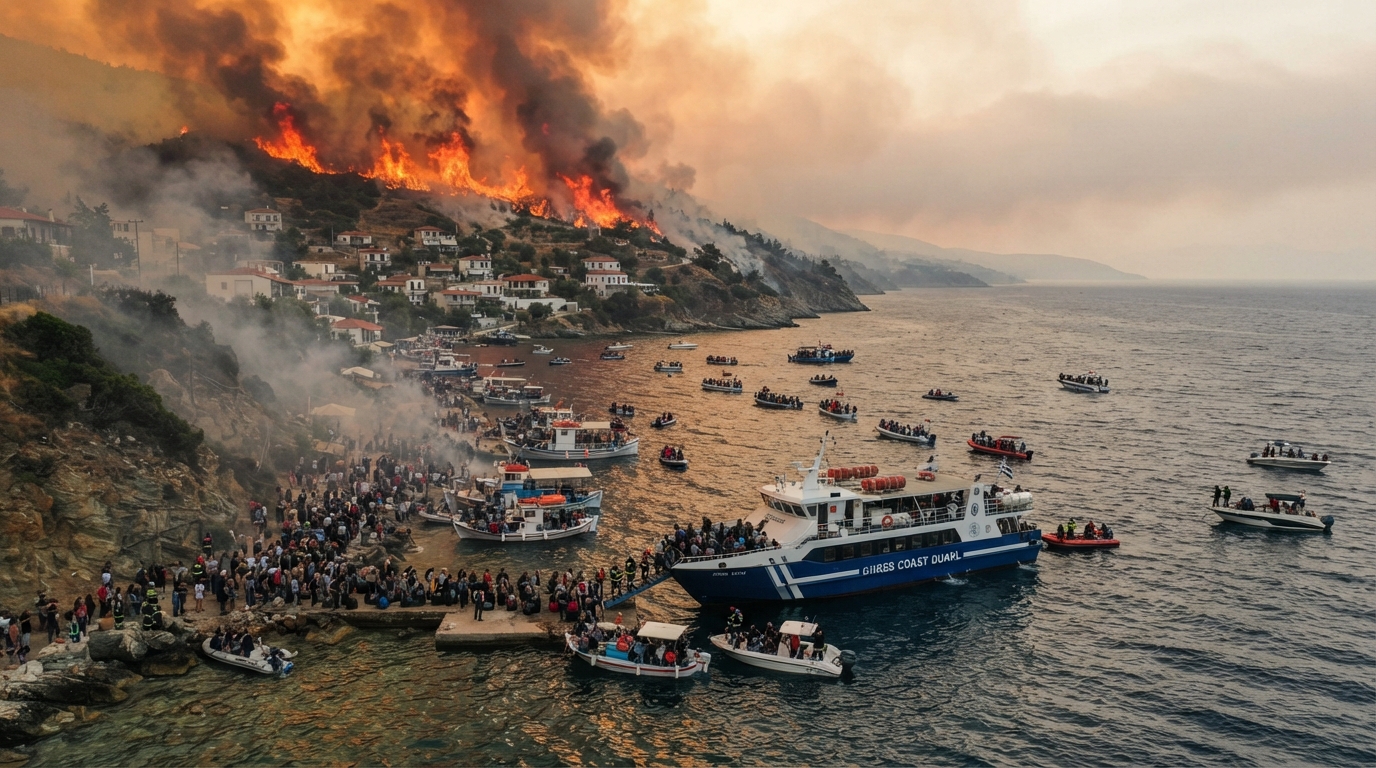
**Hundreds Flee Greek Wildfire by Sea Amid Widespread European Blazes**
In central Greece, hundreds of individuals are being evacuated by sea as a coastal town finds itself encircled by one of the numerous wildfires currently ravaging the nation.
Approximately 500 people, predominantly tourists, became stranded after a fire erupted near Agios Vasileios in Viotia on Friday morning, rapidly spreading due to strong winds, according to local media reports.
Another fire has ignited further along the coast, while firefighters persist in their efforts to control a large wildfire on the Greek island of Crete, which began earlier this week.
Greece is among several European countries experiencing destructive wildfires, fueled by a series of heatwaves that have created conducive conditions.
Firefighters in Portugal and Spain are still battling blazes that have consumed thousands of hectares. A new heatwave this week has heightened the risk of a significant fire near Madrid reigniting.
The central Greek area where the two fires started this morning was deemed most vulnerable due to high winds complicating firefighting operations.
More than 200 people have been evacuated, and another 100 are slated for boat transport from Agios Vasileios. Emergency personnel are working to safely remove those still in the town, as reported by Greek news agency Amna, citing fire officials.
Earlier, authorities had instructed residents to move further inland before the fire reached the town's outskirts.
The fire further along the coast consumed farmland before progressing through the rural town of Xironomi.
On Crete, firefighters continue to address persistent hotspots in a wildfire that has scorched thousands of hectares and necessitated the temporary evacuation of 8,000 people.
Fires have also broken out on the islands of Paros, Andros, and Kalymnos.
While most wildfires are human-ignited, whether intentionally or accidentally, climate change is increasing the frequency of conditions favorable for their occurrence.
A wildfire on Crete has already burned thousands of hectares of land.
A mild and wet winter encouraged vegetation growth, which subsequently dried out during successive hot spells, providing fuel for wildfires.
In Spain, over 200,000 hectares of land have burned in 2026—approximately five times the average for this point in the year—while the burnt land in Portugal is also higher than usual, according to EU data.
Hundreds of firefighters battled a blaze near Valpaços in northern Portugal that has ravaged 15,000 hectares, including vineyards and olive groves, news agency Lusa reported, citing officials. Five people have been injured by the fire, which has been burning since Tuesday.
A fire in Spain's Ávila region, now stabilized, is considered the largest recorded wildfire in the nation's history, while fires that burned 66,000 hectares west of Madrid are contained.
However, officials are warning of a high risk of fires breaking out or re-emerging across most of the country until at least Sunday.
Currently, there are four active fires along Turkey's Mediterranean coastline, including near the popular tourist center of Antalya, according to the country's agricultural ministry.
It states that there have been 206 wildfires across the country since Wednesday.