

How police in US are using the power of podcasts to crack unsolved murders
More police departments are trying to invigorate unsolved murder or missing cases through the power of podcasts.
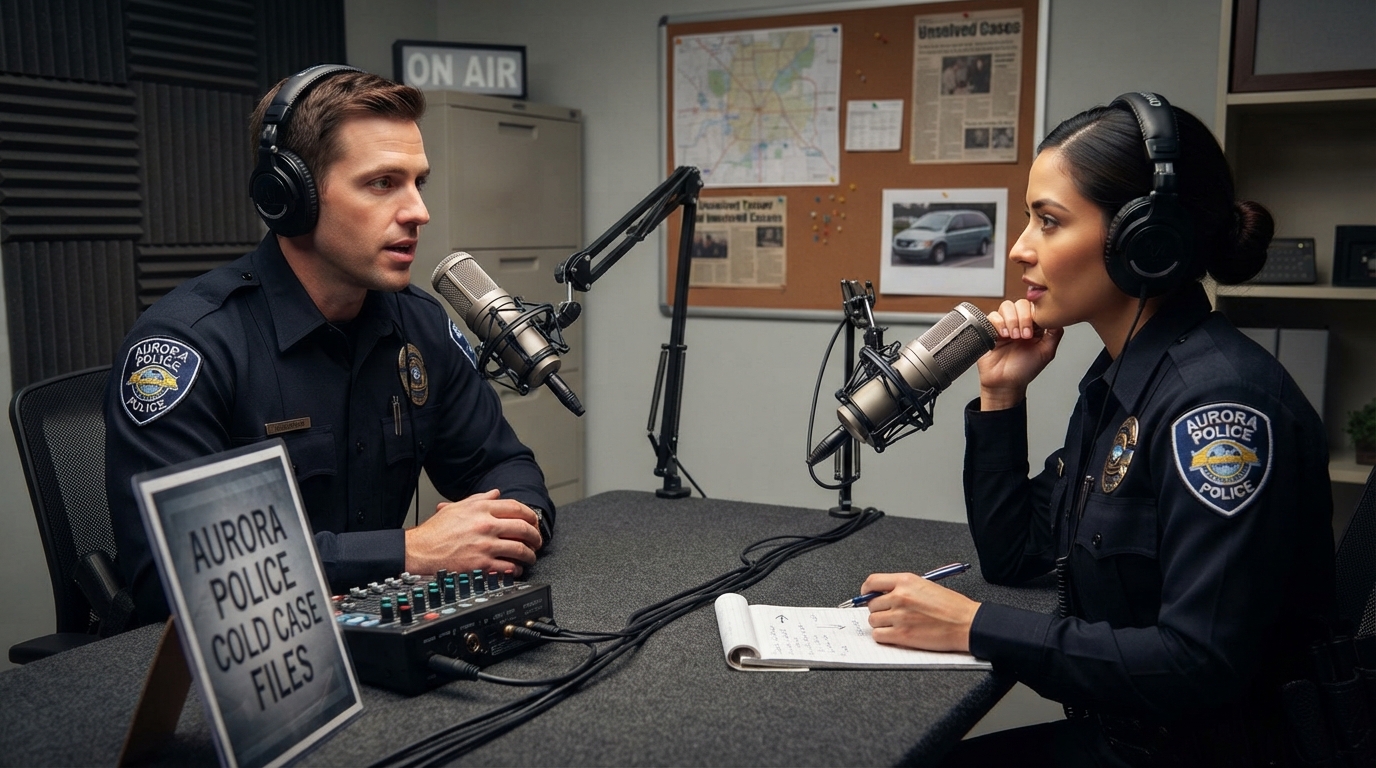
Law enforcement agencies in the U.S. are increasingly leveraging podcasts to crack cold cases and solve murders.
One notable instance involved Peter Chadwick, who was apprehended in Mexico 10 months and 20 days after California police launched a podcast detailing his alleged murder of his wife, Quee Choo Chadwick. He had been at large for nearly four years.
Similarly, in Illinois, a podcast about Karen Schepers' disappearance, which spanned over four decades, led to the discovery of her body in a river within weeks of its debut last year.
Now, the Aurora Police Department (APD) in Colorado has released its own podcast this summer, hoping to generate leads in the 2016 unsolved stabbing death of 21-year-old Chelsea Yasser, whose body was found in a shopping center parking lot.
As the true crime genre continues its widespread popularity, police departments both domestically and internationally are exploring podcast production as a tool for solving cold murder cases and other investigations.
"The true crime genre - whether it's TV, whether it's podcasts, whether it's books – I mean, it's wildly popular," stated Joe Moylan, APD's public information officer. "And we absolutely were deliberate in trying to tap into that broader audience."
While this investigative approach is still in its early stages, offering both advantages and disadvantages, experts anticipate its growth.
"I think it's a tool that everyone will eventually embrace," commented Michael Alcazar, a retired NYPD detective and adjunct professor at John Jay College of Criminal Justice. He noted that while true crime podcasts can sometimes disseminate inaccuracies, police-produced podcasts allow law enforcement to control the narrative and solicit new tips directly.
Alyce McGovern, an associate professor in criminology at the University of New South Wales in Australia, where law enforcement is also experimenting with podcasts, observed that while podcasts featuring former detectives are common, it's less frequent for police departments to produce podcasts specifically focused on cold cases and actively seeking tips, as seen with the California, Colorado, and Illinois departments.
These police-produced series are episodic, presenting crimes, victims, and investigations with engaging storytelling and details, reminiscent of the groundbreaking true crime podcast "Serial," which launched in 2014.
In Aurora, police aimed to create an equally compelling podcast that would encourage listeners to provide relevant information. The murder of Chelsea Yasser has been dubbed the "White Whale" by the podcasters, referencing "Moby Dick," due to its persistent challenge to investigators.
Yasser was fatally stabbed after entering a minivan in the parking lot, collapsing shortly after exiting. Although grainy surveillance footage captured the van during the assault, the images were too indistinct to identify a face, and DNA found under her fingernails did not match anyone in existing databases.
Upon the podcast's release in June, the APD informed listeners about new forensic genealogy technology being used to test the DNA and other ongoing investigative avenues.
Moylan explained that while the department had previously appealed for information on Yasser's murder, the podcast significantly broadens the reach for potential witnesses and tipsters. "If you weren't watching the news that night when it happened, or if you didn't pick up a newspaper, you might not know anything about this case, so we wanted to tap into that broader audience. Assuming that the suspect is still alive and out there somewhere, they could be anywhere in the country."
By the end of July, the podcast had been downloaded 7,184 times, generating several tips, one of which investigators are still pursuing.
However, many departments lack the necessary staff, budget, time, equipment, or expertise for podcast production. Others are hesitant due to concerns about potential repercussions, lawsuits, and civil liability, according to retired detective Alcazar.
The Newport Beach Police Department's podcast about fugitive Peter Chadwick, for instance, faced controversy. The first episode introduced Chadwick as "a man who killed his wife in the peaceful coastal community of Newport Beach, California in October 2012," despite him having only been charged and pleaded not guilty, not yet tried. Critics argued that the podcast's use of "murderer" without the qualifier "alleged" violated the principle of innocent until proven guilty and overstepped the police's investigative role into adjudication.
Jennifer Manzella, the public information officer who produced and hosted the podcast, defended the approach, stating that police "put out the same kinds of statements all the time." She told BBC News that her goal was to balance engaging storytelling with not jeopardizing the investigation.
After Chadwick's capture in August 2019, he pleaded guilty to second-degree murder and received a sentence of 15 years to life in prison.
Manzella clarified that a direct tip from the podcast did not lead to his capture, but it undeniably contributed by increasing pressure on Chadwick while he was on the run, making him more prone to errors. Furthermore, the podcast's awareness, which saw it reach Number 24 on the iTunes chart, facilitated obtaining warrants and extraditions "in record time." Following the podcast and Chadwick's capture, Manzella received inquiries from other departments interested in similar initiatives.
Not everyone was initially enthusiastic about the idea. Detective Andrew Houghton, now a co-host of the Elgin Police Department's podcast "Somebody Knows Something" in Illinois, admitted, "I initially was not really interested in it." He worked on the 2025 podcast alongside Detective Matthew Vartarian, with assistance from a local radio station.
Houghton and Vartarian had just been assigned to Elgin's new cold case unit in 2024 when their chief informed them that podcasting would also be part of their duties. "We're already starting this new unit," Houghton recalled. "Why are we adding something else new on top of that?"
Despite their initial reluctance, Houghton and his partner began structuring episodes, discovering that the process also helped them organize their investigation. They developed various theories about what happened to the missing 23-year-old, with each theory naturally forming an episode.
The podcast not only generated tips but also provided new avenues for leads, as detectives began monitoring social media posts about their program. "They'd say, like, 'Oh, my mom worked with this person, or I live in this neighbourhood and I remember this.'"
Ultimately, the detectives solved the case through traditional police work. One of their theories was that Schepers had crashed her car and ended up in the river. They found a 1999 local newspaper article claiming police had searched salvage yards by helicopter and dragged the Fox River, but there was no evidence the latter had actually occurred. They openly shared this with listeners.
The department then enlisted a search company equipped with advanced sonar technology and divers, leading to the discovery of Schepers and her car at the bottom of the river in March 2025.
Now in its third season, the podcast initially shifted its format in the second season to focus on homicides but has since returned to a missing persons case.
Houghton acknowledged that "it is a lot of work - it takes a lot of time and effort."
As other departments grapple with budgetary and resource constraints, there's a growing consensus that podcasts will become a more frequent investigative tool.
Janice Iwama, an associate professor in American University's department of justice, law and criminology, suggested that if police departments can sustain the staffing, podcasting could aid in both recruitment and staff retention by offering listeners insights into policing from the perspective of active officers.
Retired NYPD Detective Alcazar believes generational shifts will also drive this trend, as younger police officers are more likely to embrace the opportunities presented by podcasts and social media. "That's their world," he said. "That's what they're most comfortable with."