

How a shipwreck, a DNA test and Facebook solved a family puzzle
When a woman from Hull discovered she was half-Icelandic, she set out to track down her relatives.
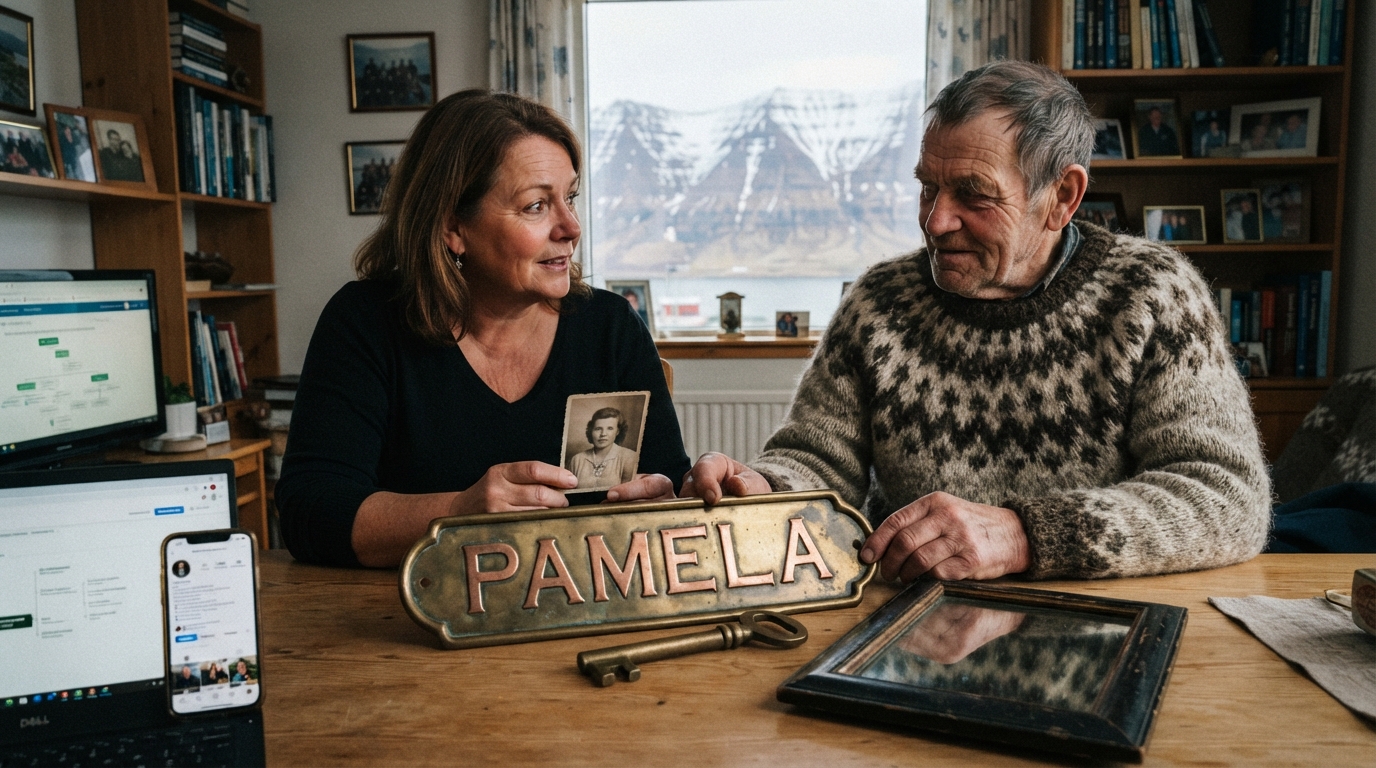
A family mystery spanning over a thousand miles has been unraveled thanks to a shipwreck, a DNA test, and a Facebook connection.
Yvette Holly, from Hull, shared her story on the "Hidden East Yorkshire" podcast, explaining that a DNA test two years ago revealed she was half Icelandic. Having never known her father, she decided to investigate his identity.
Using a genealogy website, Yvette identified individuals she believed to be her cousins, including a man named Barour Jon Grimsson, or Bari. She noticed they shared a mutual Facebook friend, Alec Gill, a prominent historian of Hull's fishing industry, and reached out to him.
Alec informed Yvette that Bari was researching the "Pamela," a ship that had been stranded off the Icelandic coast near Bari's grandfather's home. Yvette expressed her astonishment at the coincidence.
The "Pamela," a steam trawler, ran aground in a fjord on Iceland's north-west coast in 1915 due to severe weather. Bari recounted that the 12-man crew had to abandon the ship, which could not be refloated and eventually broke apart.
Over a century later, remnants of the "Pamela" still exist. Bari discovered them after his grandfather's death in Isafjorour in 1977. He recalled finding a beautiful copper-lettered sign bearing the name "Pamela" in an outhouse where items were being discarded. His grandfather had purchased it from a company that acquired the stranded ship and its contents.
After its abandonment, the "Pamela" was sold for 4,000 Icelandic krona (£24) and dismantled. The wheelhouse was repurposed as part of a garden room, and its metal plating was used for garden fences. In addition to the sign, Bari's grandfather also possessed a mirror and a large brass key from the wheelhouse. Bari noted that the ship, in its various parts, remained in Iceland for many years, just not in the fjord.
Alec Gill's research into the "Pamela" revealed it was built for North Sea fishing as part of a "box fleet" system, where trawlers fished collectively. Initially operating off the Yorkshire coast on the Dogger Bank, the outbreak of World War One transformed the North Sea into a war zone, forcing trawlers to seek new fishing grounds, with Iceland being a logical choice.
Alec explained that these ships were not designed for Iceland's rough, uncharted waters. He commended the bravery of the skippers who ventured to places like Bear Island, the White Sea, and even Greenland, making them vulnerable to the elements, which he believes led to the "Pamela" being washed ashore.
Bari, who worked on a North Atlantic trawler in the late 1970s and early 1980s, emphasized that fishing is deeply ingrained in his family's culture in Isafjorour. He stated that all his grandfathers were fishermen, living and dying by the sea. He described the harsh realities of winter trawling in the North Atlantic, noting the immense difficulty faced by the small ships of a century ago, equipped with old gear, in their quest for fish to survive.
Bari turned out to be a distant cousin of Yvette and helped her connect with her first cousins. Yvette provided him with names, and he reached out. Initially, her cousins were skeptical, believing it to be a scam, as they had no knowledge of an Yvette in England, a fact attributed to her father never knowing about her.
Since then, Yvette has visited Iceland, met a cousin, and seen where her father lived. Her father passed away in 1978.
Yvette highlighted the shared history between the people of Hull and Iceland, particularly concerning the dangers of the sea. She noted that Hull lost 6,000 men over a couple of hundred years, resulting in many families being raised by single mothers. She found a similar narrative in Iceland, where several of her relatives had drowned while fishing from small boats and ships.
Yvette concluded, "So we have the same story, just 2,000 miles apart. It's all about connections, strange, unknown connections."
More episodes of "Hidden East Yorkshire" are available on BBC Sounds. Highlights from Hull and East Yorkshire can also be found on BBC Sounds, and the latest episode of "Look North" is available for viewing.
The BBC News app can be downloaded from the App Store for iPhone and iPad or Google Play for Android devices.