

Ginger hair portraits show unexpected 'golden thread' connecting Americans
For Kieran Dodds, photographing people with red hair has become something of an obsession over the past decade or more.
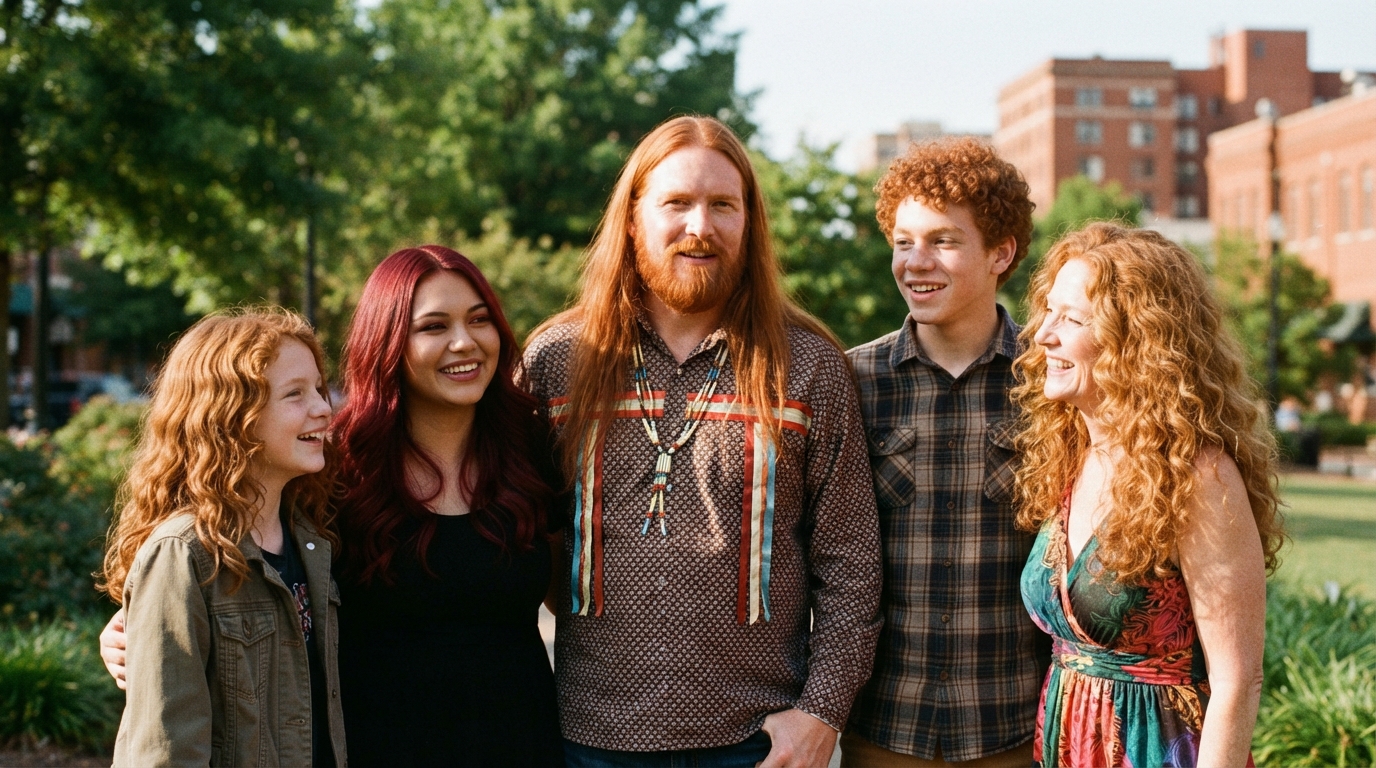
Kieran Dodds, a 45-year-old photographer from Edinburgh and a self-proclaimed "proud ginger," has spent the last decade captivated by photographing individuals with red hair. His journey began in 2013 in his native Scotland, as part of a project exploring Scottish identity. This fascination soon led him to other "ginger hotspots" like Perm, Russia, and Treasure Beach, Jamaica.
His 2020 book, *Gingers*, featured redheads from around the globe, but Dodds noticed a significant omission after its publication. "I realised I didn't have any American citizens," he told the BBC. This realization prompted an influx of contact from people across the United States. Dodds expressed a newfound patriotism for America, stating, "I was like 'oh wow, of course, the whole world is in the States.' It's a microcosm."
His curiosity was particularly piqued by a message from a Native American man with red hair. "I found it very interesting and it made me think, 'where on earth did it come from?'"
Joshua Elliot, a member of the Muscogee (Creek) Nation in Oklahoma, is featured on the cover of Dodds' latest book, *Gingers of America*. Elliot explained to Dodds that his mother's relatives were German, and his father's side included English and Swedish ancestry, which could account for his red hair. "My mom's side has always been involved with the Muscogee tribe and traditions and I've grown up around it," Elliot said. He acknowledged that his appearance might not align with common perceptions of Native Americans, but he shared a profound insight from his chief's wife: "Our chief's wife told me it's about your involvement in your community and your tribe, the people around you and what you put back into it. Which I really took to heart."
During his visits, Dodds spoke with many Native Americans, most of whom could trace their red hair to European ancestry. He was particularly struck by "how early on there were these Scots and Irish marrying Native Americans." Lottie Wahkinney, a Comanche girl from Oklahoma, has Scottish grandparents from Galashiels. Her father, Jared, told Dodds that his own father was Comanche, while his mother was born and raised in Scotland. "That's why my Lottie has a good mix of everything going on," Jared explained. He recalled his Scottish grandparents visiting every summer and his own experience in Scotland at age 22, where people asked, "'Where are your moccasins? Where's your headdress?'" to which he replied, "'I wear Nikes.'"
While most Native Americans could explain the origin of the ginger gene, one exception was Lakia, a Cherokee girl whose family had no known European ancestry. "It is a totally different colour of red," Dodds observed. "It's deep ruby. That really intrigued me." In the book, Lakia states that both sides of her family have jet-black, straight hair, but hers turned red during childhood. "Everyone thought, since I was about eight, that I dyed my hair," she said. "And still now everyone's like, 'what hair colour is that?'"
After encountering Native Americans, Dodds recognized the rich potential for exploration in the US. Over several years, he undertook seven extensive trips, often coinciding with his work as an environmental photographer. He found Alabama particularly surprising, a state often associated in the UK with racial segregation, the civil rights movement, and pioneering space exploration. "I knew it for racism and Nasa," Dodds said. "In my head it was stuck in the 60s but Birmingham is an incredibly vibrant city. I met a lot of black Americans who had often married someone who is white."
Rachel Releford shared with Dodds that when she is out with her daughter, Liliana, people often mistake her for the nanny or babysitter. "I'm like, 'nope, she's mine'," Rachel stated. She believes some people still hold onto segregated mindsets. "Some of my grandparents' friends were a little hesitant when they found out I was dating my husband. They said: 'You're really going to let her date someone of a different race?' But my grandparents were like, 'Go for it. He's a cool guy, he's a sweet one.' I love him for who he is. He's a great human being."
Also in Alabama, Dodds met Henry Davis and his young son, Henry Davis II. The elder Henry, who no longer has red hair, said he looked just like his son at that age. "We're not really sure where it comes from," Henry senior admitted. "My dad is turning grey now. He'll get some red in his beard, and then it kind of goes grey. So I guess it's from his side."
Having grown up with red hair himself, Dodds is aware that "ginger" can be used as an insult. However, he explains, "I use the word for its descriptive power because red is the colour of fire engines and blood whereas ginger has a golden tone to it. You can use it in a kind way." He views ginger hair in his book as "a golden thread" that intricately connects America's diverse and complex history, highlighting a shared human connection. "That's my big idea," Dodds said. "We are all made of the same stuff and with the ginger hair it shows."
Dodds believes no one embodies this idea better than a young man named Cali, whom he met in Alabama. "His background is everything - European, African-American, Hispanic and indigenous as well," Dodds noted. "His gran is white but was she unable to get married to a black guy in Alabama - even after the courts had made it legal. She moved to Georgia and had a family there. It's an incredibly diverse family."
In Scotland, approximately 13% of the population, or about 700,000 people, are natural redheads, the highest percentage globally. While less than 2% of the world's population has red hair, Dodds' research suggests the US figure is higher. "We landed on about 4% for the genetic prevalence," he stated. "If all the gingers in America were gathered in one place, Gingertown would be about 14 million people. It's a big city. You would see it from space it would be so bright."
Evelyn Lee, from Birmingham, Alabama, once disliked her ginger curls but now embraces them. "I think it's like Spanish princesses' flowing locks - like medieval paintings," she remarked.
Dodds observes that a key difference between America and other places is the conscious awareness of one's origins. "Everyone has self-consciously moved from somewhere," he said. "And that includes the Native Americans, who have been moved from other parts of America. That's what makes it interesting." He describes his book as a "road trip through the US trying to find out about the country through this unique trait."
Dodds believes the recent men's football World Cup reignited enthusiasm for the US, a sentiment that had waned due to political divisions in recent years. He was pleased to see visitors to the US remarking, "it is not what I expected." "There's such a lot of amazing people and communities there," he said. "People you might connect with and agree with on a lot of things. I'm quite heartened that the football has revealed that. I feel quite patriotic for America now."