

Former Uzbekneftegaz chief denies all 19 charges in $2.4 billion graft case
Tashkent Times is an English language online-newspaper that brings all latest Uzbekistan news
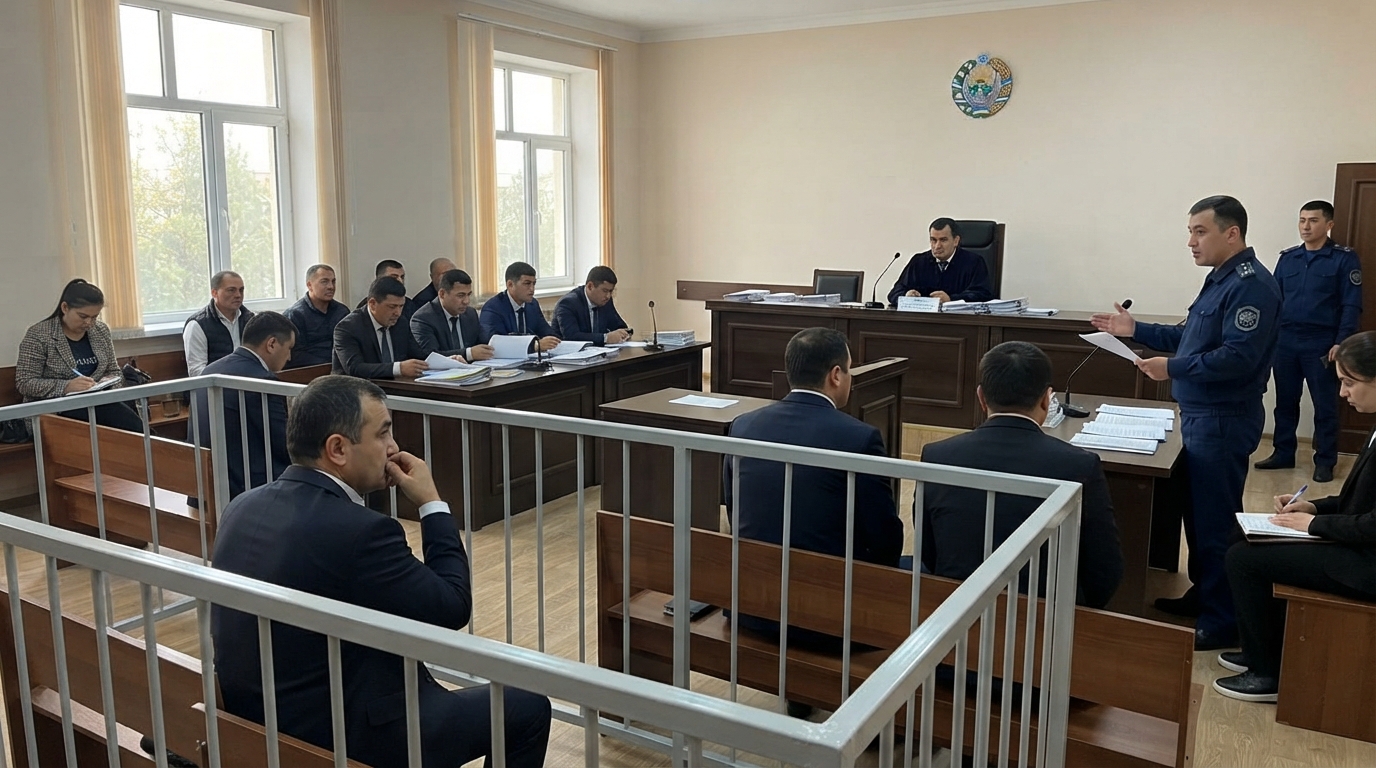
Bakhodirjon Sidikov, the former chairman of Uzbekneftegaz, has entered a plea of not guilty to all 19 charges in a $2.4 billion corruption case, providing testimony to defend his actions. He attributed the company's contentious decisions to the imperative of maintaining gas production, adherence to government directives, commitments to international creditors and investors, and commercial disagreements with contractors. The second session of the trial, presided over by the Yashnabad district criminal court, took place on July 31, following the initial hearing on July 24.
The court has yet to issue a ruling on either the prosecution's claims or the defendants' statements. The information presented here reflects the positions articulated by the parties in open court and does not represent facts established by the court. In accordance with the presumption of innocence, all defendants are considered innocent until their guilt is legally proven and confirmed by a final court verdict.
**Those Facing Trial**
In addition to Bakhodirjon Sidikov, the defendants include Ulugbek Usmonov, a representative of Enter Engineering; Nodirjon Boboev, a representative of Eriell Management; Bakhtiyor Anarkulov, former deputy chairman of Uzbekneftegaz; Dilmurod Burkhanov, the company's head of procurement; and Dilshod Hakberdiev, head of Maxsusenergogaz, an Uzbekneftegaz subsidiary.
Also on trial are Alisher Ochilov, head of Oilgasservisinvest; Khamidulla Asatov, head of Petromaruz Uzbekistan; and Masudjon Hashimov, head of Oil Ravon Servis.
Judge Jasurbek Ubaydullaev is overseeing the proceedings.
At the commencement of the hearing, the judge announced the addition of four new lawyers to the proceedings, some representing individuals whose property rights might be impacted by the case.
The hearing addressed assets seized during the investigation, including Lexus, Li Auto L9, BMW, and Mercedes-Benz vehicles.
One lawyer also reported the seizure of 15 real estate properties linked to a defendant. According to the lawyer, some of these homes are registered to the defendant's children, spouse, nephew, and assistant. The lawyer stated that some properties were inherited, while others were acquired with funds transferred from Russia.
The defense proposed questioning claimants to the seized property before calling witnesses. Conversely, the prosecutor argued that key witnesses should be questioned first.
The court granted some property owners or claimants the status of civil respondents, allowing them to attend hearings and protect their property interests without testifying as witnesses.
Sidikov's lawyer informed the court that at the time of his client's detention, Sidikov was a deputy of the Kungrad district council of people's deputies.
According to the defense, the prosecution, detention, or remand in custody of a sitting deputy required a submission from the prosecutor general and the consent of the Jokargy Kenes, the parliament of Karakalpakstan.
The lawyer stated that Sidikov was detained in January while still holding deputy status. The relevant decision, the lawyer explained, was only considered at a legislative session later, and Sidikov's mandate formally ended on June 15.
The defense contended that his detention and the taking of testimony during this period violated his parliamentary immunity, requesting the court to deem evidence gathered before the immunity was lifted inadmissible.
The judge stated that the admissibility of that evidence would be examined later, after reviewing the relevant materials, and declined to rule on the motion at this stage.
**Prosecution's Allegations**
Following organizational matters, the prosecutor began reading the charges.
The state prosecutor alleged that Bakhodirjon Sidikov orchestrated and led a group that assigned tasks among its members with the objective of embezzling Uzbekneftegaz's property and state funds.
According to the investigation, members of the alleged scheme prepared documents for projects they knew in advance had no prospects, submitted false information to state bodies, inflated the cost of equipment, works, and services, and transferred money for work that was incomplete or only partially completed.
The charges also pertain to an alleged failure to collect receivables and the transfer of oil-and-gas assets and financing to projects that the investigation claims could not have yielded the expected results.
This account reflects the prosecution's stance, which the court has yet to verify; the guilt of the defendants has not been established by a final court verdict.
Reading the indictment, the prosecutor cited a figure of approximately 2.4 trillion soums allegedly embezzled between 2020 and 2025. The total damage to Uzbekneftegaz was estimated at 7.8 trillion soums. The hearing did not clarify the relationship between these two figures or whether they overlap.
Since the defendants and their lawyers had already reviewed the indictment, the defense requested that it not be read in full. With no objections raised, the court permitted the prosecutor to summarize the main episodes and the relevant articles of the criminal code.
Bakhodirjon Sidikov faces charges under articles 167 (Embezzlement through misappropriation), 205 (Abuse of power or official authority), 209 (Official forgery), and 243 (Legalization of proceeds from criminal activity) of the criminal code.
Bakhtiyor Anarkulov is charged under articles 167, 205, and 209; Dilmurod Burkhanov under articles 167 and 209.
The other defendants—including Dilshod Hakberdiev, Ulugbek Usmonov, Alisher Ochilov, Khamidulla Asatov, and Masudjon Hashimov—are charged under articles 167 and 209 in conjunction with article 28 (complicity).
**Defendants Deny Charges**
After the charges were read, the judge asked each defendant to enter a plea.
Bakhodirjon Sidikov stated he did not admit guilt at all and disputed the charges. He later told the court he had not committed embezzlement and had acted in the company's interests, dedicating much of his testimony to explaining the economic and operational rationale behind the disputed decisions.
Bakhtiyor Anarkulov, Dilmurod Burkhanov, Dilshod Hakberdiev, Ulugbek Usmonov, Khamidulla Asatov, Masudjon Hashimov, and Nodirjon Boboev also denied the charges against them.
**Stake in Jizzakh Petroleum**
Sidikov was the first to testify, addressing each of the 19 episodes sequentially.
The first episode concerns the sale of a stake in Jizzakh Petroleum, which was later integrated into SANEG. The joint venture was established in June 2017 by Uzbekneftegaz and Gas Project Development Central Asia, a subsidiary of Gazprom International.
Prosecutors allege that the 49% stake was initially valued at over $80 million but was transferred to Belvor Holding Limited, a Cyprus-based company linked to SANEG, for $10 million, with the buyer failing to pay an additional $71 million.
Sidikov stated that the original deal was concluded in June 2021, before he became Uzbekneftegaz chairman, and that he had no role in negotiating its terms or signing the initial agreement.
The primary point of contention, he said, was the stake's valuation: KPMG, one of the world's "Big Four" audit and consulting firms, valued it at approximately $87 million; Deloitte, another Big Four firm, valued it at one soum; and PwC, brought in later, valued it at $15.1 million.
Sidikov explained that investigators consider the approximately $71 million discrepancy as damage, but he described it as the result of a valuation dispute between Uzbekneftegaz and the foreign buyer, Belvor, rather than embezzled funds.
The deal remained incomplete for about a year and a half, despite a government resolution calling for the stake to be transferred. Sidikov stated that after his appointment, he simply executed that resolution, and that Uzbekneftegaz pursued legal action in a commercial court due to the buyer's failure to meet its payment obligations.
As previously reported, Uzbekneftegaz sold its 49% stake in Jizzakh Petroleum to the Cyprus-registered Belvor Holding Limited in 2021.
**Handover of 106 Fields to SANEG**
The subsequent episodes concern the transfer of 106 oil-and-gas fields to SANEG and their cadastral registration.
Prosecutors allege that the fields were initially handed over for temporary use without finalized contracts, then scheduled for sale on a 10-year installment plan. Investigators claim the assets were sold for approximately 90 billion soums below their justified value, and the payment schedule was later eased.
Sidikov stated that the transfer had been mandated by a Cabinet of Ministers resolution adopted before his appointment, and denied that the fields' value had been lowered through a new appraisal.
He explained that only the tax component of the deal changed after the VAT rate was reduced from 15% to 12%, meaning the $9.6 million discrepancy cited by prosecutors does not reflect an undervaluation of the assets.
He attributed the extended payment deadline to the fact that the original government resolution already called for a 10-year installment plan. Changing the payment frequency from monthly to every six months, he said, also reflected constraints imposed by Uzbekneftegaz's international creditors.
The company, he stated, was in severe financial difficulty and had to comply with covenants on its external loans; new financing was capped at approximately $50 million a year, which he said was insufficient to cover the company's monthly expenses.
Separately, investigators claim that rights to some of the fields were not re-registered in time, and as a result, Uzbekneftegaz paid approximately 10.4 billion soums in land taxes on SANEG's behalf between 2023 and 2025.
Sidikov asserted that he had not acted in the interests of a private company, and that Uzbekneftegaz had sent formal claims and initiated court proceedings to recover the outstanding debt.
**Expansion of Shurtan Gas Chemical Complex and Ark Chemical**
One of the largest episodes concerns the expansion of the Shurtan Gas Chemical Complex and the establishment of the Ark Chemical joint venture.
In December 2021, following the launch of the GTL plant, the president ordered the construction of a new complex to triple Shurtan's capacity. The project was valued at $1.84 billion, with $629 million to come from Uzbekneftegaz's own funds and $1.21 billion from foreign loans.
The Shurtan expansion project, worth over $1 billion, had been underway since 2018, with Enter Engineering as the contractor, which received an advance payment of 693.7 billion soums.
In August 2022, following a Cabinet of Ministers meeting, the project was integrated into the larger MTO complex in the Bukhara province. Ark Chemical was created to implement the industrial cluster.
Prosecutors allege that Uzbekneftegaz held a 40% stake in the joint company while its private partner held 60% but failed to make its required contribution, and estimated the damage to state interests in this episode at 7.8 trillion soums.
Sidikov disputed that calculation, arguing that the investigation is effectively treating the normal investment process of an unfinished industrial project as damage.
Uzbekneftegaz, he stated, contributed assets and capital worth approximately $416 million, as valued by PwC.
The foreign partner was to provide a 60% stake worth about $660 million. Sidikov acknowledged that those obligations were not fully met but attributed this to the investor's financial difficulties—the partner had "Russian roots" and $200 million in financing from Gazprom—which he said worsened after Russia's invasion of Ukraine.
He stated that equipment orders and site work continued regardless, and in 2024, a groundbreaking ceremony was held with the country's leader in attendance. The partner's contribution was to be finalized once construction was complete, by 2028.
Sidikov said the involvement of the American company Air Products demonstrated the project's viability and its ability to attract international partners. He estimated the total cost of the Ark Chemical project at approximately $1 billion and the full MTO complex at $5.5 billion.
Responding to questions, he added that Uzbekneftegaz, as a 40% minority stakeholder, could not unilaterally control the decisions of the majority partner, halt its spending, or compel it to accelerate its investment.
**Uzbekistan GTL and the Guarantee to Air Products**
The next episode concerns obligations to Air Products under the Uzbekistan GTL project.
Sidikov stated that over 2,400 defects and deficiencies were identified after the plant was built, including around 50 critical faults at three main units, among them the air-separation equipment. As a result, he said, the plant was operating at only about 72% of capacity.
Failure to meet performance indicators required under loan agreements, he said, risked triggering a demand for early repayment of approximately $2.4 billion. Because the Ministry of Economy and Finance had guaranteed the obligations, the financial burden could have shifted to the state.
To resolve the problem, an agreement was reached with Air Products, with which the Uzbek government signed a $1 billion investment agreement in May 2023 to develop an industrial-gas processing complex as part of the Uzbekistan GTL plant in the Kashkadarya province.
Air Products President and CEO Seifi Ghasemi stated at the time that the company would own and operate two air-separation units, two auto-thermal reforming units, and a hydrogen production unit within the GTL complex, and would supply oxygen, nitrogen, hydrogen, and synthesis gas long-term under a take-or-pay, fixed-fee contract with Uzbekneftegaz, which in turn would supply feedstock, natural gas, and utilities and sell all output.
Three key units were to be handed over to the American company once their defects were fixed, with Enter Engineering responsible for the repairs.
Sidikov stated that neither the contractor nor Uzbekneftegaz had spare funds for a quick repair. Air Products agreed to finance the work, Enter Engineering was to repay the cost in three installments, and Uzbekneftegaz acted as guarantor.
When the contractor missed a $21.8 million payment, the state company settled the debt with Air Products. Sidikov said refusing to honor the guarantee would have damaged Uzbekistan's reputation with an international investor and risked triggering demands from creditors.
Before transferring the funds, he said, he informed the Presidential Administration and obtained approval. Enter Engineering's debt was to be settled through offsetting obligations tied to other work, including drilling and geological exploration.
Sidikov insisted the decision was made to preserve the project and maintain the confidence of foreign investors, not to grant the contractor an unjustified benefit.
**Compressor Station at South Tandyrcha**
Another episode concerns the construction of a booster compressor station at the South Tandyrcha field.
Work began in June 2021 and was due to finish by the end of that year. Sidikov noted he only took over as Uzbekneftegaz chairman in March 2023 and had no role in selecting the original contractor or signing the initial contract.
By autumn 2023, the project remained unfinished, yet the station needed to be brought online before winter to supply the population and the economy with additional gas.
Sidikov approved an accelerated schedule and signed off on directing 8.8 billion soums toward equipment, spare parts, and other components, stating the funds came from amounts already withheld under the existing contractor agreement rather than an increase in the project's overall cost.
He said these steps allowed the work to be completed and the station launched, and characterized the disputed sum as spending to revive a stalled project rather than damage.
**Equipment Failure at Surgil**
The Surgil field episode concerns costly compressor station equipment.
Sidikov explained that reservoir pressure at the field, originally around 200 atmospheres, had fallen to approximately 6, making continued production dependent on the compressor station.
He rejected the claim that an engine worth approximately 111.7 billion soums was missing or had been stolen, stating the equipment was delivered and installed, with photographs and reports to prove it. He said he had personally seen the engine during a visit to Surgil with the prime minister.
In June 2025, however, an accident occurred. According to Sidikov, an engineer from the foreign servicing company failed to remove technical plugs, causing the engine to run without oil and its temperature to rise to 220 degrees Celsius.
The equipment was sent for repair to Florence, Italy, and is expected to return in September 2026.
Sidikov stressed that he had not signed the original supply contract and said the fact that the engine existed and later broke down rules out the theory that it was stolen and never delivered.
**Two AI Engines**
Another episode concerns the purchase of two gas-generator AI engines worth approximately 162.5 billion soums combined.
Sidikov stated that Uzbekneftegaz operates around 100 similar engines, each with a service life of approximately 25,000 hours, requiring periodic repair or replacement; the company's annual need, he said, runs to 10-15 units.
Engines were previously supplied by Ukraine's Motor Sich, but supply problems led to a decision to build up a reserve of eight units. Two engines were purchased from Enter Engineering.
One, Sidikov said, remains in operation; the other ran for about a week—approximately 180 hours—before failing.
He acknowledged a question over the warranty period, since the engine had spent time in storage and the warranty may have lapsed, but described the matter as a commercial dispute over quality and warranty terms rather than theft.
"We didn't steal the money—we were trying to keep the population supplied with gas," Bakhodirjon Sidikov said.
He added that the contract had been signed by his deputy and that technical oversight of the project was handled by the relevant department.
**Diesel Fuel at the Gazli Gas Storage Facility**
Another episode concerns diesel fuel transferred to Enter Engineering to run specialized equipment at the Gazli underground gas storage facility.
Sidikov stated that the contractor received fuel worth approximately 3.8 billion soums and initially did not pay for it, though the contract allowed a 90-day grace period for voluntary repayment.
After the deadline passed, Uzbekneftegaz initiated commercial court proceedings to recover the debt, penalties, and other charges.
Sidikov said the investigation is attempting to criminalize an ordinary civil dispute between a customer and a contractor, that the statute of limitations had not expired, and that Enter Engineering later paid off the debt in full.
**Project at South Kemachi**
The tenth episode concerns an advance payment made to Maxsusenergogaz for a project at the South Kemachi field.
The contract was worth approximately 167 billion soums, with an advance of 54.7 billion soums, or about 30%. The feasibility calculations, Sidikov said, were carried out by Uzbekneftegaz's own design institute.
He rejected the claim that the project was doomed from the start, stating the advance was needed to order equipment and begin preparatory work.
Later analysis led to a decision to suspend construction after specialists concluded the gas could instead be extracted using an existing compressor station at the neighboring Kokdumalak oil-and-gas-condensate field.
Sidikov said this decision saved several million dollars and was made in the company's interest. After the contractor failed to return the advance, Uzbekneftegaz went to court in September 2025.
The funds were subsequently deposited into a General Prosecutor's Office escrow account. Sidikov said the money was never cashed out and the damage has been reimbursed.
**Compressor Station at Kultak**
The 11th episode also involves Maxsusenergogaz, with approximately 31.4 billion soums transferred.
Declining reservoir pressure meant that extending production at the Kultak field through 2044 required building a new compressor station.
Work had not begun because technical measurements were needed first—data required by both the contractor and the foreign manufacturer of the equipment to be installed at the station.
Sidikov rejected the suggestion that management deliberately avoided collecting the advance in order to later write off the debt, noting the statute of limitations does not expire until the end of 2028.
He also said that under his leadership, Uzbekneftegaz introduced an automated system to generate claims for receivables, which the legal department then filed in court.
Funds from this project, he said, were also deposited into the General Prosecutor's Office escrow account, and he again denied any cashing-out or money laundering.
**Gas Exploration Project in Afghanistan**
The 12th episode concerns a gas exploration project at the Tut-Maidan field in Afghanistan.
One of the prosecution's arguments, based on Sidikov's testimony, is the absence of a completed feasibility study. Sidikov countered that a full feasibility study cannot be produced before initial exploration establishes the size of reserves.
He said that amid declining domestic production, Uzbekneftegaz drew up a proposal to explore for and produce gas in Afghanistan and submitted it to the Cabinet of Ministers; the project was posted on a government portal and received official backing.
A company was created to carry it out. The Afghan side demanded a $24 million guarantee deposit at a local bank, with a further approximately $2 million earmarked for initial work including road construction and site preparation.
Sidikov stated that Uzbekneftegaz was to receive a 60% stake, with two other investors holding the remaining 40%. The state company provided $24 million to Eriell as a loan at 14% annual interest, for deposit at the Afghan bank.
The feasibility study was to be completed by the end of 2026, following preliminary exploration. Sidikov argued the project could secure gas supplies from Afghanistan and bolster Uzbekistan's energy security.
**Sale of Two Buildings to Anorbank**
Sidikov combined the 13th and 14th episodes, which concern the sale of two administrative buildings to Anorbank that prosecutors say were sold below market value, with alleged damage of approximately 58 billion soums.
Sidikov recalled that authorities had announced plans to relocate government bodies and organizations to New Tashkent, with construction of the new administrative center to be partly financed by selling off old buildings.
The properties in question were at 21 Istiqbol Street—owned by an Uzbekneftegaz subsidiary and housing the Ministry of Energy—and 85A Shahrisabz Street, the former Uztransgaz building.
Sidikov said several buyers had expressed interest, and that Anorbank founder Kakhramonjon Alimov said the bank was ready to buy both properties at a price set by independent appraisers.
At an open auction, the two buildings could have gone to different buyers, whereas the bank, given its large staff, needed both. Based on a government decision, they were sold directly: the Uzbekneftegaz building for approximately 254 billion soums and the Uztransgaz building for 185 billion soums.
The proceeds, Sidikov said, were transferred in full to the directorate overseeing New Tashkent's construction.
A further approximately 12 billion soums cited in the indictment in connection with renovation of one of the buildings, Sidikov said, represented a debt for work already completed.
He also argued that the Cabinet of Ministers had the authority to approve a direct sale or closed auction, under powers granted by a presidential resolution.
**Sale of Jarkurgan Neft**
The 15th episode concerns the sale of the Jarkurgan Neft asset to Petromaruz Uzbekistan, with the indictment citing a figure of approximately 254 billion soums.
Sidikov said the deal was concluded before his appointment, under a government decision allowing a five-year installment sale.
Several firms, including Ernst & Young, carried out valuations, and Sidikov rejected claims of an unjustified gap between the estimates.
After the buyer failed to meet its payment obligations, Uzbekneftegaz went to court, which ordered recovery of 72.6 billion soums plus penalties.
Sidikov also addressed allegations that Petromaruz subsequently transferred funds to other private companies' accounts, saying Uzbekneftegaz had no control over how a private company used its own money.
He said the sale's basis was a Cabinet of Ministers resolution, and that the buyer's non-payment became a matter of commercial dispute and court-ordered recovery, not embezzlement.
**Drilling at the Berdakh Field**
The 16th episode concerns the hiring of the Russian company Energiya Neftegazovogo Servisa (ENGS) to drill at the Berdakh field.
According to Sidikov's testimony, prosecutors compared the Russian contractor's cost with an estimate from Uznefgazburgilash Ishlari, an in-house Uzbekneftegaz drilling company. The local firm valued the work at approximately 59.8 billion soums, versus approximately 106 billion soums for the foreign contractor.
Sidikov said the terms differed: the local company planned to drill the well in about 200 days, while the Russian firm promised to finish in 90 days. The contractor also offered financing from Russia, a six-month payment deferral, and settlement in rubles.
He attributed the need for an outside contractor to a shortage of in-house capacity—the local drilling company had 23 rigs against an annual plan calling for approximately 100 wells.
Sidikov said the goal was to speed up work and boost output, not to create a price gap for embezzlement.
Under questioning from the prosecutor, it emerged that the promised 90-day timeline was not met—the work actually took about 197 days, nearly matching the local company's original schedule.
Sidikov responded that contractor selection weighed more than promised timelines alone, including track record, technical capacity, and access to financing.
He said the drilling ultimately yielded about 6 billion cubic meters of gas, helping cover part of winter demand—a claim the court has yet to verify against the specific contract in question.
**Pipe Delivery**
The 17th episode concerns a pipe delivery from Oil Ravon Servis worth approximately 37.1 billion soums.
Sidikov noted the purchase began before his appointment: the goods were listed on the commodity exchange in January 2023 and the contract signed in February, while he became Uzbekneftegaz chairman only in March.
He said he could not, "physically or legally," have organized the alleged collusion in selecting the supplier or signing the agreement.
Sidikov also disputed claims the delivery was fictitious, saying the pipes were actually delivered, inspected, and accepted by a commission, with acceptance certificates and staff testimony confirming their existence.
The supplier later sought to recover approximately 20 billion soums in principal debt and about 10 billion soums in penalties; the parties reached a mediated settlement in August 2023.
Sidikov described the episode as a payment dispute over genuinely delivered pipes, not theft of funds.
**Turbine Equipment Repair**
The 18th episode involves turbine equipment repairs and the company Oilgasservisinvest, with alleged damage of approximately 15.1 billion soums.
Sidikov said Uzbekneftegaz initially planned to hire Siemens, but the repair could not begin for eight months. Needing the equipment back in service sooner, the company turned to Germany's Chemie Elektronik—represented by Oilgasservisinvest—which promised to complete the work in three months for about 13 billion soums.
Sidikov said his deputy handled the project, negotiated the terms, and signed the contract, and that he himself did not intervene in those decisions.
The contractor missed the deadline. Uzbekneftegaz sent formal claims in September and December, then went to court seeking approximately 15.5 billion soums plus about 4 billion soums in penalties.
After the criminal case was opened, more than 15 billion soums was transferred to the General Prosecutor's Office escrow account.
Sidikov said the money has been returned and the episode should be treated as a breach of contract rather than irrecoverable damage to the state.
**Money-Laundering Charge**
The final, 19th episode concerns article 243 of the criminal code—legalization of proceeds from criminal activity.
Sidikov said investigators had seized approximately 20 real estate properties and four vehicles linked to him and his relatives.
He said the list included property belonging not only to close family members but also to distant relatives, people who share his surname, and individuals he does not know.
Some of the real estate, he said, was acquired between 2014 and 2018 and in 2022—before he became Uzbekneftegaz chairman.
Sidikov rejected the claim that this property was purchased with proceeds from the crimes he is accused of.
After Sidikov's main testimony, the prosecutor and defense lawyers questioned him on specific episodes.
The prosecutor pressed him on why the Russian contractor, which had promised to drill a well in 90 days, actually took about 197. Sidikov again pointed to the overall terms of the contract—the company's experience, technical capacity, and the financing it provided.
"It's like comparing the cost of plov cooked at home to plov ordered at a restaurant," he said of the difference in cost between contractors.
The parties also returned to the valuation of the transferred fields. Sidikov repeated that the value of the assets themselves had not changed, and that the discrepancy in the figures stemmed from the cut in the VAT rate.
A defense lawyer asked who made the decisions to transfer the property. Sidikov said the lists of assets and terms of transfer were approved by government resolutions.
On Ark Chemical, Sidikov reiterated that Uzbekneftegaz held only a 40% stake and could not unilaterally dictate the actions of its majority partner.
He also said next year's gas production plans were drawn up jointly with specialists from Schlumberger, determining where output could be increased, how many wells needed to be drilled, when to bring compressor stations online, and what technical measures were required to meet the plan—projections, he said, that formed the basis for hiring contractors and financing projects.
Sidikov also said that in discussing projects and contracts with Enter Engineering, the Russian company Energiya Neftegazovogo Servisa, and Eriell, he dealt directly with Bakhtiyor Fazylov, described as the beneficiary of those companies.
He said he did not know what role Ulugbek Usmonov, the Enter Engineering representative also on trial, played in the projects in question, and had not seen him take part in negotiations or decision-making.
The journalist noted he had attended the previous hearing and had already published coverage of the case. The court had earlier restricted photography, video, and audio recording, but had not banned written coverage of the open trial.
After the assistant informed the judge of the journalist's presence, the judge confirmed his identity and urged caution in publishing information.
The judge said, however, that he could not ban coverage of the hearing, since the trial is open and freedom of the press applies. Several lawyers subsequently spoke out against publishing the defendants' testimony.
The case continues. The court still has to examine documents, question the remaining defendants and witnesses, verify the damage calculations, and rule on the arguments made by the prosecution and defense.
Until the trial concludes, the allegations of embezzlement, abuse of power, sham projects, and money laundering remain the prosecution's version of events, subject to the court's review. Sidikov's explanations—citing operational necessity, compliance with government resolutions, and ordinary civil disputes—have likewise not yet been assessed by the court.
The next hearing is scheduled for today, August 7.