

Faisal Islam: Four reasons why Fifa's World Cup plan never stacked up
The actual presentation of FIFA's plan to part-privatise the World Cup raises many more questions than it answers.
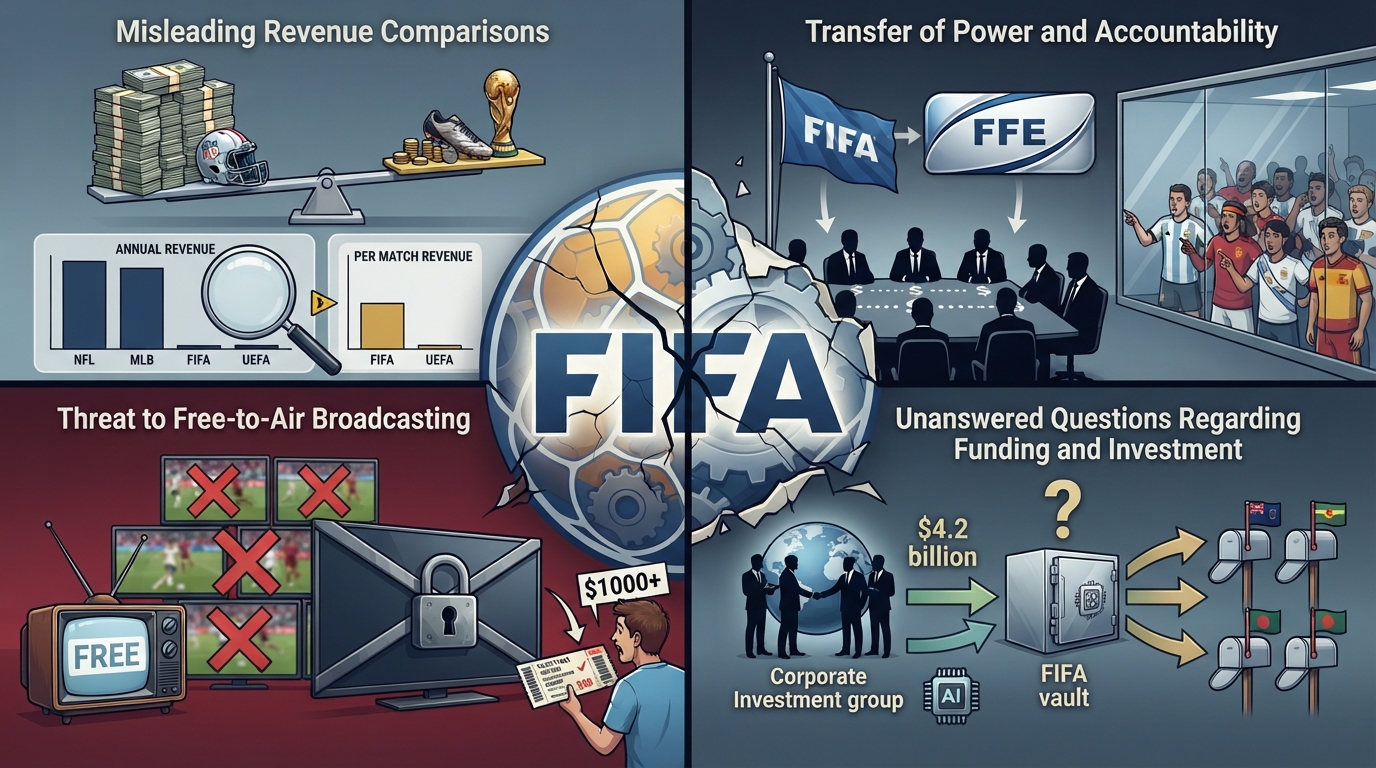
Faisal Islam: Four Reasons Why FIFA's World Cup Privatization Plan Was Flawed
Documents reviewed by the BBC, outlining FIFA's proposal to partially privatize the World Cup, reveal the underlying issues that likely led to the deal's collapse.
A sales presentation, circulated to FIFA members this week, advocated for Gianni Infantino's contentious plan. The 25-page slide deck, featuring images of the Spanish team celebrating their victory and Argentine fans, projected revenue expectations on par with American football. This suggested a potential continuation and expansion of the controversial, US-influenced 2026 World Cup model. The proposal hinted at ticket prices exceeding $1,000, dynamic pricing strategies, and a push to place broadcasting of the world's largest sports tournament behind a paywall.
The documents clearly indicate that FIFA's plan and its justifications were fundamentally unsound. Here are four key reasons why:
**1. Misleading Revenue Comparisons:**
FIFA's central argument in the slides was that football generates insufficient revenue relative to its fanbase, claiming "Fifa has been under-monetised versus other leagues," which consequently "global football development gets squeezed." This was supported by a comparative chart displaying annual revenue and revenue per fan for FIFA, the UEFA Champions League, Premier League, US baseball, and NFL American football.
Superficially, FIFA appeared to be the less affluent counterpart, with only $1 per global fan compared to the NFL's $52.8. However, this metric is highly questionable. The World Cup is a quadrennial event, not an annual competition. If revenue were instead calculated per match for the 2026 World Cup, FIFA would generate multiples of the Premier League's revenue, possibly more than three times as much.
Crucially, football is globally decentralized, meaning a larger portion of revenues flows to individual leagues like the Premier League or Champions League. FIFA was essentially arguing for a larger share of the overall football revenue pie. Furthermore, football's fanbase is globally dispersed across both affluent and developing nations. The NFL, in contrast, has a much smaller, concentrated base primarily within the US and largely encompasses American Football as a whole.
Finally, approximately half of the NFL's revenues are allocated to player wages. FIFA does not pay players such as Erling Haaland, Lionel Messi, or Vozinha. Focusing on profits rather than just revenues would have presented a significantly different picture than the chart suggested.
**2. Transfer of Power and Accountability:**
According to the document, the proposed partly privatized entity, named Fifa Forward Enterprise (FFE), would have assumed the role of "organiser and operator of competitions" – specifically the World Cup – and would be responsible for ticketing, broadcasting, licensing, and sponsorship. This would have represented a clear transfer of organizational authority from a non-profit entity accountable to the entire global football community to a privately-backed company, albeit one with a majority of FIFA board members.
The slides stated that the FFE structure would "expand and optimise media rights monetisation" and "maximise the value of Fifa IP [Intellectual Property], which has been undermonetised, historically." This would have shifted responsibility and accountability away from FIFA itself.
**3. Threat to Free-to-Air Broadcasting and High Ticket Prices:**
By highlighting the NFL's revenue per fan in the document, FIFA raised concerns about the future of free-to-air World Cup games. While protected by legislation in the UK and Europe, digital rights are expected to undergo significant changes in the coming years. This approach could also have clearly supported the continuation of the extraordinary ticket prices seen in 2026.
**4. Unanswered Questions Regarding Funding and Investment:**
FIFA had previously announced its intention to grant FFE a 20% stake in the organization, which would initially raise $4.2 billion. The document clarified that this initial cash injection would fund an "extraordinary distribution" of $20 million to each of the 211 member associations. This explained the $4.2 billion funding requirement. Essentially, the funding would have provided a $20 million one-off payment for infrastructure to every voting association that would have decided on Infantino's plan.
For instance, this would have meant providing Montserrat with a sum equivalent to nearly half its entire economy, or $10,000 per person, and the same for Bangladesh, a massive, highly-populated growth market for global football development.
Crucial questions remained unanswered: Where would the additional money for future FIFA investment come from, given that the new investment would be immediately distributed to voting members? How much would actually be repaid to FIFA as an "annual license payment," as referenced in a flow diagram in the charts but not quantified? Would this payment be fixed or proportionate to revenues? Did FFE have a mission to maximize revenues at all costs to provide returns for investors? None of these vital questions were addressed in the document.
The private timetable outlined in the document indicated that investors would gain access to materials starting this month. Terms were to be confirmed by September, with bids and fund transfers by the end of October. This demonstrated the advanced stage of the plans and the rapid pace at which members were being asked to make a decision.
The lead investors were publicly identified as Thrive Eternal, led by Joshua Kushner, brother of President Trump's son-in-law, Jared. Thrive's primary focus was AI investments, with OpenAI holding a stake in one of its divisions. Thrive only launched its sports investment arm in April, with an investment in the San Francisco Giants baseball team, pioneers in sport-based dynamic ticket pricing. Kushner stated that the fund would concentrate on certain live sports, as "these are assets with qualities that cannot be replicated by technology." This investment thesis posits that the value of certain forms of entertainment, which cannot be replaced by AI (unlike music or some films), will appreciate in the coming years.
Ultimately, the proposal presented an opaque structure designed to perpetuate the 2026 experiment with high ticket prices, commercialization that would exert pressure on broadcast costs, and inevitably lead to more matches and more frequent tournaments. A proposal that ultimately collapsed within days.