

'End this nightmare': Wife of ailing Briton jailed in Saudi Arabia appeals for release
Ahmed al-Doush has been in jail in Saudi Arabia since 2024, apparently over a handful of social media posts dating back several years.
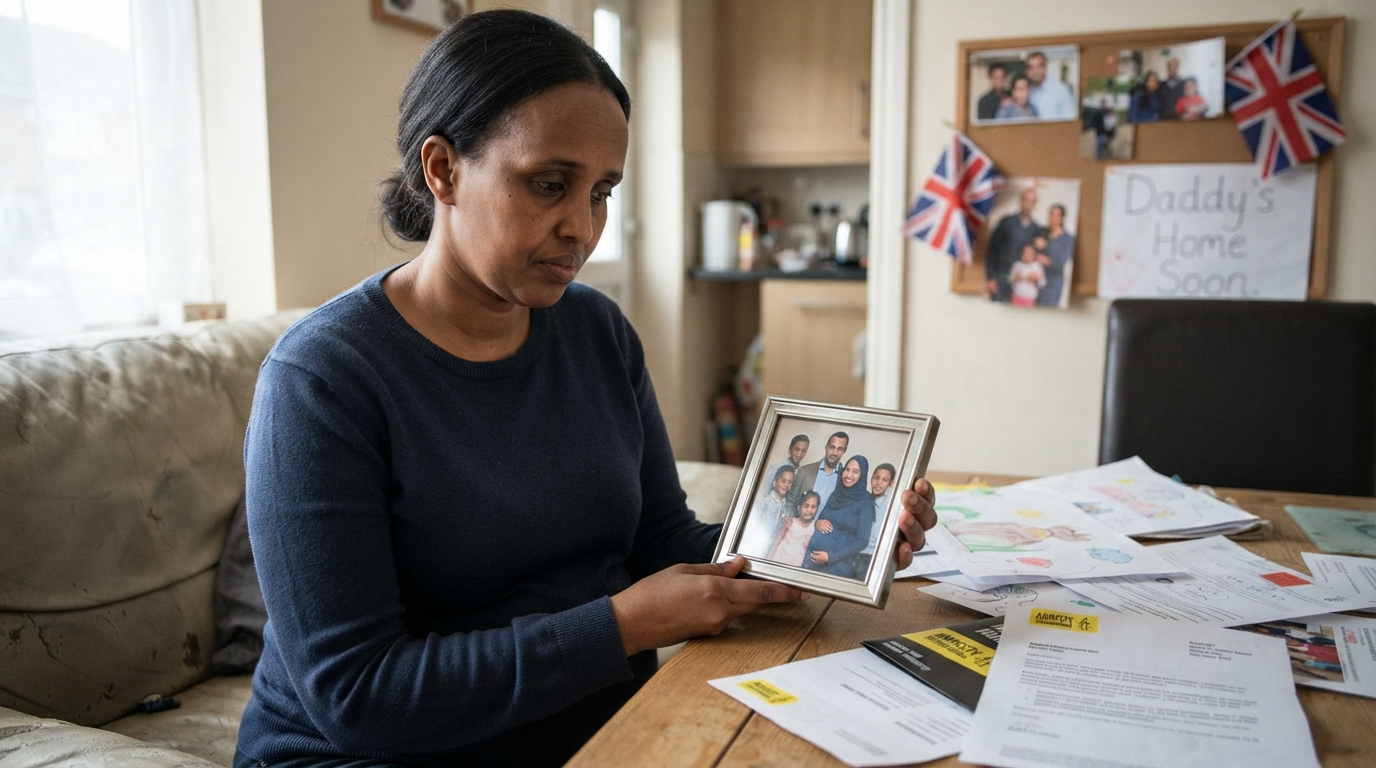
"End this nightmare," pleads the wife of a British man, Ahmed Al-Doush, who is currently imprisoned in Saudi Arabia, as she appeals for his release. Al-Doush was jailed around the time his wife gave birth to their fourth child.
Amaher Nour is overcome with emotion when she considers her husband, whom she has not seen for nearly two years, and the profound impact his absence has had on their four children. Ahmed Al-Doush, a British business analyst from Manchester, has been incarcerated in Saudi Arabia since August 2024. His detention reportedly stems from a few social media posts made several years ago.
Amnesty International, a human rights organization advocating for his release, states that Al-Doush was convicted in an unfair trial on charges that infringe upon his right to freedom of expression. Al-Doush and his family were visiting Nour's brother when he was apprehended at Riyadh airport while returning home with his pregnant wife and three children.
"Our children constantly ask about their dad," Nour shares. "I tell them that he's away working because I don't want to say that he's in prison, as they're old enough to know that prison is a place where you go if you've done something bad. And he's done nothing wrong."
She explains that she is unaware of the precise reason for the 44-year-old's detention, but she knows, from the phone calls he is permitted, that he is struggling mentally. "His voice is often unrecognisable, he is fatigued and confused why the British government aren't doing more to get him home safely," she states. "He has been on multiple hunger strikes and we have often been kept in the dark about this." He has not yet met his youngest child.
In April, then-UK Prime Minister Sir Keir Starmer met with Saudi Crown Prince Mohammed bin Salman in Jeddah. The UK Foreign Office has confirmed that Al-Doush's case has been brought to the attention of the Saudi authorities.
The UK's current travel advice warns that it is illegal in Saudi Arabia to make any public statements that the authorities "deem disruptive to public order." It also advises visitors to refrain from commenting on the royal family, the Saudi authorities, or "issues that could be perceived as political."
"Speaking publicly about these issues can be defined by the Saudi authorities as posing a threat to national security," the advice specifies. It further adds: "Statements made on social media many years ago, or those published outside Saudi Arabia, may be taken into account. Punishment can include long custodial sentences."
Al-Doush's legal team in the UK states that despite repeated requests, neither they, his family, nor the UK government have been granted access to any legal documents pertaining to his case, including the judgment. Consequently, they do not fully comprehend the charges against him or the basis of his conviction.
However, his London-based lawyer, Haydee Dijkstal, indicates that he appears to have been questioned about several tweets posted in 2018—and subsequently deleted—concerning Sudan, his birthplace, and his acquaintance with the son of a UK-based Saudi dissident.
Dijkstal explains that Al-Doush was initially held for five months without charge and interrogated without a lawyer before being sentenced in May 2025 to 10 years in jail by Saudi Arabia's Specialised Criminal Court. This court is understood to have convicted him of using social media to disseminate fake news against the government. Human rights groups assert that this court has been utilized as a political instrument, relying on vague counterterrorism and cybercrime laws to penalize online expression.
This April, Al-Doush's sentence was reduced on appeal to five years. Nevertheless, his physical and mental health continue to deteriorate, according to his wife.
Amnesty International reports that he is being held in a cell designed for six to eight people, which currently houses approximately 16 prisoners. His phone calls home have been frequently restricted, the group notes. Furthermore, he has been warned that he will face punishment if he discusses his health or his legal case.
"Ahmed Al-Doush has a family in the United Kingdom who urgently need him. He has been imprisoned for nothing more than social media posts—posts that would raise no eyebrow in any democratic country," states Eilidh Macpherson of Amnesty International UK.
"His health is now in crisis, and every day he remains detained is another day of unconscionable injustice inflicted not just on him, but on four young children who are growing up without their father."
"The Saudi authorities have the power to end this nightmare today," she adds. "We call on them to act without delay: release Ahmed Al-Doush and allow him to return home."
The group has also urged governments worldwide to update their travel advice to ensure visitors to Saudi Arabia are aware of the risks that their past social media activity could entail, especially as the country prepares to host the World Cup in 2034 and other major events.
Ahmed Al-Doush's physical and mental health are deteriorating, his wife confirms. The Saudi embassy in London has not responded to a BBC request for comment on Al-Doush's case.
However, the Saudi authorities informed the UN Working Group on Arbitrary Detention (UNWGAD) that "there was evidence proving that Mr al-Doush had committed terrorist crimes, including his support for terrorist ideology."
UNWGAD's independent experts concluded in March, however, that his detention was arbitrary under international law, based on a series of violations of the Universal Declaration of Human Rights in his case. They subsequently called for his release.
"The government has not provided detailed or substantiated information indicating why Mr al-Doush presented a violent threat to the community through his actions such that detention was strictly necessary," they stated.
In May, Al-Doush's wife directly appealed to Crown Prince Mohammed bin Salman, Saudi Arabia's de facto ruler, to grant him clemency on humanitarian grounds.
"Ahmed's absence has left a void which is impossible to fill," Nour tells me. "The children constantly ask for their father and struggle to comprehend why he isn't home for bedtime or take them out as he used to. He was a very loving, involved father." She has put away his clothes to prevent the children from being constantly reminded of him.
"I am pleading for the UK government to recognise the UN's finding on arbitrary detention and the need for his immediate release, and to support the request that he is granted clemency on humanitarian grounds given his deteriorating wellbeing and need to be reunited with his young children," she says.
In related news, a man who mocked the Saudi leader on YouTube reported that his phone was subsequently hacked and he was beaten up in London. Rights groups have also condemned a new record number of executions in Saudi Arabia. Additionally, a US citizen jailed in Saudi Arabia for criticizing the regime has been permitted to return to the US.