

Court Delivers Verdict in Tashkent Overpass Collapse Case
A Tashkent court has convicted six officials and contractors following the partial collapse of an overpass, imposing fines and ordered budget repayments.
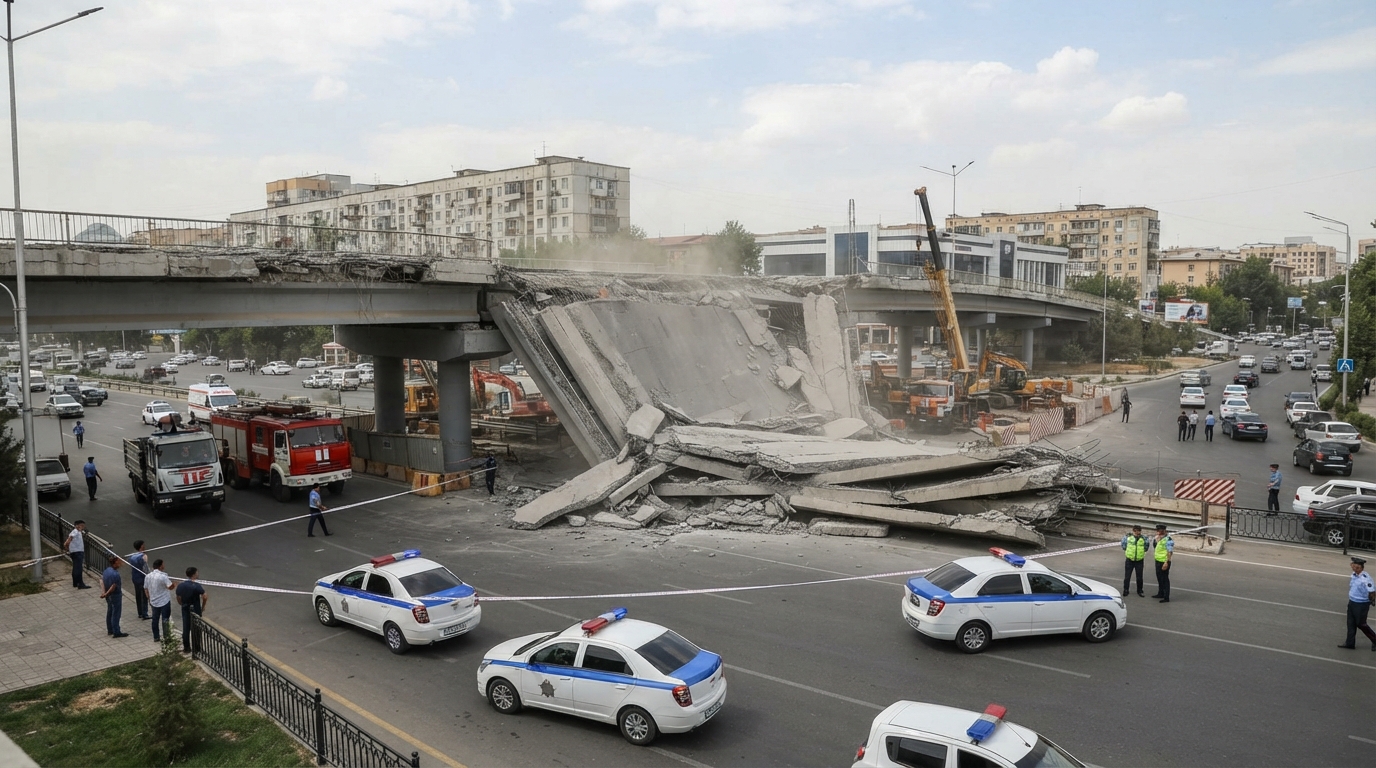
**Tashkent Court Issues Verdict in Overpass Collapse Case, Finding Six Guilty of Embezzlement and Forgery**
Tashkent, Uzbekistan (UzDaily.uz) – The Mirzo-Ulugbek District Court in Tashkent has rendered its decision in the criminal proceedings stemming from the partial collapse of an overpass situated at the intersection of Temur Malik and Buyuk Ipak Yuli streets. Six individuals faced charges and were ultimately convicted of official forgery and the misappropriation of public funds.
The structural failure, which occurred on March 12, 2026, involved an overpass that had been operational since August 2024. This incident triggered a comprehensive criminal investigation. Investigators determined that construction activities valued at 6.177 billion soums were executed with significant safety breaches. Furthermore, an additional 1.2 billion soums was disbursed based on falsified documents for work that was never performed. The total financial detriment to the state budget was calculated at 7.377 billion soums.
The defendants in the case were identified as: Akmal Murodov, Deputy Director of the Tashkent Regional Branch of Uzyulkuprik Cluster State Institution; Sanjar Mannonov, Deputy Director and Chief Engineer of the Directorate for Construction and Reconstruction of Public Roads; Zafar Sharakhmedov, Chief Specialist of the Directorate's Technical Supervision Department; Abdumutal Isropilov, Production Department Head at Uzyulkuprik Cluster; Nurshod Mavlonov, Chief Project Engineer at Yol Loyikha Büroisi LLC; and Obid Adilov, Director of Grand Nur Yo‘l Qurilish LLC.
According to court records, the reconstruction of a segment of the Tashkent Ring Road and the construction of the overpass were authorized by a Cabinet of Ministers resolution dated March 24, 2022. In 2024, contractor agreements exceeding 213 billion soums were finalized.
The investigation brought to light that critical stages of the construction process deviated from technical standards. Moreover, reports of completed work erroneously included the installation of a basalt geogrid, valued at 433 million soums, and a sand-gravel mixture, valued at 766 million soums, despite these tasks never having been carried out.
Five of the six defendants maintained their innocence, asserting that the documented violations bore no direct causal link to the overpass's collapse and that certain disputed works were only incorporated into a supplementary cost estimate. Only Abdumutal Isropilov offered a partial admission of guilt, acknowledging that specific tasks were completed prior to the final approval of design and cost estimates.
Under the directive of the Transport Prosecutor’s Office, specialists from the Republican Center for Forensic Expertise and other relevant agencies conducted an on-site inspection. Experts identified widespread non-compliance with building codes, including insufficient rebar anchorage length, errors in mounting, excessive concrete cover thickness, the presence of cold joints, and improper concreting techniques. The expert consensus was that the collapse could have been averted had proper construction standards been adhered to.
The court ultimately found all six defendants guilty under Article 167 (embezzlement) and Article 209 (official forgery) of the Criminal Code. Five of the defendants were each ordered to pay a fine of 116.2 million soums, while one defendant received a fine of 112.5 million soums. Additionally, all six individuals were prohibited from holding managerial and financially responsible positions for a period of one year.
Furthermore, the court mandated that the 7.377 billion soums previously deposited into the Prosecutor General’s Office account be transferred to the state budget.