

Construction of 27,000-kilometer mega-ring begins in China
The Chinese government has launched a project to build a single transport ring along the country's land borders and sea coasts, with a total length of more than 27,000 kilometers. The project will be implemented as part of the 15th Five-Year Development Plan for 2026-2030.
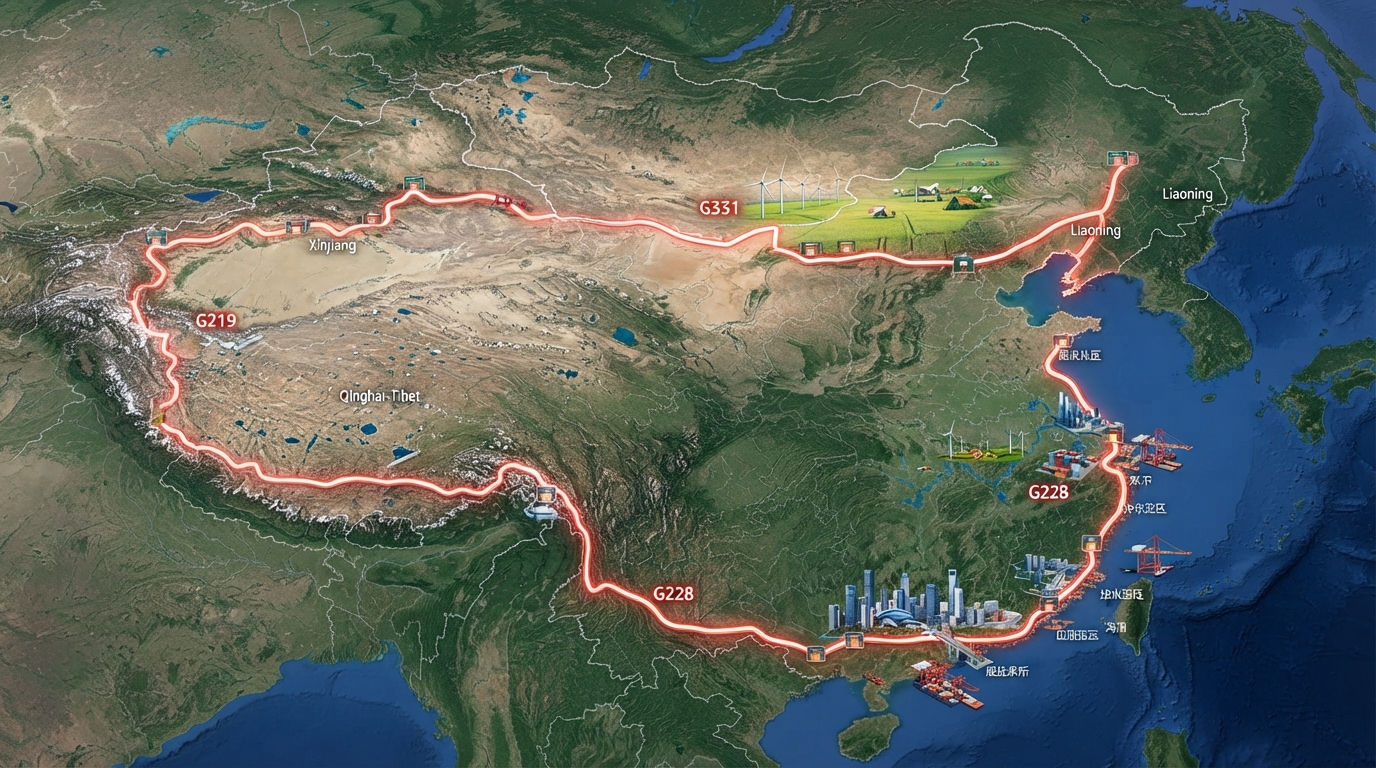
China has begun construction of a massive transport ring spanning more than 27,000 kilometers. According to the Chinese Ministry of Transport, the new system will consist of three national highways – G219, G331 and G228 – that will span almost the entire perimeter of the country.
These three highways will be interconnected in the Xinjiang Uygur Autonomous Region, Liaoning Province and Guangxi Zhuang Autonomous Region. As a result, a system will be formed that will connect the northern, western, southern and eastern coasts of China into a single transport network.
The longest section of the transport ring is the G219 highway, which is almost 10,000 kilometers long. This road starts in the Kanas region of Xinjiang and reaches the city of Dunxin in Guangxi. It passes through deserts, the Qinghai-Tibet Plateau, the Himalayas, deep gorges, glaciers and wetlands.
The G331 highway is about 9,200 kilometers long, running from Dandong in Liaoning to Altai in Xinjiang. It crosses China's northern borders, the steppes of Inner Mongolia, and the country's major agricultural, forestry, and energy regions.
The G228 highway, which runs along the east and south coasts, is about 7,400 kilometers long. It connects the cities of Dandong and Dunxin, connecting dozens of port cities and the basins of the Yangtze and Pearl Rivers.
China's Ministry of Transport said that this project will not only expand the highway network, but also help develop the country's border areas, develop natural resources, and promote domestic tourism. The transport ring will also connect hundreds of natural and historical sites, as well as major industrial, energy, and agricultural centers.
The project will integrate more than 100 major border crossing points and numerous seaports into a single transport network. This is expected to improve logistics efficiency, develop foreign trade, and further strengthen the economic and transport potential of border regions.