

Climate-Smart Technologies Strengthen Uzbekistan Horticulture
The FAO and ISCAD are implementing a project in Uzbekistan to boost commercial horticulture resilience through climate-smart and precision farming technologies.
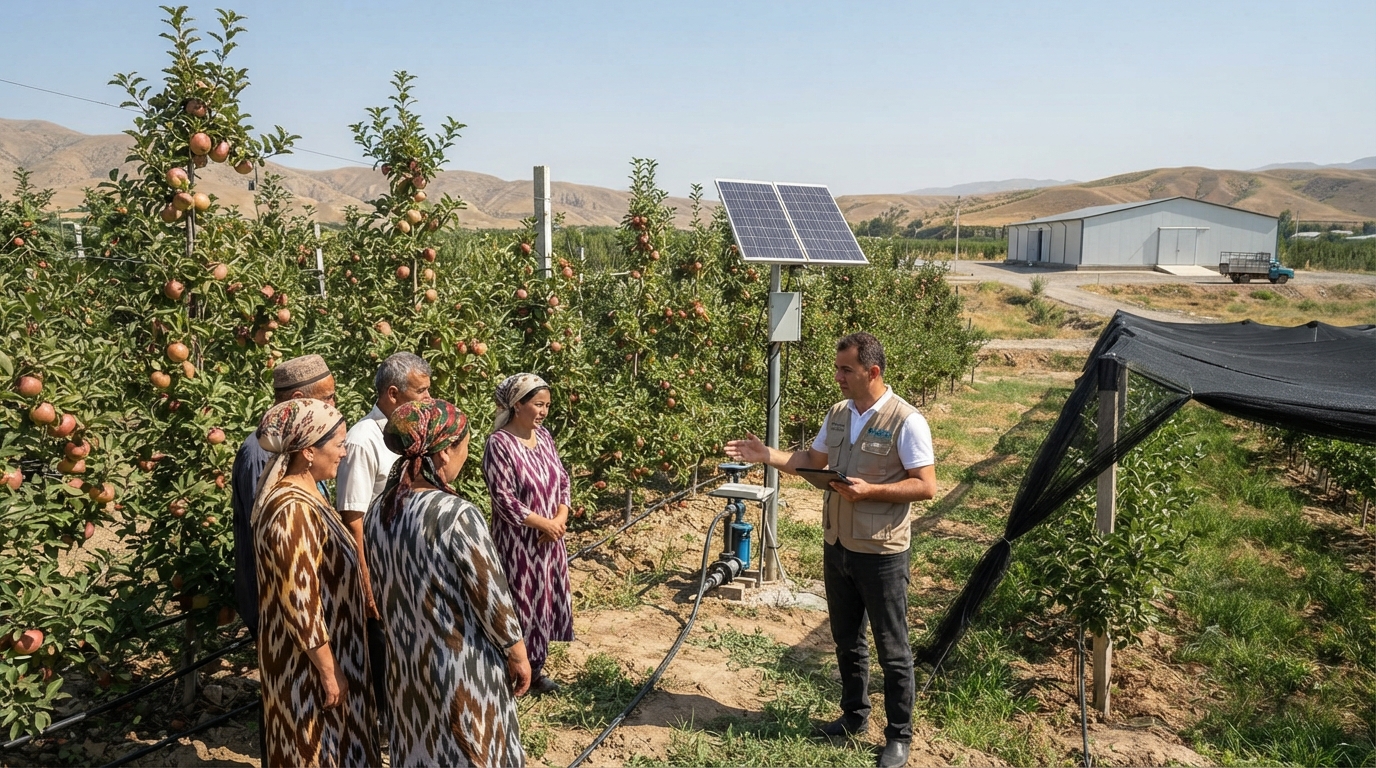
Climate-Smart Innovations Boost Uzbekistan's Horticulture Sector
Tashkent, Uzbekistan (UzDaily.uz) —
The Food and Agriculture Organization of the United Nations (FAO), in collaboration with the International Center for Strategic Development and Research in Food and Agriculture (ISCAD), operating under Uzbekistan's Ministry of Agriculture, is executing the Precision Agriculture for Resilient Commercial Horticulture (PARCH) project. This initiative aims to integrate advanced technologies and bolster the horticulture sector's ability to withstand climate challenges.
The Asian Development Bank (ADB), through the Japan Fund for Prosperous and Resilient Asia and the Pacific (JFPR), is funding this project, which is scheduled to run from 2025 to 2028. The PARCH project is designed to elevate commercial horticulture productivity by employing precision agriculture techniques, optimizing natural resource utilization, and implementing climate-smart agricultural practices.
The project engages 15 farmer groups, comprising 35 orchard owners, 82 representatives from dehkan farms, and seven farmers operating under contract with an agricultural limited liability company. Through an open selection process that evaluated business proposals and farm requirements, 124 beneficiaries were chosen, consisting of 75 women and 49 men.
To support these participants, a comprehensive package of modern equipment has been assembled. This includes solar power systems, drip and smart irrigation systems, agricultural sprayers, shade nets, water pumps, and cold storage facilities.
The deployment of these solutions is anticipated to significantly enhance water use efficiency, decrease production expenses, increase crop yields, and strengthen farms' resilience against the impacts of climate change.
Project specialists also conducted a technical assessment of 15 orchards and 20 dehkan farms located in the Bakhmal district.
The findings indicated that water scarcity remains the primary constraint hindering horticulture development. Solar-powered irrigation systems were identified as one of the most effective remedies, facilitating judicious water resource management while lessening farmers' reliance on conventional energy sources.
The project also highlights the potential of contemporary intensive horticulture technologies. While traditional apple orchards typically yield 8–12 tonnes per hectare, intensive orchards can achieve 25–40 tonnes. A growing number of farmers are adopting High-Density Planting (HDP) systems, which can boost yields by four to five times compared to traditional methods.
"Establishing a sustainable horticulture sector necessitates not only the adoption of modern technologies but also the enhancement of farmers' knowledge and skills, alongside providing practical solutions tailored to local needs. Within the project's scope, we assist agricultural producers in mastering precision farming technologies, utilizing natural resources more efficiently, and strengthening the long-term sustainability and competitiveness of horticulture production," stated Khayrulla Esonov, the project's technical specialist.
In the subsequent phase of the project, farmers will receive training in Integrated Pest Management (IPM), precision agriculture technologies, and climate-smart agriculture. The procurement procedures have already been finalized, which will enable the provision of necessary equipment to participants in the near future.
Beyond supplying technical equipment to farms, the project also encompasses advisory support for farmers, infrastructure development, the introduction of modern agrotechnologies, the improvement of entrepreneurial skills, and the expansion of producers' access to sales markets.
The implementation of the PARCH project contributes to the development of a competitive, highly productive, and climate-resilient horticulture sector in Uzbekistan.