

Central Asia, Azerbaijan Build Unified Transport Area
Central Asia and Azerbaijan are expanding transport cooperation through the Trans-Caspian corridor, multimodal routes, and digital solutions.
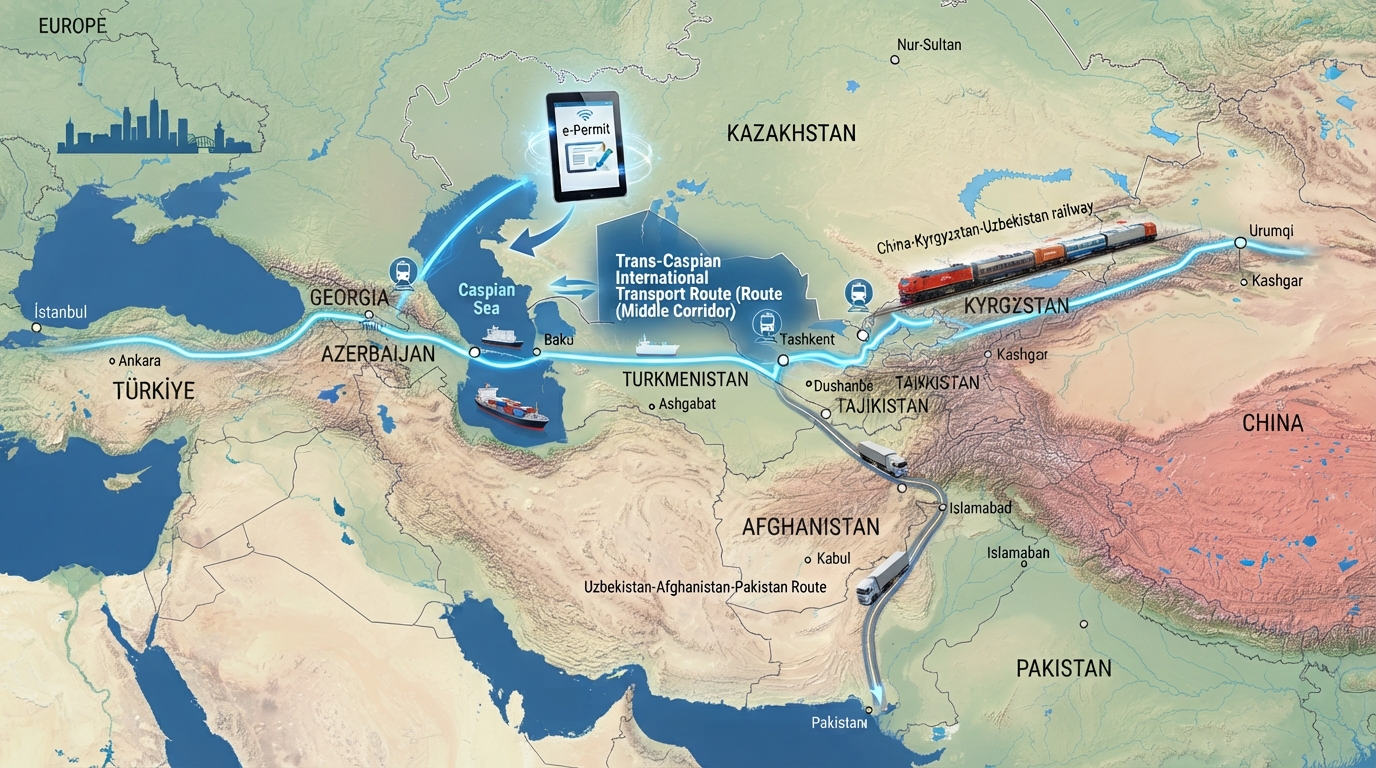
Tashkent, Uzbekistan (UzDaily.uz) – Central Asia and Azerbaijan are forging a unified transport area through enhanced cooperation in transport and logistics, focusing on the Trans-Caspian International Transport Route, new multimodal corridors, and digital solutions. This information comes from an article by Sh. Akhmedov, a leading specialist at the Center for Research on Transport and Logistics Development Problems under Uzbekistan’s Ministry of Transport.
A new framework for regional collaboration emerged after the seventh Consultative Meeting of the Heads of State of Central Asia, held in Tashkent on November 15–16, 2025. Following this summit, Azerbaijan was granted full participant status in this cooperative format.
The Trans-Caspian International Transport Route, also known as the Middle Corridor, has become a central pillar of this collaboration. In 2025, cargo traffic along this route surpassed 4.7 million tonnes.
The Middle Corridor's significance is also growing for Uzbekistan. Over a five-year period, the volume of Uzbek cargo transported via this route doubled, reaching 1.3 million tonnes by the close of 2025. The proportion of cargo moved along this route to and from EU nations increased from 12% in 2021 to 28% in 2025.
A joint Working Group is actively engaged in efforts to further boost cargo traffic along the Trans-Caspian corridor to 1.5 million tonnes. This group is exploring options to expand the route's capacity, increase transit volumes across the Caspian Sea, and acquire additional vessels.
Concurrently, Uzbekistan is pursuing the development of alternative routes. The China-Kyrgyzstan-Uzbekistan railway remains a pivotal project.
According to expert projections, once completed, this railway will shorten the distance between China and countries in Europe and the Middle East by 900 kilometers and reduce delivery times by seven to eight days. Until the rail line becomes operational, transport along this corridor is being conducted using the existing network of international highways.
Another mechanism for fostering regional connectivity is the CASCA+ multimodal route, which connects Asia-Pacific countries with China, Kyrgyzstan, Uzbekistan, Turkmenistan, Azerbaijan, Georgia, Türkiye, and Europe. In 2025, container cargo traffic on this route reached 6,722 TEUs, marking a 47% increase from 2024.
Tariff preferences, granted annually by the railway administrations of participating countries, serve as an additional support tool for cargo transport, with discounts potentially reaching up to 70%.
The institutional framework for cooperation is also expanding. In 2024, railway authorities from Uzbekistan, Kyrgyzstan, Turkmenistan, Azerbaijan, Georgia, Türkiye, and Tajikistan established the Eurasian Transport Route association. Its primary goal is the swift removal of logistical barriers along the route.
A distinct area of focus is the development of the Uzbekistan-Afghanistan-Pakistan route. Calculations cited in the article suggest that this route could reduce the distance from European and CIS countries to Indian Ocean ports by up to 1,000 kilometers compared to existing corridors.
In the future, this route could be integrated with pathways through Kazakhstan, Azerbaijan, and Georgia, forming a single multimodal chain linking South Asia with European markets.
Simultaneously, the involved countries are advancing the digitalization of transport processes. Notably, Uzbekistan is implementing the e-Permit system, which facilitates the electronic exchange of international road haulage permits.
According to the article, the electronic permit exchange between Uzbekistan and Azerbaijan is designed to streamline administrative procedures, accelerate customs clearance, and minimize human error. The text indicates that the system between these two countries was launched in 2025.
Türkiye is highlighted in the article as the first international destination where Uzbekistan implemented the electronic permit exchange system, in 2021. The system was introduced with Kazakhstan in 2024, and with Azerbaijan and Kyrgyzstan in 2025. Its rollout with Tajikistan, Turkmenistan, and China is slated for 2026.
The article concludes that the ongoing development of transport infrastructure, multimodal routes, and digital tools is laying the groundwork for closer integration of Central Asia and Azerbaijan into Eurasian supply chains.