

Big Macs v Supermac's: Irish burger chain loses trademark appeal against McDonald's
The European Union Intellectual Property Office rules Supermac's logo and signs could be confused with the Big mac trademark.
**Irish Burger Chain Supermac's Loses EU Trademark Appeal Against McDonald's' Big Mac**
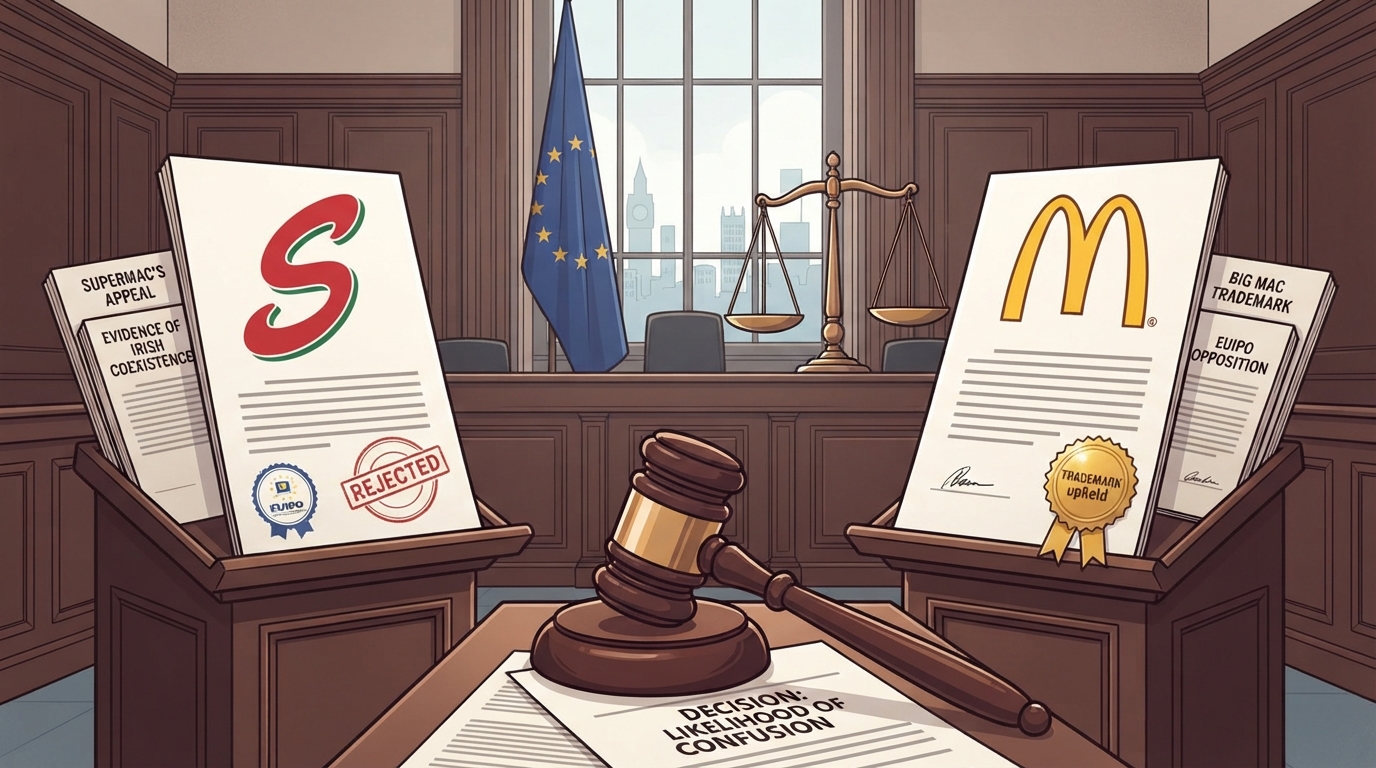
An ongoing trademark dispute between Irish fast-food chain Supermac's and global giant McDonald's has seen Supermac's denied the right to register its name as a trademark within the European Union. The European Union Intellectual Property Office's (EUIPO) board of appeal ruled that Supermac's logo and signage bore too close a resemblance to McDonald's' Big Mac trademark, which has been registered in the EU for meat sandwiches since December 1998.
The EUIPO's decision, issued in June, cited a "likelihood of confusion" among English and German-speaking consumers between Supermac's and the Big Mac trademark. This ruling upholds a previous decision from last year that similarly found registering Supermac's name as an EU trademark would likely cause confusion. The decision, however, does not affect Supermac's operations within Ireland.
Supermac's, established in Galway in 1978 by Pat McDonagh, first sought an EU trademark in May 2016. McDonald's promptly opposed this, highlighting the Big Mac's long-standing trademark status.
In its most recent appeal in June, Supermac's argued that the two chains had coexisted in Ireland for approximately 40 years without any evidence of consumer confusion. Its legal team contended there was "no reasonable likelihood that the relevant public would mistake a Supermac's restaurant for a Big Mac burger." They further asserted that an adverse finding would imply a consumer might enter a Supermac's expecting to buy a Big Mac, a notion they deemed "fundamentally inconsistent" with McDonald's' own evidence that the Big Mac is almost universally recognized as a McDonald's product.
McDonald's countered that the issue of coexistence was irrelevant, emphasizing that the core question was whether a conflict existed across the European Union. The fast-food giant also argued that consumers might not "inevitably be able to easily recognise that Big Mac designated a food product" while Supermac's "designated a restaurant chain," suggesting that "the boundaries between food products… and… a restaurant name, are blurred in the perception of the relevant public."
The EUIPO concluded that the Big Mac trademark enjoys "very high awareness" and an "enhanced degree of distinctiveness for meat sandwiches… by virtue of intensive use and recognition in the EU market." It stated that a more distinctive trademark carries a greater risk of confusion, and therefore, the enhanced distinctiveness of the Big Mac meant the likelihood of confusion could not be dismissed.
The ruling suggested that "it cannot be excluded that the contested sign may be perceived by the relevant public as a sub-brand or a variant of the earlier mark for another (new/enhanced) line of meat sandwiches." It also noted that the signs shared a common semantic reference, potentially suggesting a link in consumers' minds, and that proof of coexistence in a single state was "inadequate" given the Big Mac's EU-wide trademark protection.
This legal battle is part of a broader, long-running dispute between the two chains over the use of brand terms, including "Mac." In a separate development in 2024, following a legal challenge from Supermac's, the European Court of Justice ruled that McDonald's no longer holds the exclusive right to use the "Big Mac" label for chicken burgers sold in the EU.