

Banned from football at home, Afghan women's team reunite 8,000 miles away
Women in the team, which is recognised by Fifa, say football has given them freedom and independence.
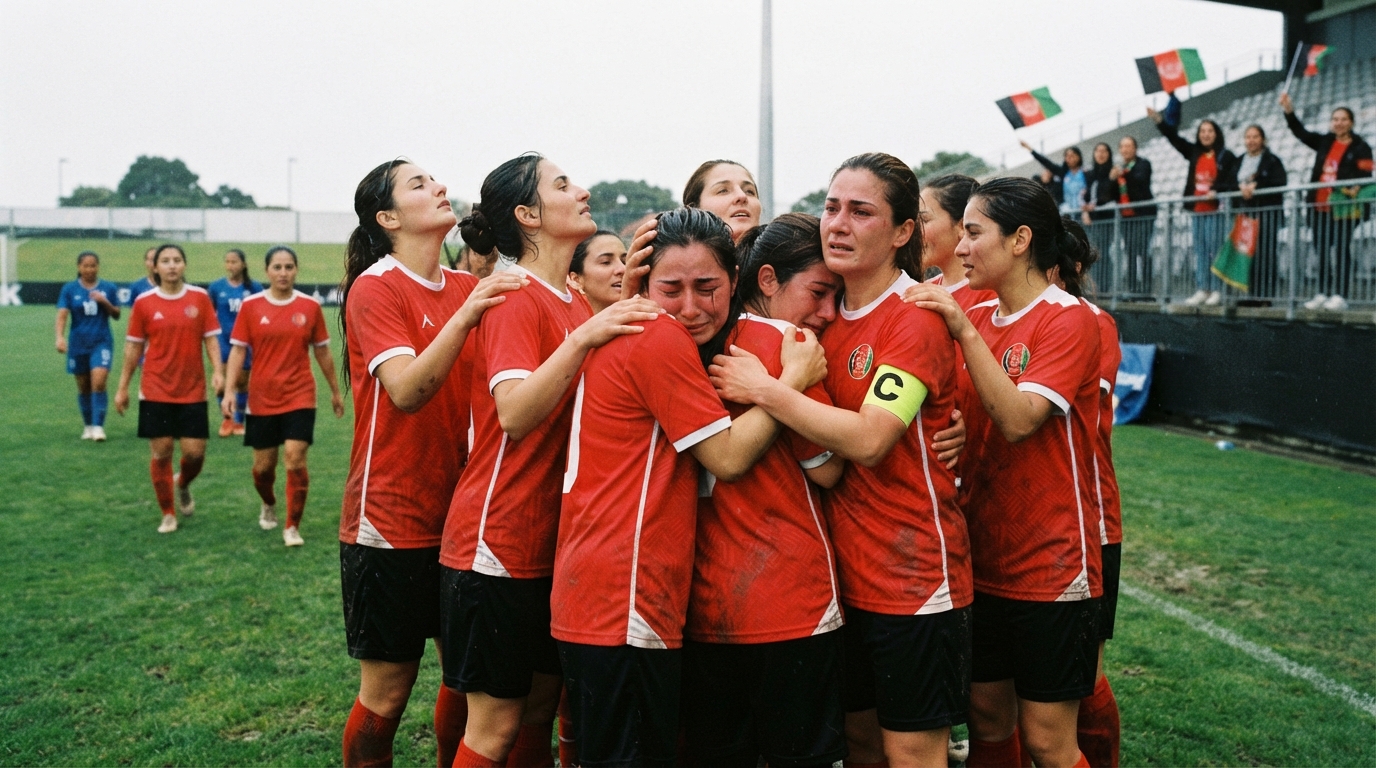
**Afghan Women's Football Team Reunites 8,000 Miles From Home After Domestic Ban**
For the first time since FIFA's ruling in April that granted them permission to represent their nation in official matches, the Afghan women's football team has reconvened.
The atmosphere in the changing room is electric as players engage in their pre-match rituals. Some stretch and adjust their boots, while others share embraces. Midfielder Fatima Haidari addresses her teammates in Afghan Women United, urging them to "Be strong as always because we are representing Afghan women."
Applause fills the room, adorned with an Afghan flag, as a patriotic song plays. Tears well up in the eyes of some players as they sing along. A final team huddle, with words of encouragement from their coach, precedes their entrance onto the pitch—a space they were long told was not for them.
This 23-player squad, comprised of Afghan athletes now residing abroad, has traveled to New Zealand for a training camp and two unofficial friendly matches against the Cook Islands. The team harbors aspirations of qualifying for international competitions like the World Cup and the Olympics in the future.
Previously, such participation would have required the approval of the Afghanistan Football Federation, an impossibility under the Taliban's rule. Since their return to power in August 2021, the Taliban have imposed extensive restrictions on women and girls, including prohibitions on secondary and university education, most professions, and organized sports.
The national women's team, established in 2007, was consequently disbanded, and its members were among those evacuated and resettled in countries such as Australia, the UK, and Portugal. Years of advocacy led to the formation of a refugee team, which evolved into Afghan Women United. Thanks to FIFA's recent decision, this team can now pursue qualification for international tournaments.
Gathered in New Zealand, the squad is thrilled to be playing together. As asylum seekers living in various nations, securing the necessary travel documents for team training has been a significant challenge over the past five years.
In a hotel in Auckland the day before the match, Manozh Noori, 23, with short hair, a T-shirt, and knee-length shorts, reflects on how her appearance has often drawn criticism from relatives for being too masculine. As she discusses her family with BBC Global Women, her voice wavers. She pauses, takes a deep breath, and looks away before continuing, her emotions palpable despite the absence of tears.
Noori, now living in Australia, grew up playing football with boys on the streets of Kabul. After discovering women's football on television, she secretly joined local clubs and steadily advanced through the ranks in Afghanistan. Aware of her older brother's disapproval, she wore a face covering to minimize the risk of recognition. Over six years, she accumulated league titles, national championships, and individual accolades.
Her success eventually became undeniable. Around 2018, her teammates convinced her to remove her face covering for a TV interview, which aired on the news alongside match highlights. The realization that her brother might see it filled her with dread. "I was so scared," she recounts. "I kept thinking, 'He's going to see me. He's going to know.'" In a desperate attempt to prevent her family from watching the news, she turned off the electricity, but her brother soon learned of it and was furious, she says.
"He was screaming," Noori recalls. "'You told us you were studying. You said you wanted to become a teacher or a doctor. What is this?'" He threatened to sever ties with the family if she didn't stop playing. "My mother was crying. She told me, 'He's the person who supports us financially. How are we going to survive?'"
Noori temporarily ceased playing but eventually resumed. She credits her other brother, who resides in Germany, with providing financial support for her dream. When the Taliban seized power in 2021, Noori decided to flee, but not before burying her football medals and trophies in her family home's garden. More than four years later, they remain there. "One day I will go back and dig them out," she says, a brief smile gracing her face.
"Football helped me get my mum and sister out of Afghanistan," she states. Two years after establishing herself as a football player in Australia, she was able to bring them over. This enabled her sister to resume her studies, as her brother, despite his disapproval of their sports involvement, always supported their education. "I hope my brother now realises I am not a bad person," Noori adds.
**Afghan Reunited: The Fight for Football**
As Noori and her team prepare for the matches in Auckland, many describe football as their lifeline during one of the most tumultuous periods in their country's recent history. "If I wasn't a footballer, I would still be in Afghanistan, one of millions of girls who are not allowed to study, speak up or choose their own future," says Mursal Sadat, who also lives in Australia.
Now 24, Sadat works as a football coach, youth facilitator, and advocate for refugees, women's rights, and human rights. At 19, when the Taliban returned to power, she was among those evacuated from Kabul in August 2021. In Afghanistan, she says she was often judged, harassed, and told that no one would want to marry a woman who played sport. Today, she is engaged to a man still in Afghanistan, and both he and his family are supportive of her work and her place on the national team. "They tell me, 'You are the pride of our family. We are so lucky to have you.'"
As the players step onto the pitch in the driving Auckland rain to face the Cook Islands, they exude energy and determination, unfazed by the weather. They have endured far harsher conditions back home. As a teenager, defender Najma Arefi trained in temperatures exceeding 45C (113F) because girls were often assigned the least desirable training slots. Yet, she persevered.
The 22-year-old's efforts ultimately contributed to a Herat-based team winning a national championship. This victory, she says, transformed attitudes towards women's sport in the city. "There were billboards of us across Herat," she recalls. "People were proud. More families started letting their daughters play football." She now resides in Doncaster, northern England, having arrived in the UK after the Taliban takeover.
Describing herself as an extrovert, Arefi says she now has opportunities she never imagined growing up in Afghanistan. She studies criminal justice at college, plays football, and makes independent decisions. "Having that freedom is incredible," she says.
However, she admits to often feeling guilty and profoundly saddened by the freedoms denied to women back home. "Millions of girls don't have the chance to study or follow their dreams. I feel I have to make the most of every opportunity. Sometimes I put too much pressure on myself," she says, tears streaming down her face.
She expresses gratitude to Khalida Popal, who founded the original Afghan women's team, for her efforts in pushing FIFA to recognize them in exile. "To receive Fifa's recognition without the approval of the Taliban" has made history, she says. This official status is "something I'll always be proud of," she adds.
When the BBC sought comment from the Taliban's director for sports, Ahmadullah Wasiq, regarding FIFA's backing of the women's team, he declined. However, he expressed a desire for FIFA to visit the country and resume its general support for football there, as the organization largely withdrew after the Taliban came to power. FIFA has previously stated that any resumption of support would be contingent on women being allowed to play.
The game in Auckland proves challenging. A single goal in the first match results in a 1-0 victory for the Cook Islands. Three days later, despite the Afghan team's best efforts, the Cook Islands win again, this time 3-0.
Yet, for the players, these matches signify something far more profound than two defeats. They represent a return to the pitch and irrefutable proof that despite exile, separation from their families, and years of uncertainty, Afghanistan's women footballers refused to disappear.
This report is part of the BBC World Service's Global Women series, which shares untold and important stories from around the globe.