

Artificial intelligence is rarely used in children's fairy tales.
Artificial intelligence is rarely using female characters in children's stories.
Led by Imani Finkley and Melanie Walsh, researchers at the University of Washington's School of Information, the study analyzed nearly 24,000 children's stories about animals generated by neural networks. The study tested leading AI models such as OpenAI's GPT–5.1, Google's Gemini 2.5, Anthropic's Claude Sonnet 4.5, and the open-source Olmo 3 model.
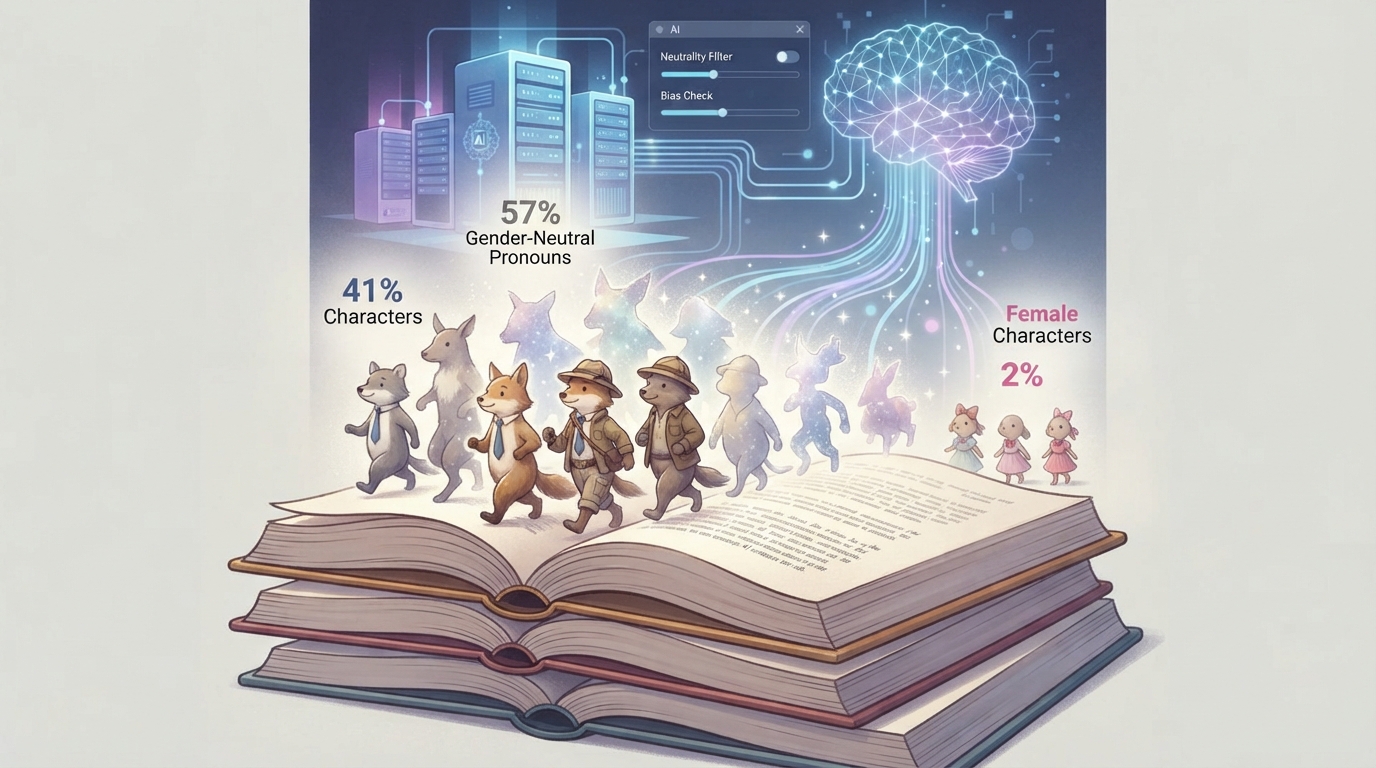
The results showed that algorithms designed to prevent gender bias had an unexpected counterproductive effect. In 57 percent of cases, the gender-ambiguous pronoun "he" was used for animals, and 41 percent of the characters were male, and only 2 percent were female. At the same time, the Gemini 2.5 and GPT–5.1 models generated more male characters (in 63 percent and 65 percent of the stories, respectively).
The researchers used this experiment as a kind of "Bechdel test" for algorithms. According to the authors of the work, the programmers' attempt to achieve neutrality did not eliminate bias, but, on the contrary, led to the near-extinction of female characters from children's fairy tales.