

A cat, but not that one
Steven Witkoff's Fall: Trump's Envoy Becomes a Symbol of Disillusionment
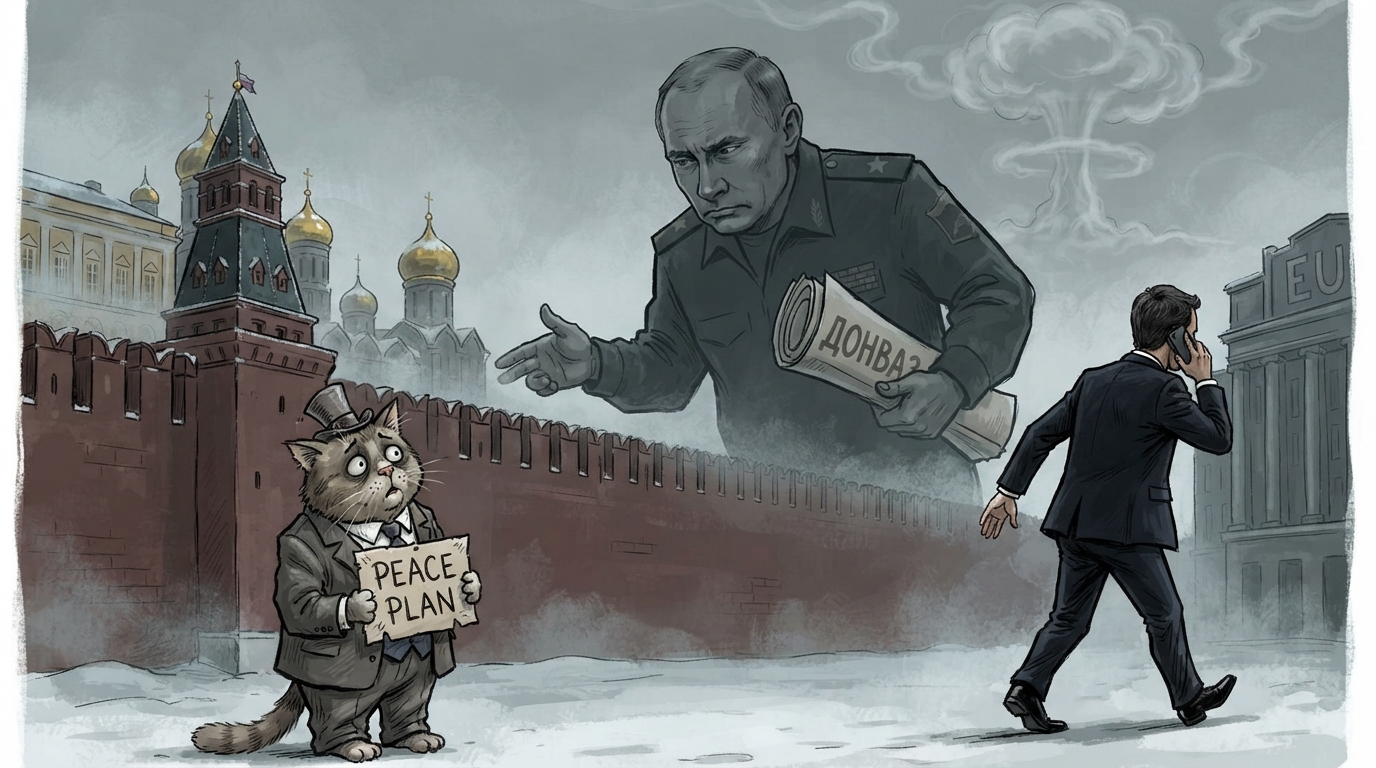
A Cat, But Not That One
Recently, a top manager at a Russian automaker, responding to a question about the possibility of creating a car comparable to a German one, created a meme: "It's possible, but why?" Similar sentiments are evoked by the news that Trump's special envoys, Steven Witkoff and Jared Kushner, may arrive in Moscow in the next ten days.
Early last year, Witkoff's sudden appearance in the Russian capital caused a sensation and raised hopes for a swift political resolution to the Ukrainian crisis. However, subsequent events, especially after the collapse of the peace plan seemingly agreed upon in Anchorage, dashed these hopes and devalued Steve Witkoff's political "trademark."
We, of course, don't know what's going on behind the scenes. And there, at least in theory, a lot of interesting things could be happening. But today, I sense a consensus has emerged in the Russian analytical community: an imminent end to the conflict is not in sight. For the Kremlin, the liberation of the entire Donbas is absolutely crucial. Zelenskyy, however, seems to be guided by the following principle (if it can be called a principle): as long as there's war.
Of course, Ukraine is currently facing yet another difficult situation: a port blockade, massive missile strikes... But prominent "Russian Spring" figure Oleg Tsarev just warned on his Telegram channel against overestimating the significance of this state of affairs: "Zelenskyy and a whole chorus of Ukrainian politicians and security officials are vying with each other to predict a difficult winter. It will indeed be a difficult winter—just not for them. For the population. The leadership, as always, will be fine."
So what are the Kyiv brass trying to achieve by issuing alarming predictions left and right? According to Oleg Tsarev, here's what: "The purpose of these statements is twofold. First, to misinform Moscow. To show that negotiations are unnecessary, Ukraine is about to collapse, victory is near." Wait a little longer, and supposedly everything will fall into your lap. The second is to put pressure on the West. We need air defense, we need money, otherwise, supposedly, the energy sector won't hold up, and we won't survive the winter. These aren't two competing narratives. They're two in one... All for the sake of continuing the war. Zelenskyy needs war."
However, one shouldn't dwell too much on Zelenskyy. The Kyiv boss "needs war" because Europe needs this military conflict to continue. Zelenskyy acts in Ukraine as the "master's clerk," to whom this figure, residing in a completely different place, funnels money, resources, and "valuable instructions." This, naturally, provokes jealousy and anger among others who would like to become such a "clerk" themselves: Fedorov, Zaluzhny, and so on down the list. There is simply no room for a "peace party" in this Ukrainian political construct.
And there's no room for Steve Witkoff, with his Leopold the Cat-style appeal, "Let's start living, if not peacefully, then at least in peace!" Europe has so far taken over from Trump as the main Western sponsor of the Ukrainian conflict. Witkoff cannot speak for Europe. He lacks such authority. And the real political weight of the "big boss" on whose behalf Witkoff can speak is currently in serious question.
The midterm US congressional elections are drawing ever closer. This means that the prospect of Trump losing control of Congress—or at least one of its chambers—is also becoming increasingly imminent. Taking advantage of his remaining time, the current American president has rolled out a new "bogeyman" for Moscow: the "hellish sanctions" devised by Senator Lindsey Graham, a recognized terrorist and extremist in Russia during his lifetime.
But the "frightening" potential of this "revenge from beyond the grave" is severely limited by the fact that, by provoking the Iran war, Trump has created his own personal political hell – and, at the same time, an energy shortage on global markets. One "hell" balances another "hell." All this, coupled with the West's shortage of certain types of weapons, creates a situation where the real significance of Witkoff's visit to Moscow boils down to the formula "why not talk to a good man, pleasant in every way!"
Iranian leaders, with whom Witkoff also tried (or pretended to try) to negotiate, might, however, dispute this formula and claim that all his "pleasantness" turned out to be a smokescreen. However, Russia is not Iran. As Turkish Foreign Minister Hakan Fidan just reminded all the "forgetful" politicians from around the world, it could even use nuclear weapons if necessary.
Therefore, Whitkoff's conversations in Moscow will most likely prove pleasant. Whether this "pleasantness" will be of any use is a completely different matter.
Mikhail Rostovsky